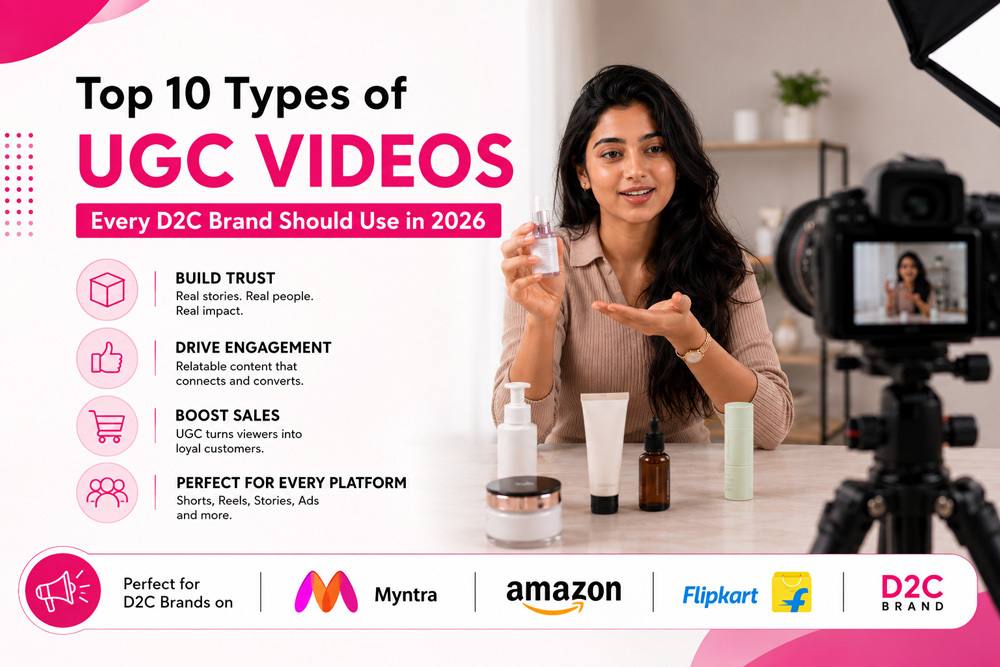
Top 10 Types of UGC Videos Every D2C Brand Should Use in 2026
From unboxing reels that flood Instagram feeds to GRWM clips winning Myntra carts — the ten UGC video formats that are quietly powering India’s fastest-growing D2C brands this year.
By Prince
17 May 2026
10–12 min read
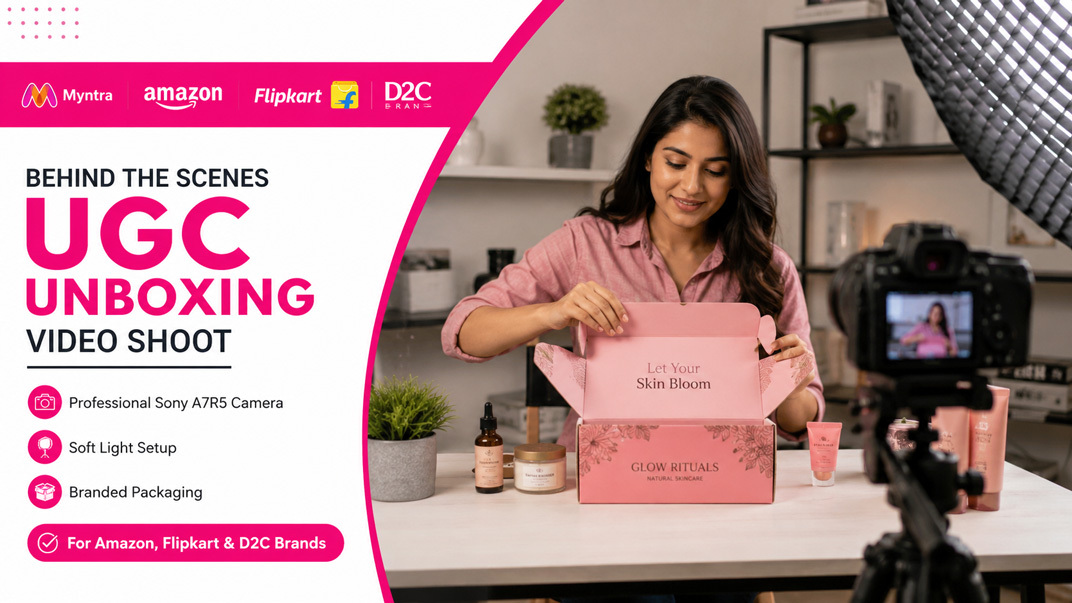
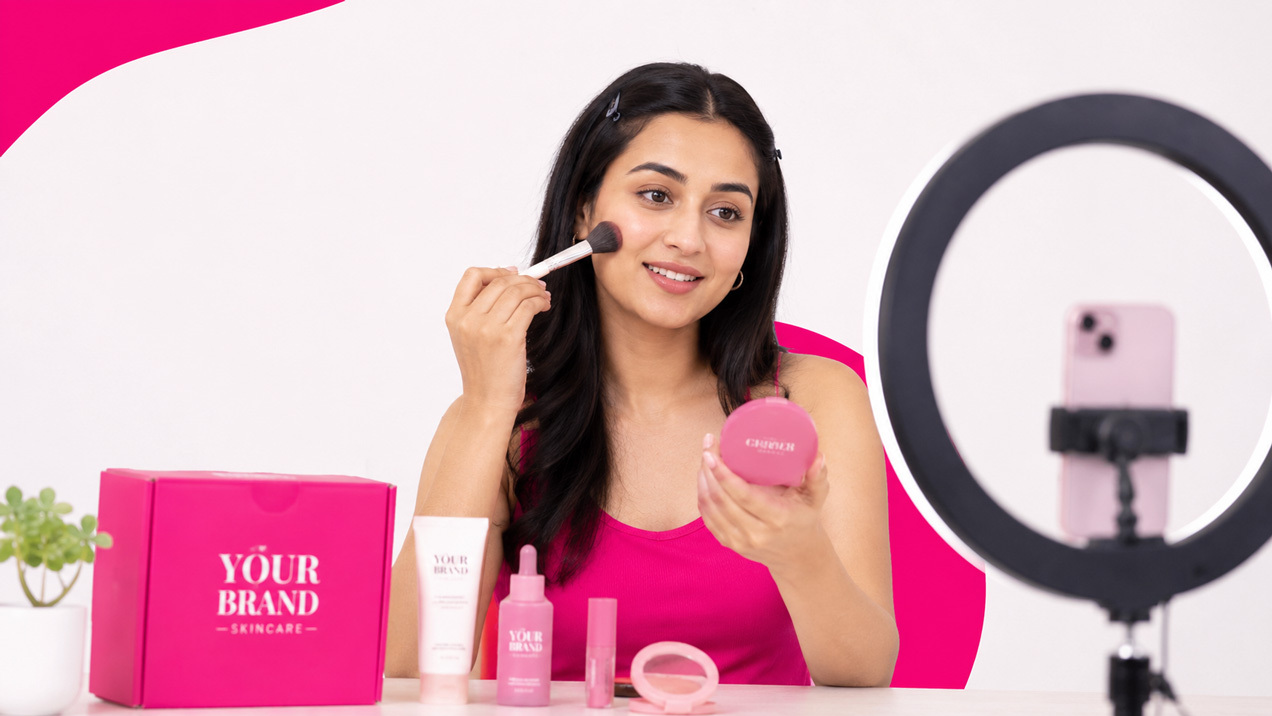
A Ckstudio creator capturing native-style UGC for a D2C beauty brand — shot in our Delhi studio.
If you run a D2C brand in 2026 and your ad creative still looks like a glossy commercial from 2019, you’re already losing. Buyers scroll past polished brand films in under two seconds — but they stop, watch, and buy when a real person opens a box, applies a serum, or shows the inside of a packaging insert. That single shift in viewer behaviour is why UGC video has become the highest-ROI content format for direct-to-consumer brands across India.
This guide breaks down the ten UGC video formats that consistently outperform traditional brand content on Instagram, Meta Ads, Amazon Posts, Flipkart Video, Myntra Studio, and Meesho. Each format includes when to use it, who it works best for, ideal length, and the production playbook the Ckstudio video team uses for clients shooting 8 to 15 UGC videos a month.
By the end, you’ll know exactly which three formats to start with this quarter — and which ones to skip until your brand is ready.
Key Takeaways
UGC videos consistently drive 2x to 4x higher engagement than polished brand films on Instagram Reels and Meta Ads in 2026.
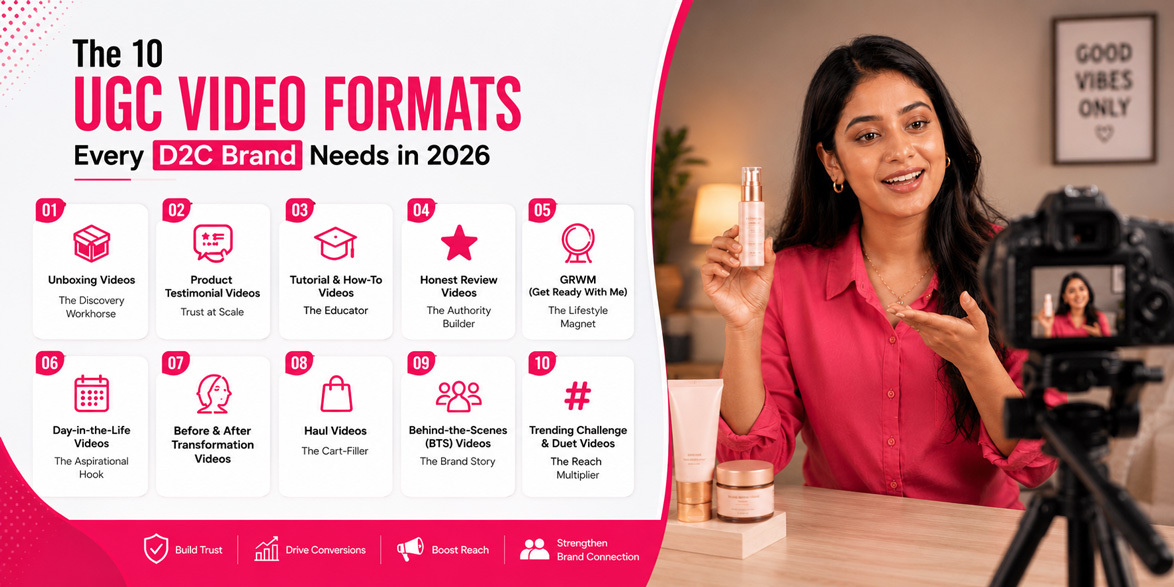
The ten core UGC formats are: Unboxing, Testimonial, Tutorial, Honest Review, GRWM, Day-in-Life, Before & After, Haul, Behind-the-Scenes, and Trending Challenge.
Each product category has a “primary” UGC format — beauty and apparel win with GRWM and tutorials; gadgets and home goods win with unboxing and demos.
A single studio day at Ckstudio can produce 8 to 12 UGC videos across multiple formats — cutting cost-per-video by up to 70% versus per-video freelance hiring.
AI-generated avatar videos hurt conversion rates and risk ad-policy violations on Meta and Amazon — real human-shot UGC remains essential for hero assets.
Understanding UGC: What It Really Means in 2026
UGC, short for User-Generated Content, originally meant videos and photos created by genuine customers and shared organically. In 2026, the definition has expanded. Today, UGC also covers studio-shot creator content — videos designed to look like a real customer made them on their phone, even if they were filmed in a professional studio with proper lighting and direction, the kind of setup our UGC video production studio in Delhi uses every day.
Both forms work because the format triggers what marketers call the peer-trust reflex: viewers process creator-style content as a recommendation from a friend rather than an advertisement from a brand. Meta’s own creative benchmark studies confirm this — UGC-style ads typically deliver lower CPMs, higher click-through rates, and better post-click conversion than studio-glossy creative.
For Indian D2C brands and marketplace sellers creating UGC videos for Amazon, Flipkart and Meesho as well as their own Shopify stores, UGC has become non-negotiable. The brands winning right now are running UGC across paid acquisition, organic social, marketplace listings, and even WhatsApp catalogue carousels.
Real UGC vs AI-Generated Videos — Why Authentic Wins
A growing temptation in 2026 is to replace human creators with AI avatar tools that promise to “make UGC at scale.” On paper, it sounds efficient. In practice, it backfires for three reasons: viewers detect the artificiality within seconds, platform algorithms downrank synthetic content, and ad policies on Meta and Amazon increasingly flag undisclosed AI faces.
Real UGC ✓
Genuine micro-expressions build trust
Natural voice cadence and pauses
Real hand interactions with the product
Passes Meta & Amazon authenticity checks
Higher add-to-cart and ROAS on paid campaigns
Reusable across reels, ads, listings, WhatsApp
AI Video ✗
Uncanny eyes and lip-sync mismatch
Robotic voice rhythms reduce watch-time
Cannot physically demonstrate product feel
Risks ad disapprovals and policy flags
Lower CTR — viewers scroll past in under 2 seconds
Cannot be used in testimonial schema or claims
The smart approach is to use real UGC for every hero asset — testimonials, GRWM, unboxing, demos — and to let AI assist only with editing, captioning, b-roll, or repurposing into vertical cuts. This is exactly the workflow Ckstudio runs for D2C clients: human-shot UGC + AI-assisted post-production for speed.
Need UGC Videos That Actually Convert?
Ckstudio shoots 8 to 12 UGC videos in a single studio day — across unboxing, GRWM, tutorial & testimonial formats. Real creators, studio lighting, brand-ready edits.
The 10 UGC Video Formats Every D2C Brand Needs in 2026
Below is the playbook the Ckstudio team uses to plan UGC content for D2C clients across beauty, apparel, gadgets, FMCG, and home categories. Each format includes its strategic role, ideal length, primary platform fit, and the production tip that moves the needle.
01
Unboxing Videos — The Discovery Workhorse
Unboxing is still the highest-converting UGC format in 2026, especially for newly launched D2C SKUs. The format works because it satisfies three psychological hooks at once: anticipation (what’s inside), tactility (how it feels), and social proof (someone else already bought it). Beauty, gadgets, jewellery, and gifting brands see particularly strong returns.
A high-performing unboxing video on Amazon’s video carousel or a Flipkart product video slot can lift add-to-cart by 25 to 40 percent within the first month — provided the packaging tells a story and the creator’s reaction reads as genuinely surprised, not scripted.
Length 30–60 secBest for New launches, gifting, beautyPlatform Amazon, Flipkart, Reels
Pro Tip: Shoot the unboxing twice — once vertically for Reels and Shorts, once horizontally for Amazon listings — using the same creator, same angle, same wardrobe in a single sitting. This is the standard Ckstudio bundle approach that saves studios hours of re-setup.
02
Product Testimonial Videos — Trust at Scale
Testimonial UGC is the format that converts warm traffic into buyers. Where unboxing creates discovery, testimonials close the deal. The most effective testimonials are 20 to 45 seconds long, feature a specific result (not vague praise), and include a credible micro-detail like the duration of use, the price point, or a “before” frustration.
For D2C brands selling skincare, supplements, kitchenware, or any considered-purchase category, a rotating bank of 6 to 10 testimonial videos can be the single highest-ROI creative investment of the quarter. Ckstudio recommends shooting testimonials with 3 to 4 different creators per quarter to keep the ad rotation fresh.
Length 20–45 secBest for Skincare, supplements, considered-purchasePlatform Meta Ads, Amazon, landing pages
Pro Tip: Start the testimonial with the customer’s specific problem before introducing the product — viewers stay 2x longer when the hook resonates with their own frustration.
03
Tutorial & How-To Videos — The Educator
Tutorials answer the question every consideration-stage buyer is silently asking: how do I actually use this? They reduce return rates, build perceived value, and make complex products feel simple. For beauty, fashion styling, fitness gear, kitchen appliances, and skincare, tutorials are often the highest organic-search-friendly UGC format because they double as YouTube and Google search content.
A well-shot tutorial video earns its keep for 18 to 24 months because the content stays evergreen. The Ckstudio team often shoots tutorials with multiple cut-points so the same footage can be edited into a 60-second YouTube version, a 30-second Reel, and a 15-second story.
Pro Tip: Tutorials work best when the creator makes one visible mistake and then “fixes” it — this small imperfection signals authenticity and increases watch-completion by 30 to 40 percent.
04
Honest Review Videos — The Authority Builder
Honest review videos differ from testimonials in one important way: they include at least one mild critique. A reviewer might say “I wish the packaging was slightly smaller” or “the scent took 2 days to grow on me.” These small imperfections are the secret weapon — viewers immediately trust the review because it doesn’t read as a paid endorsement.
For mature D2C brands selling on Myntra, Ajio, or their own DTC store, hosting a content shelf of honest review videos can lift conversion by 12 to 18 percent. The format also feeds nicely into Amazon product detail pages as Q&A video answers.
Pro Tip: Brief the creator with the “yes, but…” framework — they say yes to the product overall but list one or two minor cons. This raises trust dramatically without hurting the brand.
05
GRWM (Get Ready With Me) — The Lifestyle Magnet
GRWM is the dominant UGC format on Instagram Reels and TikTok-style short video — and in 2026, it’s been adopted enthusiastically by Indian beauty, fashion, jewellery, and athleisure brands. The format works because it embeds the product inside a narrative the viewer can relate to: “getting ready for a Sunday brunch,” “office day GRWM,” “Karwa Chauth special look.”
For apparel brands shooting through Ckstudio’s model photoshoot studio, GRWM can be filmed in tandem with regular lookbook shoots — meaning you walk away with stills and motion content from the same model day.
Length 45–75 secBest for Beauty, fashion, jewelleryPlatform Reels, Myntra, Ajio
Pro Tip: Anchor every GRWM to a specific occasion (“Friday date night,” “Diwali office party”). Generic GRWMs without an occasion underperform by roughly 35 percent in our internal client benchmarks.
06
Day-in-the-Life Videos — The Aspirational Hook
Day-in-the-life videos place your product inside a routine the viewer wishes was theirs — a morning run with the supplement, a coffee ritual with the brewing kit, a Sunday brunch with the new dress. The product appears for only 10 to 15 seconds of the total runtime, which is precisely why the format works: viewers don’t feel pitched to.
This is the format home, lifestyle, FMCG, and wellness brands win with most often. Ckstudio’s lifestyle production team typically blocks a half-day on location plus a half-day in our lifestyle photography studio to produce 3 to 4 day-in-life videos.
Pro Tip: Use a single creator across 4 to 6 day-in-life videos over a quarter — viewers begin to recognise them as a “brand face” and trust compounds.
07
Before & After Transformation Videos
Before-and-after is the format that performs the fastest on cold traffic. Within the first 3 seconds, viewers see a clear visual difference — and curiosity does the rest. Skincare, hair care, fitness, home cleaning, and even apparel “styling” brands benefit hugely. Compliance matters here: claims should be honest, time-bounded, and supported by visible context.
For Ckstudio clients, before-and-after videos are typically the second creative we ship after a baseline testimonial. The combination of those two formats alone can carry a Meta ad account for a full quarter.
Length 15–45 secBest for Skincare, hair, fitness, homePlatform Meta Ads, Reels, YouTube Shorts
Pro Tip: Show the “before” for at least 4 seconds before revealing the after — the longer the contrast, the higher the watch-completion.
08
Haul Videos — The Cart-Filler
Haul videos showcase multiple SKUs from your range in a single creator-led sitting. The format is particularly powerful during seasonal sales, festive collections, and category drops because it normalises buying 3 to 6 items at once. Apparel brands selling on Meesho, Ajio, and their own D2C site see haul videos lift average order value by 18 to 25 percent during sale periods.
The Ckstudio team typically shoots haul videos in the same session as the regular garment photoshoot — meaning the creator tries on each item once while we capture both the still frames and the haul video footage.
Length 60–120 secBest for Apparel, beauty, accessories, festive dropsPlatform Reels, YouTube, Myntra Studio
Pro Tip: Group 5 to 7 SKUs into a single haul rather than 10+ — viewers retain decisive interest only for the first 6 to 8 product appearances.
09
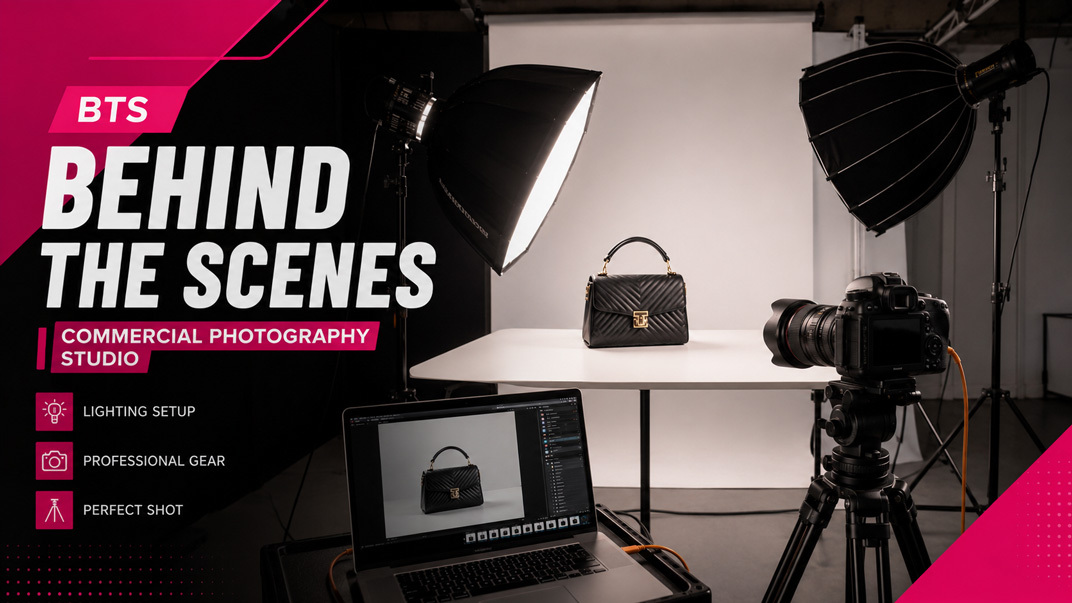
Behind-the-Scenes (BTS) Videos — The Brand Story
BTS UGC pulls back the curtain on how a product is made, packed, or sourced — and it’s the format that builds the strongest brand loyalty over time. Sustainable brands, artisan-led D2C labels, handicraft sellers, and food brands lean on BTS to differentiate from generic Amazon and Meesho listings.
BTS works because it answers a question the viewer never thought to ask but is delighted to learn: “wait, this is hand-stitched?” “the founder herself packs every order?” The Ckstudio team often shoots BTS as an add-on layer during regular commercial photography shoots.
Pro Tip: Feature an actual team member, not a paid creator. Authenticity in BTS lifts conversion meaningfully — the format loses its power the moment it feels staged.
10
Trending Challenge & Duet Videos — The Reach Multiplier
Trending challenge videos hijack an existing viral audio or format — and embed your product naturally into the punchline. In 2026, Indian D2C brands using trending Reels audios consistently see 4x to 8x higher organic reach versus original-audio reels. The catch: the trend cycle is short, often only 5 to 10 days, so brands need a rapid-response production capability.
This is the one format Ckstudio recommends D2C brands shoot in batch — capture 4 to 6 versatile clips during a single studio day, then have the editor adapt them to whichever trending audio is hot that week.
Length 7–20 secBest for Reach-stage organic growthPlatform Reels, YouTube Shorts
Pro Tip: Always have 3 to 4 “trend-ready” raw clips on hand — clips that can be cut to any audio. This means you can ship a trend video within hours, not days, of an audio going viral.
UGC Video Format Comparison — Which One to Pick
If you can only invest in three formats this quarter, this comparison table will help you choose based on your brand stage, product category, and primary platform — and if you’re an ecommerce seller planning UGC for marketplace listings, start with the formats marked for Amazon and Myntra.
Format
Best Stage
Top Platform
Expected ROAS Lift
Unboxing
Discovery
Amazon, Reels
25–40%
Testimonial
Conversion
Meta Ads, landing pages
30–50%
Tutorial
Consideration
YouTube, Amazon A+
15–30%
Honest Review
Trust-building
Myntra Studio, YouTube
12–18%
GRWM
Reach + Consider
Reels, Myntra
20–35%
Day-in-Life
Brand affinity
Organic feed
10–22%
Before & After
Cold traffic
Meta Ads
40–70%
Haul
AOV lift
Reels, Meesho
18–25% AOV
BTS
Brand loyalty
Reels, LinkedIn
Brand lift (not direct ROAS)
Trend Duet
Reach scaling
Reels, Shorts
4x–8x organic reach
Platform-Specific UGC Tips for 2026
Each marketplace and social platform rewards a slightly different UGC flavour. Here’s the quick playbook the Ckstudio team uses when shipping UGC for D2C clients across Indian platforms — including authoritative seller resources you should bookmark.
Amazon & Flipkart
Amazon Posts and product video carousels favour 30 to 60 second unboxing, demo, and tutorial formats. Brands should review Amazon’s official video specifications at Amazon Seller Central India before shipping the final cuts. Flipkart prefers 16:9 horizontal demos and you can find the latest creative guidelines at Flipkart Seller Hub.
Myntra & Ajio
Myntra Studio is the top destination for GRWM, haul, and styling videos for apparel and beauty D2C brands. Ajio rewards trend-led, fast-cut content that matches Gen-Z aesthetics. Ckstudio’s Myntra-ready video bundles are specifically designed around Myntra Studio’s vertical 9:16 spec.
Meesho & Instagram Reels
Meesho leans heavily on haul and “haul-style” review content because of its value-conscious audience. Instagram Reels remains the highest-leverage organic surface for trend-led duets, GRWM, and day-in-life content for all D2C brands.
Common UGC Mistakes to Avoid
Even brands with the right format mix often lose momentum because of avoidable production errors. Here are the six mistakes Ckstudio sees most frequently — and how to fix each one.
Over-scripted creators — When the creator sounds like they’re reading from a teleprompter, viewer trust collapses. Brief the creator with talking points, not lines.
Poor lighting on a “real-feel” set — UGC should look natural, not under-lit. A single softbox or ring light at 45 degrees solves 90% of the issue.
Loud branded music — Trending audio or natural ambient sound outperforms branded jingles by a wide margin in 2026.
Wrong aspect ratio — Shipping a 16:9 ad to a 9:16 Reels surface kills reach immediately. Always export multiple aspect ratios from the same source.
One creator across every format — Viewers get fatigued. Rotate 3 to 4 creators per quarter to keep ad creative fresh.
No clear call-to-action — UGC isn’t editorial. Every video should have a soft CTA in the final 3 seconds.
Tools & Equipment Ckstudio Uses for UGC Production
For brands curious about the production stack behind professional UGC, here’s the equipment the Ckstudio video team works with daily. None of this is strictly required for early-stage UGC, but understanding the kit helps when evaluating quotes from production partners.
Camera Body
Sony A7R V & Canon R10
Full-frame mirrorless setups for 4K UGC footage with shallow depth control.
Lens Kit
50mm, 35mm, 100mm Macro
35–50mm for creator-facing UGC, 100mm macro for product detail close-ups.
Lighting
4× Godox SK 400II + Elinchrom FRX 400
Strip softboxes for even creator lighting, octabox for beauty & fashion UGC.
Audio
Rode Wireless GO II
Lavalier-grade audio capture for testimonial & tutorial formats.
Stabilisation
DJI RS 4 Gimbal
For day-in-life & BTS handheld-feel footage with cinematic smoothness.
Editing
DaVinci Resolve & CapCut Pro
DaVinci for hero edits, CapCut for fast-turnaround trend-led cuts.
Implementation Checklist — Your UGC Roadmap for Q3 2026
Tick through the checklist below to align your team on a 90-day UGC production sprint.
Future of UGC — Trends to Watch Beyond 2026
The UGC playbook continues to evolve. Three shifts the Ckstudio team is preparing for over the next 12 to 18 months:
Interactive UGC — Reels with embedded shoppable hotspots are rolling out across Meta surfaces and Indian D2C brands will see direct cart links inside the video itself.
Long-form UGC podcasts — Founder-led 3 to 8 minute UGC podcasts are becoming the trust-building counterpart to short-form Reels for premium D2C categories.
AI-assisted editing, human-shot content — The winning formula will be real-creator footage with AI handling captioning, voiceover sync, b-roll suggestions, and aspect-ratio reframing. Pure synthetic UGC will continue to underperform.
Frequently Asked Questions
What is UGC and why is it important for D2C brands in 2026?
UGC (User-Generated Content) is video, photo, or written content created by real customers or paid creators that feels authentic rather than corporate. For D2C brands in 2026, UGC is critical because consumers trust peer-style content roughly 6x more than polished brand ads, and platforms like Instagram, Meta Ads, and Amazon Posts reward authentic creator-style videos with higher organic reach and lower ad CPCs.
Which UGC video format converts best for ecommerce?
Unboxing videos and honest review videos typically convert the highest for e-commerce, often driving 2x to 3x more add-to-cart actions than standard product videos. However, the best format depends on your product category — apparel and beauty perform well with GRWM and tutorials, while gadgets and home products benefit from unboxing and demos.
Can I use AI-generated videos instead of real UGC?
AI-generated videos can supplement your content but should not replace real UGC. Authentic human-shot UGC builds trust, passes platform authenticity checks, and triggers genuine emotional engagement. AI-generated faces and voices often feel uncanny, hurt conversion rates, and may violate Meta and Amazon ad authenticity policies. Ckstudio recommends real shoots for all hero UGC assets, with AI assisting only in post-production.
How much does professional UGC video production cost in India?
Professional UGC-style video production in India typically ranges from ₹3,000 to ₹10,000 per finished video depending on whether you need a creator, model, set, props, and editing. Studio-shot UGC bundles from Ckstudio start around ₹1,000 to ₹2,500 per video when booked in packages of 5 or more, which is far more cost-effective than per-video freelancer hiring. For exact pricing on your category, reach Prince directly on WhatsApp at +91-8700258773.
What length should UGC videos be for Amazon, Flipkart and Instagram?
For Amazon and Flipkart product listings, 30 to 60 seconds works best. For Instagram Reels and YouTube Shorts, 15 to 30 seconds delivers highest completion rates. For Meta and Google ads, 6, 15, and 30-second cuts of the same UGC video should be edited so you can A/B test placements without re-shooting.
Should D2C brands hire creators or shoot UGC in a studio?
A hybrid approach works best in 2026. Studio-shot UGC at facilities like Ckstudio gives you controlled quality, consistent lighting, and faster turnaround for evergreen formats like unboxing, demos, and tutorials. Hire real creators for testimonial, GRWM, and day-in-life formats where authenticity of voice matters most.
Conclusion — Your Next Move
The UGC playbook is no longer optional for D2C brands in 2026. The ten formats outlined above — unboxing, testimonial, tutorial, honest review, GRWM, day-in-life, before-and-after, haul, BTS, and trending challenge — together cover every stage of the buyer journey across every major Indian platform.
The brands winning right now aren’t producing all ten formats simultaneously. They’re choosing three formats that match their product category, shipping them at scale through a professional UGC video production team in Delhi like Ckstudio, and iterating ruthlessly based on what the data says. Start there. Pick three. Ship in 30 days. Measure. Scale the winner.
If you’d like to map your product range to the right UGC formats and plan a single studio day that produces a quarter’s worth of content, the Ckstudio team is happy to walk you through a free 15-minute consult.
Ready to Shoot UGC That Actually Sells?
Prince and the Ckstudio team produce ready-to-ship UGC videos for D2C brands across Amazon, Flipkart, Myntra, Ajio, Meesho & Instagram. One studio day. Up to 12 videos. Native creator look. Brand-ready edits.