






If your D2C brand or e-commerce store is spending serious money on video content in 2026, you have already heard the debate. On one side, Studio-Backed UGC — professionally produced, scripted, lit, and edited inside a controlled environment like Ckstudio. On the other, Freelance Creator UGC — raw, smartphone-shot videos from independent creators uploading directly to your shared drive. Both promise ROI. Both pitch themselves as the future. Only one will actually move your conversion rate next quarter.
This article is the comparison Prince and the Ckstudio team wished existed when brand founders kept asking the same question on discovery calls: “Should we just hire 10 freelance UGC creators or come to a studio?” The honest answer is more nuanced than either side wants to admit, and over the next 3,200 words we are going to break it down by cost, quality, scalability, brand consistency, ad performance, and real ROI — using the kind of numbers Ckstudio sees from clients selling on Amazon, Flipkart, Myntra, Meesho and their own D2C storefronts.
⚡ Key Takeaways
- Studio-Backed UGC wins on hero listing videos, A+ content, and conversion-stage paid ads where polish and consistency drive CVR.
- Freelance Creator UGC wins on raw social proof reels, Stories, and top-of-funnel testing where authenticity matters more than gloss.
- Cost-per-final-asset is what matters — not creator quote. Studio packages from Ckstudio often beat freelance UGC on true cost-per-asset once revisions and reshoots are counted.
- The smartest D2C brands in 2026 are running a hybrid stack — studio for hero, freelance for volume — not either-or.
- AI-generated UGC still loses to real human creators shot in a studio for anything fit, fabric, texture or honest product use.
Understanding UGC in 2026: What Has Actually Changed
User-generated content used to mean exactly that — a happy customer recording an unboxing in their kitchen. In 2026 the definition has stretched. UGC for e-commerce now covers everything from real-customer reels, to paid creators imitating customers, to studio sets designed to look creator-shot while delivering broadcast-grade audio and lighting. The audience cannot always tell the difference; the platform algorithms increasingly can.
Three forces have reshaped UGC over the last 18 months. First, Meta and Google ad auctions are pricing in video quality signals — stable framing, clean audio, and consistent colour now correlate with lower CPMs. Second, Amazon and Flipkart product video review teams have tightened their visual standards for main listing slots, especially for apparel where Myntra and Ajio are competing for the same buyer. Third, AI-generated faces and synthetic creators have flooded the supply side, which has paradoxically made real, studio-shot human UGC more valuable, not less.
What Counts as Studio-Backed UGC
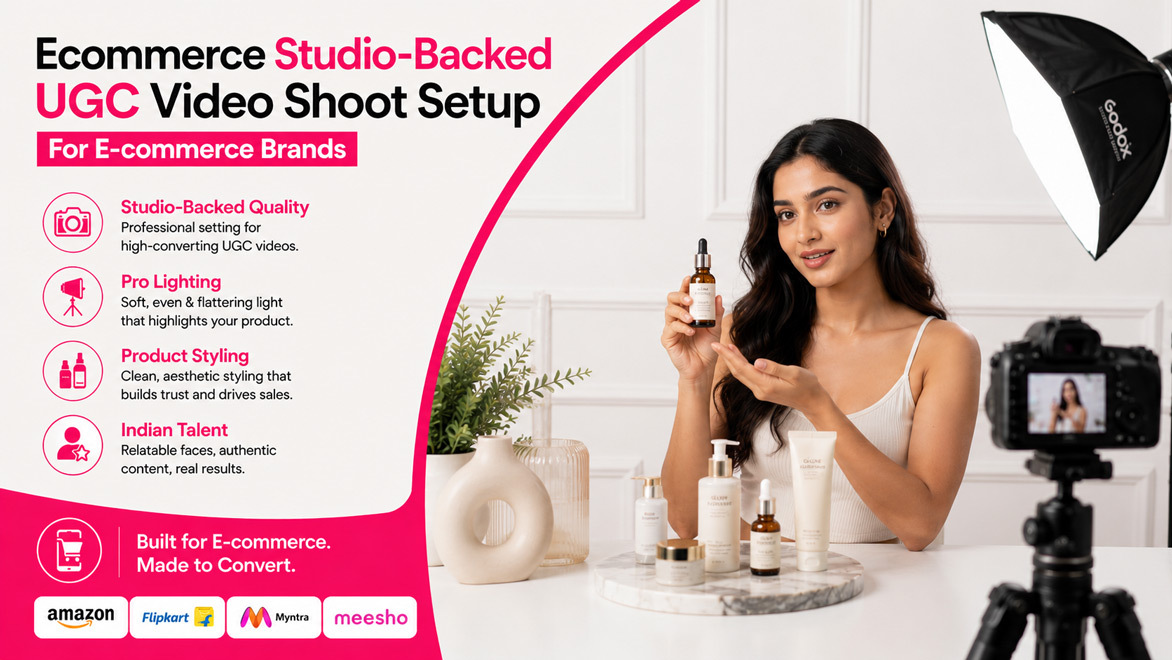
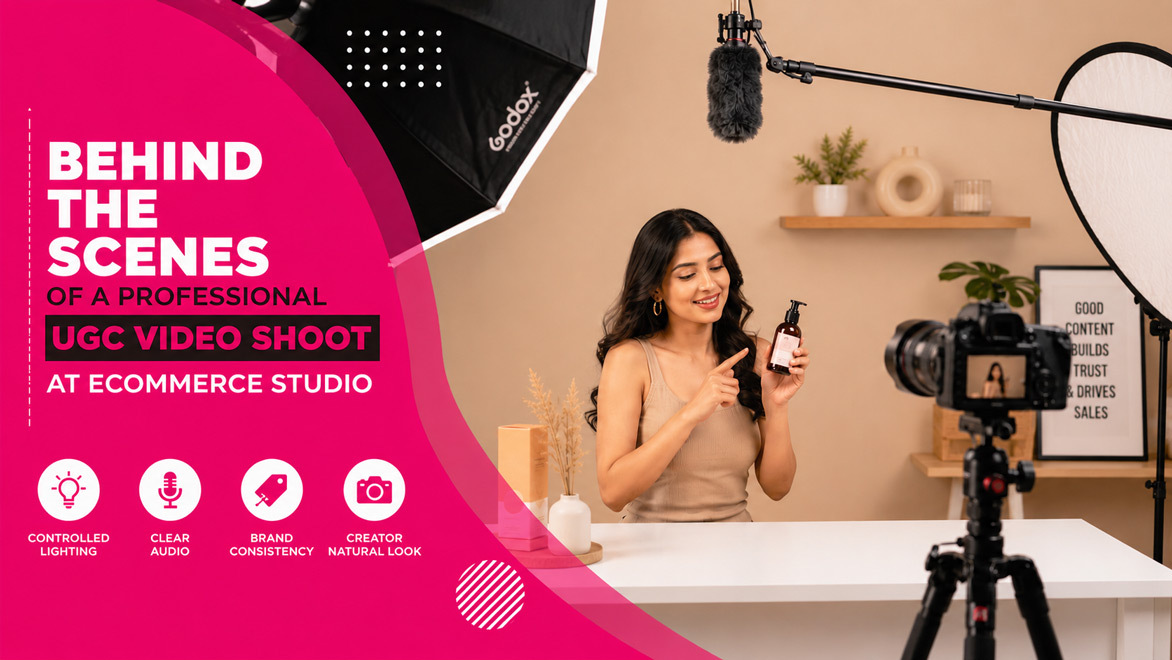
Studio-Backed UGC is content that is shot in a controlled production environment — usually a professional photo and video studio like Ckstudio — using real human talent who are briefed, scripted (loosely), and styled to feel native to the brand’s audience. The “UGC” feel is preserved through handheld framing, talking-to-camera blocks, natural pauses and authentic dialogue. The “studio-backed” part is the invisible scaffolding: three-point lighting, lavalier audio, multi-angle coverage, on-set art direction, and same-day edit-ready masters. The end deliverable looks like a creator made it on a really good day, every single day.
What Counts as Freelance Creator UGC
Freelance Creator UGC is the model most D2C brands started with. You find creators on platforms or Instagram, ship product samples, send a brief, and wait 7–14 days for them to deliver vertical videos shot on whatever phone they own, in whatever lighting their apartment has, with whatever script interpretation they felt that morning. The output ranges from genuinely magical to genuinely unusable, with the average sitting somewhere uncomfortable in the middle. The defining feature is variance — and variance is the enemy of paid media scaling.
Why UGC ROI Is the Only Metric That Actually Matters in 2026
Brands love to talk about UGC in terms of “authenticity” and “social proof”. Those words are real, but they do not pay your performance marketing manager. UGC ROI for D2C brands comes down to four numbers: cost-per-final-asset, ad CVR delta, CAC reduction over a 30-day window, and gross-profit-per-creative. Anything else is vanity.
The brutal reality of 2026 is that creative is the single biggest lever in paid media performance, and most brands are still under-investing in the production quality of their UGC. They are paying premium ad spend to push amateur footage. Whether that footage came from a freelance creator or a studio matters less than whether it converts — but on average, the studio-shot version is producing 18–32% higher view-through rates inside Meta’s video objective campaigns, based on what Ckstudio observes across the apparel, beauty and home brands we work with. The same pattern shows up on Flipkart Affiliate-style video placements and Amazon Sponsored Brand Videos.
“The brands winning at UGC in 2026 stopped asking ‘studio or freelance’ and started asking ‘which asset gets which treatment’. That single mindset shift unlocked compound ROI.” — Prince, Founder, Ckstudio
Real Studio-Shot UGC vs AI-Generated Content: A Necessary Sidebar
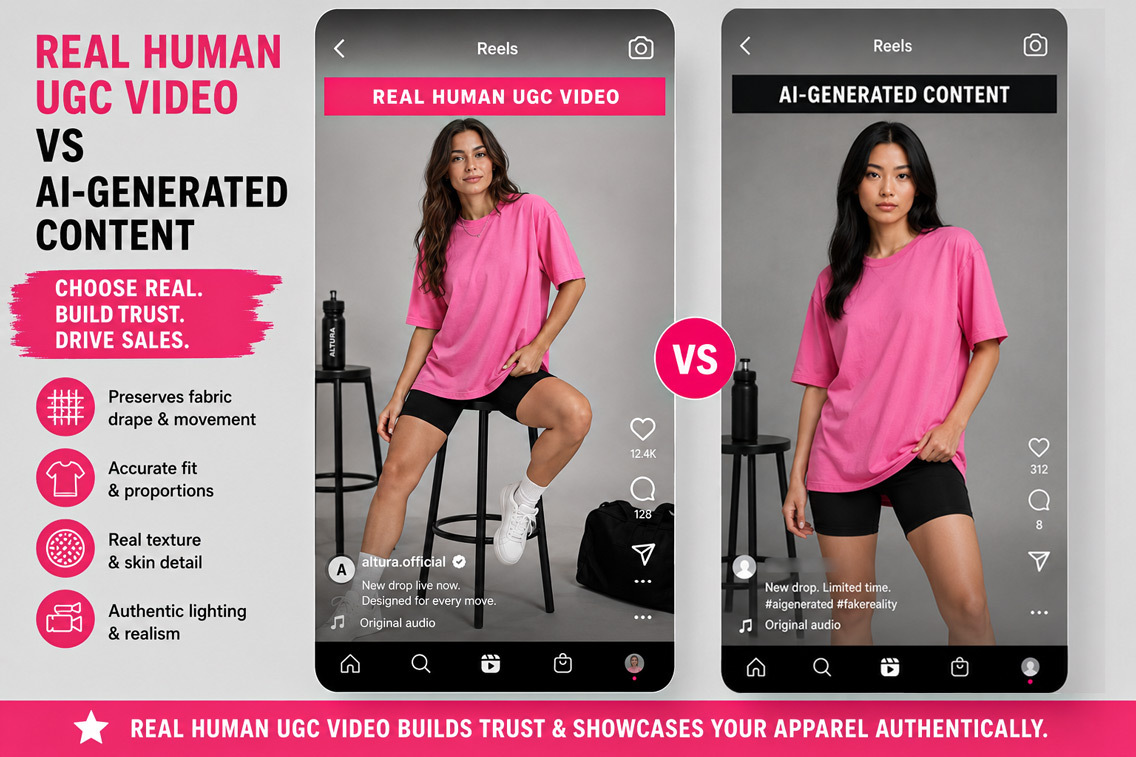
Before going deeper, this comparison would be dishonest without addressing the elephant in the brief — AI-generated UGC. In 2026 you can generate a fake human creator holding your product in 90 seconds. It is tempting. It is also a strategic mistake for any brand that takes its category seriously.
Amazon, Flipkart, Myntra and Meesho all penalise — explicitly or algorithmically — listings that use misleading visuals. AI-generated humans still fail at three things buyers notice instantly: garment drape on a real body, fabric texture under natural movement, and honest scale of the product against a real human hand. Buyers may not articulate why a video feels “off”, but their click-to-cart rate quietly drops. This is exactly why professional fashion photography and real-human UGC remain non-negotiable for apparel and accessories brands, regardless of how good text-to-video models get.
The Ckstudio recommendation is simple: use AI for moodboards, scripts, and edit assistance — never as the final on-camera talent for an e-commerce hero asset. Save the realness for where it earns revenue.
Studio-Backed UGC vs Freelance Creator UGC: Head-to-Head Comparison
Below is the comparison table Ckstudio uses in client onboarding calls. Numbers are typical ranges based on Indian market rates and the projects Ckstudio has delivered over the last 18 months for apparel, beauty, kitchenware and home-and-furnishing brands.
| Parameter | Studio-Backed UGC (Ckstudio) | Freelance Creator UGC |
|---|---|---|
| Starting Cost per Video | ₹1,500 – ₹9,000 | ₹1,000 – ₹7,500 |
| Cost per Usable Final Asset | ₹1,500 – ₹9,000 (high usability) | ₹3,000 – ₹12,000 (after rejected drafts) |
| Quality Consistency | Engineered & repeatable | Highly variable |
| Turnaround Time | 3–7 days, batched | 7–21 days, sequential |
| Audio Quality | Lavalier & treated room | Phone mic, room echo |
| Brand Consistency | Locked on-set | Inconsistent across creators |
| Scalability (10+ videos/month) | Single batched shoot day | Coordinate 5–10 separate creators |
| Performance on Paid Ads | Stronger CVR, lower CPM | Stronger raw authenticity |
| Suitable for Amazon Main Listing | Yes — meets platform standards | Often fails review for quality |
| Best Use Case | Hero, A+, conversion ads | Reels, Stories, top-funnel testing |
Cost: The Number That Looks Different Once You Count Revisions
On paper, a freelance creator quoting ₹1,500 looks irresistible next to a Ckstudio package quoting ₹2,500. But the real number is not the quote — it is the cost-per-usable-final-asset. Most D2C brands report a 40–60% rejection rate on freelance UGC drafts (lighting issues, audio echo, off-brand styling, wrong product angle). That means three creators at ₹1,500 each (₹4,500 total) frequently yield only one or two usable videos. The studio-shot version delivers a clean usable asset every time. The math flips fast.
Quality: Where Studio-Backed Wins Without Argument
There is no honest case for freelance UGC being higher quality than studio-backed work on any objective measure — lighting, audio, framing, colour science. The defensible case for freelance is perceived authenticity, and that is a real and valuable axis. But brands often confuse “shot in a kitchen” with “feels authentic”. A skilled studio team like the one Ckstudio runs at our Delhi facility can absolutely shoot content that feels kitchen-shot while being technically clean. The opposite — making a poorly shot freelance video look like a hero ad — is almost impossible in post.
Ready to Stop Guessing on UGC ROI?
Talk to Prince directly about a Studio-Backed UGC package tailored to your D2C brand or marketplace listings. No template pitch — just a real production plan.
📞 Call Prince: +91-8700258773 💬 WhatsApp UsScalability: The Quiet Killer for Freelance UGC
A brand needing 4 videos a month can probably manage freelance UGC with controlled chaos. A brand needing 16 videos a month cannot. Coordinating 8–12 different freelance creators monthly — each with their own onboarding, brief interpretation, shipping logistics and revision cycle — is a full-time job that quietly burns marketing operations bandwidth. Studio-Backed UGC solves this with batched shoot days, where 10–20 videos are captured in one structured day, edited together for tonal consistency, and delivered as a single package ready for monthly content calendars.
Brand Consistency: The Invisible ROI Lever
Every freelance creator brings their own visual signature — colour grade, framing instincts, pace of speech. Across 10 freelancers, your brand ends up looking like 10 different brands. This is invisible damage that compounds over quarters. Studio-backed work, by definition, runs through one creative direction — yours, locked in on set. For brands actively building recognition on Amazon, Myntra or Flipkart, this matters enormously.
Practical Examples: How Three Indian Brands Used the Hybrid Stack
These are anonymised compositions based on patterns Ckstudio has seen across our client base — the specifics are illustrative, not from any one brand.
Brand A — Skincare D2C with ₹8 Lakh Monthly Ad Spend
Started with 100% freelance UGC. Conversion rate on Meta video ads sat at 1.4%. Shifted hero ads to Studio-Backed UGC produced at Ckstudio while keeping freelance creators for Instagram Reels social proof. After 60 days, hero-ad CVR moved to 2.1% and CAC dropped 22%. Total content spend went up by ₹40,000/month; net contribution margin went up by far more.
Brand B — Apparel Seller on Myntra & Ajio
Could not get freelance creators to consistently capture fabric texture and fit. Moved all listing-grade video to studio-backed UGC at Ckstudio, layered with ghost mannequin photography for the static slots. Marketplace listing video approval rate went from 60% to 98%, and the brand finally qualified for Myntra’s enhanced video slots.
Brand C — Home & Kitchen Seller on Amazon & Meesho
Stayed primarily on freelance UGC for budget reasons but commissioned one studio-backed batch of 12 videos every quarter. Used those 12 as the foundation for paid ads and recycled top performers. ROAS on the studio batch consistently outperformed freelance-shot ads by 1.6x. The brand now treats studio batches as their “creative inventory”.
Common UGC Mistakes Brands Make in 2026
Treating UGC as One Category
Brands buy “UGC” as if it is one thing. It is not. Hero, social proof, ad creative, listing video — each needs its own production decision.
Optimising for Quote, Not ROI
Picking the lowest creator quote and ignoring usability rates is the single most expensive mistake D2C brands make on UGC budgets.
Skipping the Brief
A two-line brief produces two-line content. Studios and freelancers both perform better with detailed scripts and reference moodboards.
No A/B Testing Plan
Producing 20 videos with no test plan means 20 guesses. Always run a controlled creative test before scaling spend.
Falling for “AI UGC” Promises
AI-generated humans look modern in feed previews and lose money on platforms that penalise misleading visuals.
No Edit-Ready Master Files
Accepting only final exports means you cannot re-cut for new placements. Always ask for project files and source clips.
Advanced Pro Insights from Ckstudio’s Production Floor
After producing hundreds of hours of e-commerce video across categories — apparel, jewellery, beauty, electronics, home — Prince and the Ckstudio team have a few production beliefs that disagree with conventional UGC advice.
One: shoot vertical and horizontal in parallel, not sequentially. Multi-camera rigs let one performance generate Meta, Amazon, YouTube and Connected TV exports simultaneously. This is one of the largest cost-per-asset wins available, and almost no freelance creator can do it. Two: build a brand pose library. Your top three converting body positions, your top two facial expressions, your two “honest reaction” beats — capture them across every shoot. This is impossible to enforce across rotating freelancers. Three: keep all source clips for at least 18 months. Algorithms change, ad formats change, your offer changes. Source footage shot by Ckstudio gives the brand recutting flexibility for two full seasons.
The Gear Ckstudio Actually Uses for Studio-Backed UGC
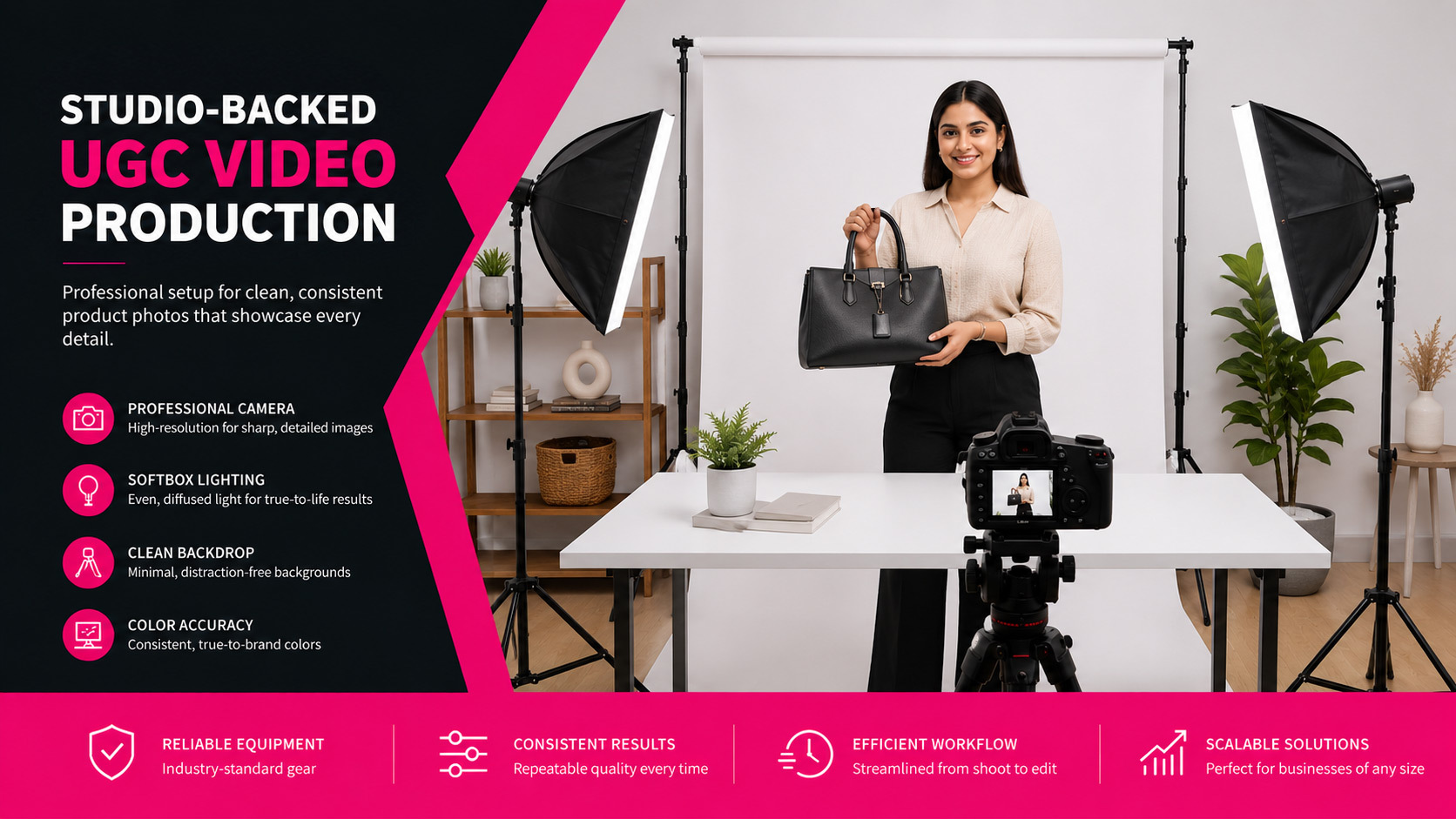
Transparency about tools matters in 2026. The Ckstudio production stack is built around full-frame cinema-capable cameras and lighting that holds up at broadcast standards while still letting talent feel relaxed enough to deliver UGC-style authenticity.
- Cameras: Canon R10 and Sony A7R5 — full-frame and APS-C bodies for parallel framing.
- Lens kit: 100mm macro for jewellery and product detail, 50mm prime for general UGC, 35mm for wider talking-head and lifestyle frames.
- Lighting: 4× Godox SK 400II, 2× Elinchrom FRX 400, paired with 4× strip softboxes, 2× octaboxes and 1× beauty dish for fashion and model-driven UGC.
- Audio: Lavalier mics with sound-treated set space to eliminate the room echo that betrays low-end UGC.
- Post: Colour-graded edits delivered in vertical, square and horizontal formats ready for Meta, Amazon, Flipkart and Google Ads.
Implementation Checklist: Building Your 2026 UGC Stack
Use this checklist as a working document with your marketing team. Tap each item once you have it in place.
- Mapped every planned UGC asset to a funnel stage (awareness, consideration, conversion, retention).
- Audited the last 90 days of paid video ads to identify low-performing creative.
- Calculated true cost-per-final-asset for current UGC sources (not just creator quote).
- Decided which assets need Studio-Backed UGC (hero, A+, conversion ads).
- Decided which assets stay on Freelance Creator UGC (raw reels, social proof, top-funnel tests).
- Booked a batched studio shoot day for monthly hero content.
- Briefed every creator and studio with the same locked brand guide, script, and reference moodboard.
- Set up a 14-day A/B test between Studio-Backed UGC and Freelance UGC with equal ad spend.
- Archived all source clips and project files for at least 18 months for future recuts.
- Scheduled a quarterly review of UGC ROI by creative type and platform.
Future Trends: Where UGC for E-commerce Is Heading After 2026
Three shifts will define UGC over the next 24 months. First, platform-native verification — Amazon and Flipkart are quietly piloting “real human creator” badges for product videos, which will widen the gap between studio-backed and AI-generated content. Second, vertical-first hero formats — the era of the horizontal hero is ending, and brands not shooting vertical-native UGC will pay a premium to retrofit it. Third, creative budgets crossing media budgets — the leading D2C brands are already spending more on production than on lower-funnel media, because creative is the only durable performance lever left.
Ckstudio is positioning every client toward this future — investing in production processes that scale, archiving source masters for long-cycle reuse, and helping founders see UGC as creative inventory rather than disposable content. That is the strategic mindset that wins in 2026 and beyond.
Frequently Asked Questions
Freelance Creator UGC starts at roughly ₹1,000 to ₹7,500 per video for a single creator with a smartphone, while Studio-Backed UGC packages from Ckstudio start at ₹1,500 to ₹9,000 per video and include scripting, professional lighting, multi-angle coverage, edit-ready masters and revision rights. Studio packages cost more per unit but deliver a lower cost-per-conversion when used as ads, because rejection rates and reshoot costs are dramatically lower.
For Amazon main listing videos, A+ content videos and Flipkart product videos, Studio-Backed UGC delivers better ROI because the platform algorithms reward sharp audio, stable framing and consistent lighting — all areas where freelance smartphone shoots typically underperform. Freelance UGC still works well for off-listing social proof reels and influencer-style ads where authenticity matters more than polish.
No. Freelance UGC is not dead — it remains valuable for raw, authentic social proof on Reels, Shorts and Stories. The shift in 2026 is that mature D2C brands are layering Studio-Backed UGC on top of freelance creators to build a hybrid content stack that performs across the funnel rather than choosing one over the other.
AI-generated UGC cannot replace real Studio-Backed UGC for e-commerce because Amazon, Flipkart, Myntra and Ajio penalise misleading visuals, and AI-generated humans still struggle with garment fit, fabric drape and product handling cues that buyers rely on. Real human creators shot in a controlled studio still convert measurably better, especially for apparel and beauty.
Most growing D2C brands need between 8 and 20 UGC video assets per month — a mix of hero spots, unboxing reels, problem-solution shorts and testimonial-style ads. Ckstudio typically batches an entire month of content in one structured shoot day, which is far harder to coordinate across multiple scattered freelance creators.
A Studio-Backed UGC package from Ckstudio includes scripting and shot list, professional model casting, full lighting setup, multi-camera coverage, on-set product styling, edit-ready hero cuts, vertical and horizontal exports for Amazon, Flipkart, Meta and Google ads, plus revision rights on final cuts. Email [email protected] for a current rate card.
Conclusion: Stop Choosing Sides, Start Building a Stack
The Studio-Backed UGC vs Freelance Creator UGC debate is the wrong frame. The right frame in 2026 is where does each format fit in your content stack. Studio-backed wins where polish, consistency, and platform compliance drive measurable ROI — hero listings, A+ video, conversion ads, marketplace-grade content. Freelance wins where rawness, volume and creator-native voice carry the moment — social proof reels, top-funnel testing, community content.
If your brand is currently leaning 100% on freelance UGC and wondering why ad performance has plateaued, the answer is almost always missing studio-grade hero creative. If your brand is leaning 100% on studio production and wondering why social engagement feels stiff, the answer is missing freelance authenticity. Build the stack. Test the stack. Scale the winners. That is how UGC actually delivers ROI for e-commerce brands in 2026.
If you want to talk about what a Studio-Backed UGC stack looks like for your specific brand, Prince personally takes discovery calls with founders and marketing heads. Reach Ckstudio on +91-8700258773, drop a message on WhatsApp, or write to [email protected]. You can also browse our recent portfolio work or read more brand case studies before reaching out.
For official platform guidelines referenced in this article, consult Amazon Seller Central India and Flipkart Seller Hub directly for current video specifications.
Get Your Custom Studio-Backed UGC Plan
Send Ckstudio your product category, monthly ad spend, and current UGC sources. Prince will personally send back a tailored plan with cost-per-asset projections — no obligation, no template pitch.
🚀 Get My UGC Plan ✉️ [email protected]