



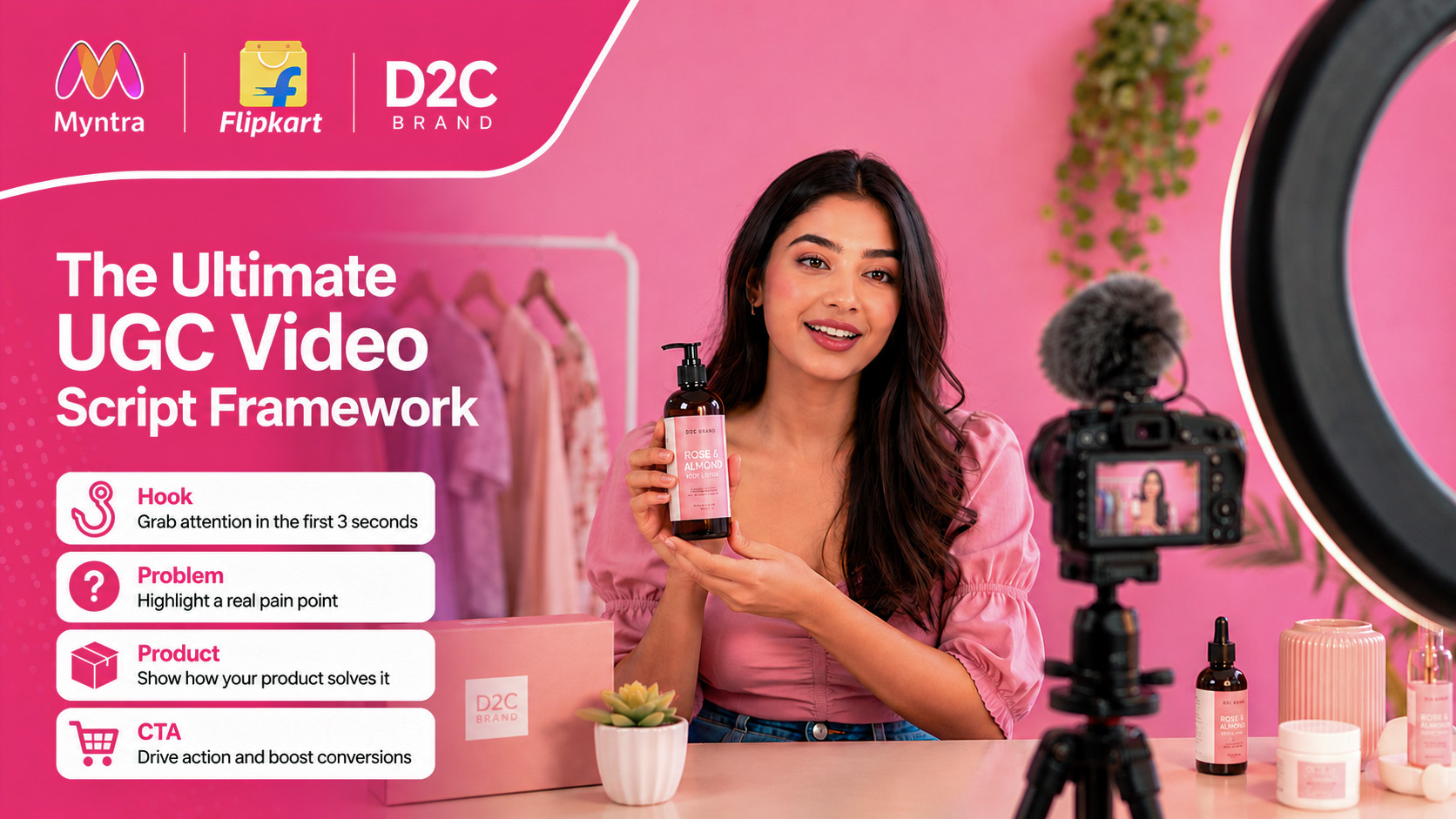
If a shopper scrolls past your product video in the first three seconds, every rupee you spent producing it is wasted. That is the brutal economics of UGC video script writing in 2026. Attention is the rarest currency on Amazon, Flipkart, Myntra, Meta and YouTube Shorts — and the only way to earn it is with a script that does four things in sequence, every single time.
At Ckstudio, our team has produced thousands of product videos for sellers across India over the last nine years. The single biggest pattern we have observed in high-performing creatives is not the camera, not the model, not the editing software — it is the script structure. The same four-part framework keeps surfacing in winning ads, irrespective of category. Whether the product is a saree on Myntra, a face serum on Amazon, or a kitchen gadget on Meesho, the architecture stays the same: Hook → Problem → Product → CTA.
This guide unpacks the entire framework. You will learn how to write a 3-second hook that stops the scroll, frame a problem your buyer feels in their bones, demonstrate your product in a way that creates instant desire, and close with a CTA that converts. We also compare real human-shot UGC with AI-generated alternatives, walk you through tools and equipment, and give you a ready-to-use scripting checklist.
Key Takeaways
- The first 3 seconds of any UGC video are responsible for 60–80% of its conversion performance.
- The Hook–Problem–Product–CTA framework works across Amazon, Flipkart, Myntra, Ajio, Meesho and Meta — only the CTA must change per platform.
- Real, human-shot UGC consistently outperforms AI-generated video for trust-led product categories.
- Test 3–5 hook variations per product before changing anything else in your script.
- Authentic does not mean amateur — lighting, audio and framing still need to be intentional, which is where a studio like Ckstudio earns its keep.
Understanding the UGC Video Script: Why a Framework Beats Inspiration
UGC — user-generated content — was originally an organic phenomenon: real buyers posting unscripted product reviews on social media. What we now call “UGC-style video” is a deliberate, scripted recreation of that authentic feel, used as paid advertising creative. The distinction matters, because once UGC moves into your ad account, it has a job to do: it must convert.
Most sellers approach product video scripting like a creative exercise. They sit down hoping for inspiration. The result is unfocused, meandering content that looks fine but doesn’t sell. A framework solves that problem by removing decision fatigue. Once you internalise the four-part structure, you stop asking “what should the video say?” and start asking “how do we sharpen each beat?”
A solid framework also makes the work scalable. When you are running 20 product listings on Amazon or pushing a new D2C launch on Meta, you cannot afford to reinvent the script each time. Our video production team at Ckstudio uses this exact structure across categories — from fashion and jewellery to FMCG and electronics — and the consistency is what allows quality to stay high even at volume.
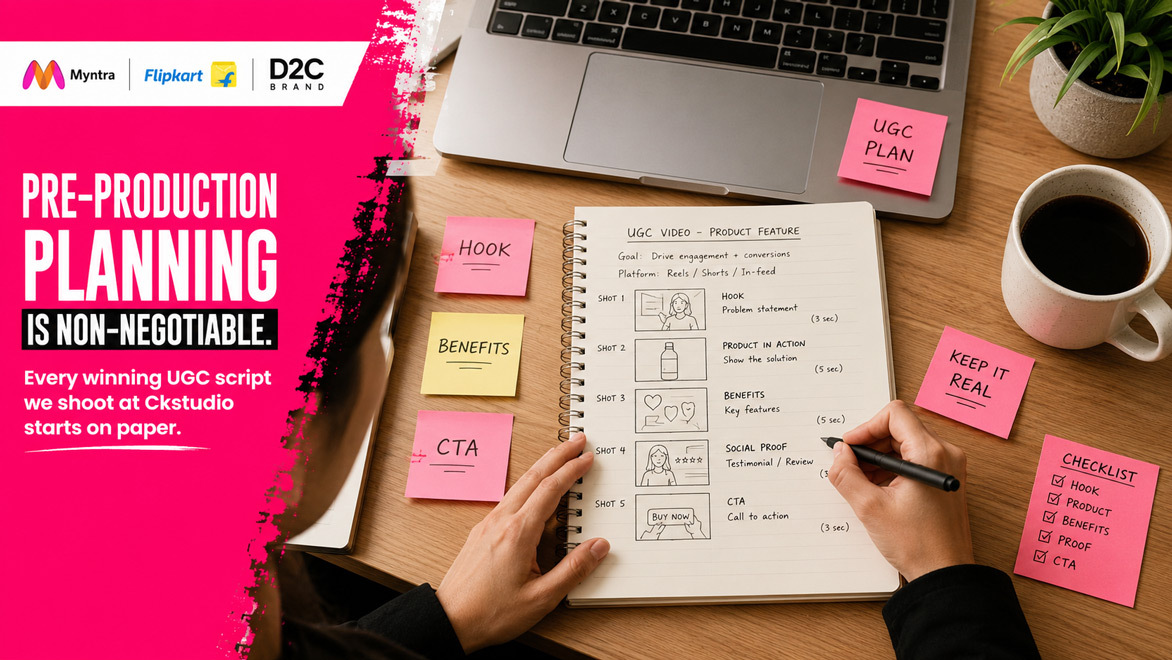
Pre-production planning is non-negotiable. Every winning UGC script we shoot at Ckstudio starts on paper.
Why a Scripted UGC Framework Matters for E-commerce in 2026
Three structural shifts have made script-led UGC the highest-ROI creative format for Indian e-commerce right now.
First, attention has collapsed. The average shopper now scrolls past content in under two seconds on mobile. There is no time to “warm up” a video — the hook either lands or you lose the impression.
Second, paid CPMs have risen sharply. Whether you are running Amazon Sponsored Brand Video, Meta Advantage+ campaigns, or Flipkart Product Listing Ads, the cost of reaching one thousand viewers has climbed steadily for three years. Inefficient scripts now cost real money.
Third, AI-generated video is everywhere. Synthetic creatives are flooding feeds, and audiences have grown allergic to anything that smells AI-shot. Genuine, well-scripted, human-performed UGC has become a trust signal — and trust now sells.
Figures above reflect industry-wide benchmarks observed across e-commerce creative campaigns; actual performance varies by category and audience.
Real UGC Videos vs AI-Generated Product Videos: The Honest Comparison
This is the conversation every D2C founder is having in 2026. AI video tools can now produce passable product clips in minutes. So why does Ckstudio still believe in shooting real people with real products in real spaces? Because the data — and the platforms — agree.
| Dimension | Real UGC Video (Human-Shot) | AI-Generated Product Video |
|---|---|---|
| Buyer Trust | High — authentic micro-expressions, real product handling, genuine reactions | Low — the uncanny valley still triggers skepticism, especially for skin, hair, food, fashion |
| Platform Compliance | Fully compliant on Amazon, Flipkart, Myntra, Meta, YouTube | Increasingly restricted — Meta and TikTok now down-rank obvious AI creatives |
| Conversion Rate | Consistently higher for purchase-intent campaigns | Acceptable for awareness, poor for direct-response |
| Product Accuracy | Exact — colour, texture, scale and behaviour are real | Often distorted — fabrics drape wrong, materials shimmer incorrectly |
| Brand Differentiation | Unique to your brand, creator, story | Looks like every other AI-generated competitor |
| Cost per Variation | Higher upfront, optimised through scripting | Lower per asset, but lower performance erodes the savings |
| Best Use Case | Direct-response, performance ads, listing videos, A+ content | Concept tests, low-stakes social fillers, B-roll |
The most reliable path right now is to use AI for ideation and storyboarding, then commit to professional, human-shot footage for everything that touches a buying decision. Our e-commerce content team regularly produces both Amazon listing videos and Meta ad-ready UGC for the same brand, calibrated for the platform’s audience.
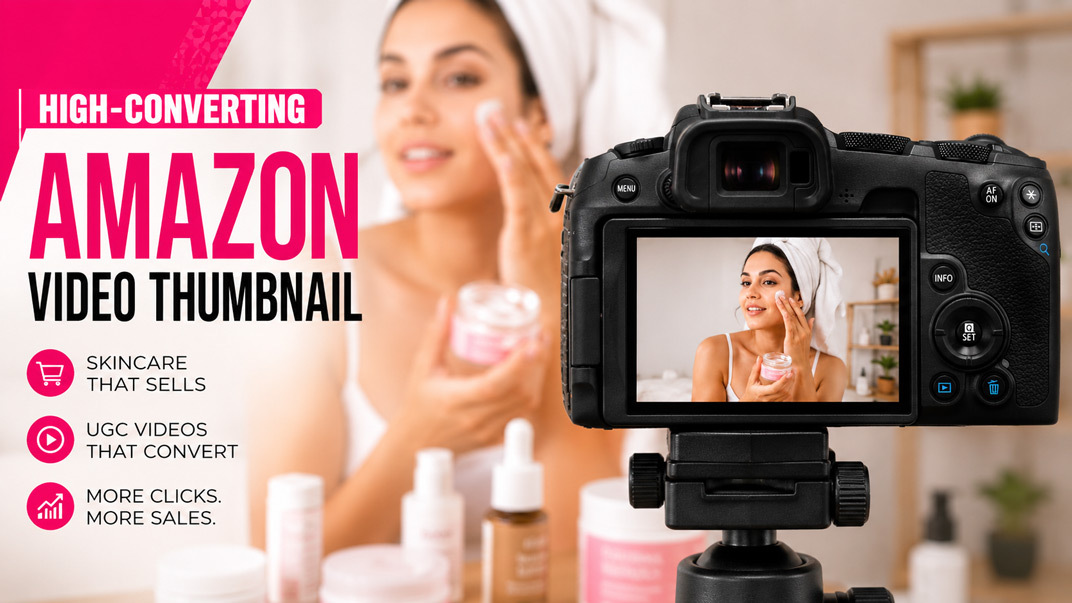
A strong opening frame doubles as a clickable thumbnail. Treat every UGC video as if its first frame is the ad.
The Four-Part UGC Script Framework, Decoded
Now, the meat of the guide. Each of the four parts has a job, a target duration, and a set of techniques that consistently lift performance. Treat the timings as defaults — adjust to your platform, but keep the order locked.
0–3 seconds: Stop the scroll, or stop the campaign
The hook has one job: make the viewer’s thumb pause. Nothing else. Forget brand name, forget context, forget aesthetics — just earn the next three seconds. Successful hooks fall into five reliable categories.
- Pattern Interrupt: A surprising visual or sound in the first frame — a hand slamming on the table, a product cracking, a colour explosion.
- Bold Claim: “I have not used shampoo in 90 days.” “This kurta saved my Diwali week.” Specificity sells.
- Direct Address: “If you are a small Amazon seller, watch this before you list one more product.”
- Curiosity Gap: “Most people use this product completely wrong. Here is the right way.”
- Reaction-Led: Start with the creator’s genuine “wow”, “oh no”, or shocked expression to a result.
The hook must visually preview what is to come. Misleading hooks — “you won’t believe what happened” with nothing happening — get punished by every algorithm now. Ckstudio’s general rule: write five hooks for every script, shoot all five as variants, and let the data pick.
3–10 seconds: Name the pain your buyer is silently carrying
Once the scroll stops, the next obligation is empathy. The viewer needs to feel understood within seven seconds. This is where most scripts collapse — they jump straight to features. Resist that urge.
- Use specific, sensory language: “The third time my foundation broke out my skin this month…” not “many people have skin issues”.
- Show the problem, do not just narrate it. Smudged makeup, wrinkled kurta, clogged kitchen drain — let the camera carry half the message.
- Match the creator’s demographic to the buyer’s. A 24-year-old college student selling skincare to homemakers in their 40s will not land.
- Keep it to one problem. Multi-problem scripts dilute urgency and confuse the algorithm.
For fashion sellers, the problem is rarely the garment itself — it is the moment the garment fails. The slip strap during a wedding. The fading colour after one wash. The fit that flatters on the model but not on the buyer. Frame the problem at that moment of failure and your product becomes the rescue. Our garment and apparel shoot team builds entire shot lists around these failure moments.
10–25 seconds: Show, don’t sell. Then sell, don’t tell.
This is the longest section and the one most sellers overstuff. The viewer just needs three things in this window:
- Demonstration: A clear, watchable proof that the product solves the problem named in Part 2.
- One sharp benefit: Not five. One headline that earns its place in the viewer’s memory.
- Authentic reaction: A genuine moment — relief, surprise, satisfaction — from the creator.
The demonstration is non-negotiable. If you are selling a kitchen scrub, the camera must follow it cleaning the dirtiest surface in one stroke. If you are selling a serum, we want to see the texture, the application, and the after-glow on the same skin. This is also where production quality quietly earns its keep — soft lighting, clean audio, and a stabilised handheld feel can be the difference between “trustworthy” and “sketchy”. For products with critical detail like jewellery or watches, we often combine UGC framing with the studio-grade close-ups that our jewellery photography team and watch photography specialists shoot in parallel.
25–30 seconds: One action, said clearly, with reason to act now
The mistake here is asking for too much. “Follow us, visit our site, use the code, share with friends” is four CTAs. Pick one. The best UGC scripts ask for a single, frictionless action and pair it with a reason to act today.
The exact CTA must adapt to the platform — and this is where most sellers get penalised:
- Amazon Sponsored Brand Video: External links are blocked. Push attention to the listing’s bullet points or A+ content. “Tap the listing — check the third image” is fair game.
- Flipkart PLA / Listing Video: Same restriction as Amazon. Use the CTA to reinforce review count or “bestseller” position.
- Myntra Studio / Reel: “Tap to add to wishlist” works because the action lives inside the platform.
- Meta (Instagram + Facebook): Use a clear “Shop now” voice CTA and pair it with the in-feed button. Discount codes are powerful here.
- YouTube Shorts / Ajio / Meesho: Match CTA to where the buy button actually exists in that environment.
Adding mild urgency — “limited stock,” “this week only,” “new launch price” — lifts conversions, but only when it is genuinely true. Hollow urgency damages brand trust faster than anything else in your funnel.
Practical Examples: The Framework Across Categories
To make the framework tangible, here is how the four beats look across four different product categories we frequently shoot for our ecommerce UGC video clients at Ckstudio.
Example 1 — D2C Face Serum on Meta
Hook (0–3s): Close-up of a face mid-application, voice-over: “I tried 14 serums in 2026. This is the only one I kept.”
Problem (3–10s): Cut to bathroom shelf, half-used bottles being binned. “Every serum either broke me out or did nothing.”
Product (10–25s): Texture pour-shot, application, before/after side-by-side at the same time of day. One benefit: “Cleared my texture in 21 days.”
CTA (25–30s): “Tap Shop Now — first 100 orders ship with the travel size free.”
Example 2 — Saree on Myntra
Hook: Twirl shot, the pallu catching light. “If your wedding saree feels heavy by hour two, this video is for you.”
Problem: Cut to a creator visibly uncomfortable in a heavy embroidered drape.
Product: Reveal of the lightweight alternative, the weight comparison in hand, full draped look in motion.
CTA: “Tap to wishlist on Myntra — sizes are selling fast.”
Example 3 — Kitchen Cleaner on Amazon
Hook: A genuinely greasy kitchen hood. No narration. Just visual horror.
Problem: “I scrubbed this for 40 minutes last weekend. It came back in three days.”
Product: Spray, wait five seconds, single wipe, hood gleams. Real time.
CTA: “Check the listing — read the verified reviews before you order.”
Example 4 — Smart Watch on Flipkart
Hook: Watch face lighting up on a wrist mid-run.
Problem: “I needed a smartwatch under ₹3,000 that doesn’t die in eight hours.”
Product: Battery test, GPS demo, water test. One sharp benefit: “Seven full days on one charge.”
CTA: “Tap to view price drop — Flipkart Big Sale price live now.”
Common UGC Scripting Mistakes That Quietly Kill Conversions
Across the hundreds of scripts we have audited at Ckstudio, the same eight mistakes account for almost every underperforming UGC video.
- Burying the hook. Logos, music intros, brand mentions in the first three seconds — all of these displace the actual hook.
- Talking at the viewer. First-person, peer-to-peer voice (“I”, “we”, “you”) consistently outperforms third-person brand-speak.
- Showing the product before showing the problem. Buyers care about themselves before they care about what you sell.
- Multiple CTAs. Every additional ask cuts your conversion rate.
- Generic models. Casting that doesn’t match the audience produces emotional dissonance.
- Polished lighting on raw products. Lifestyle products need lifestyle environments — the kitchen, the bathroom, the metro.
- Music drowning the voice. Audio is half of video. Voice forward, music subtle.
- Reusing the same script across platforms. The framework stays, the CTA must adapt.
Advanced Pro Insights: What Separates Good Scripts from Top-Performing Ones
Once you have the framework working, these refinements will push performance another notch.
Test hooks in isolation. Keep the problem, product and CTA identical across five video variants and rotate only the hook. The data will rapidly show which framing your audience responds to.
Use voice-over for variant velocity. Shoot the visuals once, then record three different voice-overs over the same footage. Same script structure, three personas — student, working professional, parent — and you have three audience-tuned ads from one shoot day.
Watch your script through silent eyes first. 70% of feed video is consumed muted. Captions, on-screen text and visual storytelling must carry the message without audio. We always design our lifestyle product shoots so the same content works in both stills and video.
Build to platform-native aspect ratios from the storyboard. Vertical 9:16 for Reels, Shorts and Stories. Square or 4:5 for in-feed. Horizontal 16:9 for YouTube and Amazon listing videos. Each ratio needs its own framing pass.
Layer a soft hook on top of the hook. The first 0.5 seconds carries a visual surprise. The next 2.5 seconds carries a verbal hook. Two thumb-stoppers in three seconds, working together.
Tools, Equipment and Resources for Scripted UGC Production
You do not need cinema gear to produce conversion-ready UGC. You do, however, need intentional gear. Here is the kit list we use at Ckstudio for hybrid “authentic-but-intentional” shoots, and the lighter version a seller can self-produce with.
Ckstudio’s Pro UGC Production Kit
- Cameras: Canon R10 and Sony A7R V (full frame for hero shots, APS-C for handheld UGC feel).
- Lenses: 50mm for general UGC, 100mm macro for skincare, jewellery, food close-ups; 35mm for environmental shots.
- Lighting: 4× Godox SK 400II and 2× Elinchrom FRX 400 with strip softboxes for soft, even fill; a beauty dish for model and fashion-led UGC.
- Audio: Lavalier mic on every voice-over and on-camera dialogue take — phone audio is the most common reason a UGC video underperforms.
- Editing: DaVinci Resolve for colour, Premiere Pro for cutting, CapCut Pro for the final platform-native pass.
Seller’s Self-Production Kit (Budget)
- A flagship smartphone (last two generations is enough — most ads on Instagram are shot on phones).
- One soft daylight LED panel or a clean north-facing window.
- A clip-on lavalier mic — non-negotiable.
- A small tripod with phone mount, or a steady handheld grip.
- CapCut on mobile for editing.
If you want platform-perfect output without building this in-house, our Amazon product video team, Flipkart model and video shoot team, and Myntra apparel video team regularly produce 30 to 50 UGC variants per brand per month at Ckstudio’s Delhi studio.
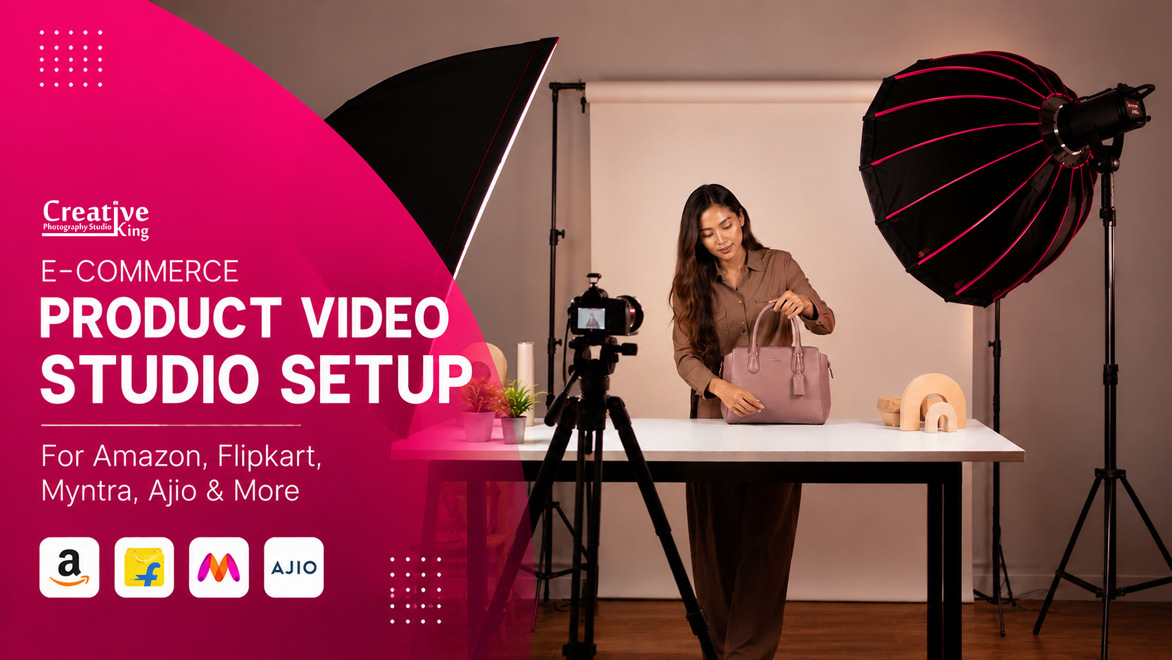
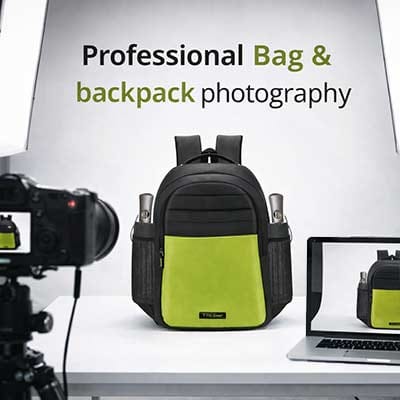
Studio environment from a recent Ckstudio shoot — softboxes calibrated for an authentic UGC feel rather than glossy commercial.
Implementation Checklist: From Brief to Shoot-Ready Script
Tick this off before any UGC video script goes to production
Need This Done For Your Brand?
Ckstudio’s Delhi team produces conversion-led UGC video packages for Amazon, Flipkart, Myntra and Meta — script to delivery, in 7–14 days.
Future Trends: Where UGC Scripts Are Headed Next
Four shifts are already reshaping how we write product video scripts heading into the second half of 2026.
Vertical-first as default. Even Amazon listing videos are increasingly consumed on mobile. Storyboards should start in 9:16 and adapt outward, not the other way around.
Hyper-niche creators over polished influencers. Audiences are responding more strongly to a creator who lives the exact problem than to one with a large following.
“Anti-ad” production values. Visible script seams, gentle imperfections, real backgrounds — when done with intent — outperform glossy ads on every short-form platform.
Modular scripts. The same problem-product-CTA core, with hooks and creators swapped out, will replace one-off campaigns. Brands that build a UGC library will outpace those that build one ad at a time.
AI-assisted, human-shot. AI for ideation, scripting variants, storyboarding and post-production captions — but the camera still pointed at real people, real products, real spaces, exactly how we approach every ecommerce UGC project. This is the workflow our Amazon A+ and infographic team uses every week, and it is the model we recommend to every D2C founder Prince meets.
Want a Conversion-Led Video Strategy Built for Your Catalogue?
Email us your top three SKUs. We’ll send back a free 4-part script outline for one of them — no obligation.
Frequently Asked Questions
The sweet spot is 15–30 seconds for paid social platforms like Meta and YouTube Shorts, and 30–60 seconds for Amazon and Flipkart product listing videos. The first 3 seconds are non-negotiable for the hook — if you don’t earn attention there, length is irrelevant.
Authentic and casually shot UGC consistently outperforms over-polished production for paid ads, but the audio, lighting and framing must still be intentional. The goal is “authentic-but-intentional” — which is exactly the brief Ckstudio works to for every UGC project.
The four-part framework stays the same, but the CTA must change. Amazon and Flipkart videos cannot use external URLs or discount codes, so the CTA must direct buyers to in-listing actions. Meta allows external shop links and codes, so the CTA can be more direct. Reusing CTAs across platforms is one of the most common reasons UGC videos underperform.
Start with 3–5 hook variations on the same problem-product-CTA structure. Hooks are responsible for 60–80% of performance variance, so you should iterate there first. Once you have a winning hook, you can begin testing problem framings and CTAs in subsequent rounds.
Not necessarily. UGC works because it feels real — and “too professional” can actively hurt conversion. However, casting matters enormously. The creator must match your target buyer’s demographic, look authentic on camera, and be able to deliver lines naturally. Ckstudio maintains a creator roster spanning student, working-professional and homemaker personas exactly for this reason.
A typical project — scripting, casting, shoot, edit and platform-native delivery — runs 7 to 14 working days. Bulk packages of 10+ variants can move faster because the shoot day is shared. Call Prince at +91-8700258773 for an exact timeline based on your catalogue.
Yes. Amazon allows brand-registered sellers to upload videos to product listings and Sponsored Brand Video campaigns. The content must follow Amazon’s policy — no external URLs, claims must be substantiated, and certain categories have additional rules. The official guidelines are available on Amazon Seller Central India.
Yes, with adjusted pacing. The hook becomes more credibility-led, the problem more specific to a workflow, the demonstration more proof-driven, and the CTA more lead-focused. Our industrial content team regularly applies this structure to machinery, B2B equipment and pharma packaging videos.
Conclusion: Frameworks Free You, They Don’t Cage You
The Hook–Problem–Product–CTA framework is not a script — it is a scaffold. Once you internalise it, you stop staring at blank pages and start refining specific beats. You shift from creative paralysis to creative iteration, which is the only state in which performance compounds.
The brands winning on Amazon, Flipkart, Myntra, Ajio, Meesho and Meta right now are not the ones with the biggest budgets. They are the ones running the most disciplined script tests, the most consistent production cadence, and the cleanest hand-off between strategy and execution. That is exactly the workflow our UGC video production team in Delhi has built for Indian e-commerce sellers over the last nine years — and the framework above is how we begin every single new project.
Start with one product. Write five hooks. Pick the strongest framing of the problem. Lock the one benefit that matters. Match the CTA to where the video will live. Shoot it intentionally. Test, learn, refine. Then do the next one.
Ready to Build a UGC Video Engine for Your Brand?
Whether you are a first-time Amazon seller or a scaling D2C brand, Ckstudio can script, shoot and deliver platform-ready UGC video — at one product or one hundred. Talk to Prince today.
Related Posts You May Also Like
- Amazon Product Photography: The Complete Seller’s Guide for 2026
- Flipkart Photography Guidelines 2026 — A Beginner’s Walkthrough
- Product Video for Ecommerce: What to Show in the First 3 Seconds
- Myntra Model Photoshoot: Apparel Imaging Standards That Actually Sell
- Ghost Mannequin Photography for Apparel: The Definitive Guide