
Fashion Photography Services
E-commerce Photography

Bust, flat lay or on-model? A practical comparison for wedding-season sellers who list multi-piece bridal sets online.
Bridal jewellery photography is a different job from shooting a single ring or pendant, because a bridal set is sold as a story of four to seven matching pieces that a buyer must understand in one scroll. A kundan choker, its jhumkas, a maang tikka, a nath and sometimes a haath phool or passa all have to look like they belong to the same family, in the same gold tone, at the same scale.
At Ckstudio, which has been shooting product and fashion catalogues since 2015, wedding season is when we see the most confusion about one question: should the set sit on a bust, lie flat, or be worn by a model? This guide compares the three formats piece by piece and material by material. If you want the full service view first, our jewellery photography page explains how we light and retouch every category, while this post stays focused on multi-piece bridal sets for e-commerce listings.
In this guide
Bridal jewellery photography has to show a coordinated set, not one object. The images must prove that every piece matches in tone, stone colour and scale, and they must tell the buyer how the set will look on a bride, all inside the first three or four thumbnails.
A solitaire ring is judged on sparkle and metal finish. A bridal set is judged on completeness. Buyers searching for a wedding necklace set want to know exactly what arrives in the box: is the tikka included, does the nath come with a chain, are the earrings jhumkas or studs, is there a matching haath phool? If the listing images leave even one of those questions open, the buyer either scrolls to a competitor or orders and returns the set when the missing piece becomes obvious.
The second difference is scale. A heavy rani haar can be 30 to 40 centimetres long when laid flat, while the maang tikka next to it is barely 6 centimetres. Photograph them in one frame without planning and the tikka disappears; photograph them separately and the buyer loses the sense of proportion. Good bridal jewellery photography solves this with a deliberate mix of a full-set hero shot, piece-by-piece detail shots and at least one worn reference.
The third difference is colour consistency across the set. Bridal sets mix gold or gold-plated metal, kundan glass, uncut polki, meenakari enamel on the reverse, pearls and coloured beads. Each of these reflects light differently, so a lighting setup that flatters the gold can turn the red stones orange or wash out the pearls. Ecommerce buyers compare the necklace thumbnail with the earrings thumbnail, and a visible tone shift between them reads as two different products.
Finally, the buyer is often not the bride herself. Mothers, sisters and wedding planners shop for sets on Amazon, Flipkart and Myntra, often on a phone, and they are comparing dozens of near-identical listings. That is why bridal jewellery photography leans on clarity first and mood second: a clean, honest view of every piece, then one or two styled frames that sell the occasion.
A bridal set listing should open with the complete set in one frame, then show the necklace, earrings and head piece individually, then the reverse and clasp details, and finish with a worn reference. That order answers “what do I get” before “how does it look”.
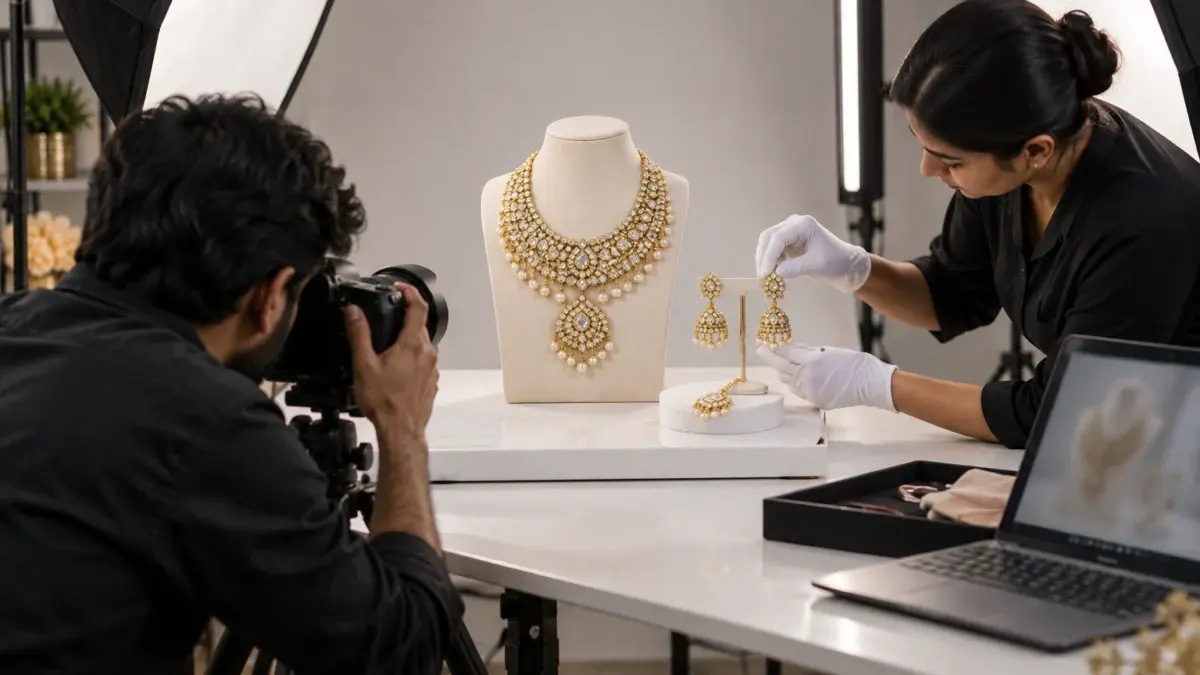
Most marketplace galleries allow between seven and nine images, so every frame has to earn its place. At Ckstudio we plan bridal sets as a fixed shot list and only change it when the set has an unusual piece, such as a kamarbandh or a full passa. The table below is the shot list we use as a starting point for a five-piece kundan or polki set.
| Slot | Shot | Format | What it proves to the buyer |
|---|---|---|---|
| 1 | Complete set, all pieces | Flat lay or bust with earring stands | Exactly what is in the box |
| 2 | Necklace front | Bust | Drape, length and centre pendant |
| 3 | Earrings pair | Hanging on stand or flat | Drop length and stone pattern |
| 4 | Maang tikka or passa | Flat, macro | Chain length and hook type |
| 5 | Reverse side (meenakari) | Flat, macro | Craft quality and finishing |
| 6 | Clasp, dori and adjuster | Macro | Fit and comfort |
| 7 | Worn look, head to collarbone | On-model | Real scale on a person |
| 8 | Scale shot with a hand or ruler | Flat or on-model | Size without guessing |
Kundan and polki sets are traditionally finished with meenakari enamel on the back, and serious buyers flip the piece in their mind before they pay. A clean macro of the reverse shows the enamel colours, the jadau setting and the quality of the backing, which is exactly where cheaper sets cut corners. Showing it openly signals confidence in the product and pre-empts the “looks different from the photo” complaint.
For a five-piece set we usually deliver one hero, one image per major piece, two detail macros and one worn reference. Adding more angles of the same necklace rarely helps; adding a scale reference almost always does. If a set includes a nath, give it its own frame, because nose rings are the piece buyers most often say they could not see clearly.
Keep the order identical across every set in your catalogue. When a buyer opens three of your listings in a row and slot 4 is always the tikka, your store feels organised and comparison becomes easier, which is a quiet advantage in a crowded wedding category.
Kundan glass reflects hard and flat, uncut polki diamonds scatter light softly, and temple gold reflects its surroundings like a mirror. Each material therefore needs a slightly different light angle, diffusion and exposure, even when the three sets are shot on the same day.
The biggest mistake in bridal jewellery photography is using one lighting recipe for every set. A layout that makes temple gold look rich can make kundan stones look like plastic, and a soft wrap that flatters polki can leave temple carvings flat and muddy. The comparison below is how we adjust our setup between materials.
| Material | How it behaves | Light approach | Retouch focus |
|---|---|---|---|
| Kundan (glass on gold foil) | Flat, mirror-like hotspots on every stone | Large diffused source from above, black flags to add contrast lines | Remove blown hotspots, keep foil glow |
| Polki (uncut diamonds) | Soft, milky sparkle, low fire | Soft wrap plus a small hard kicker for depth | Protect the natural haze, no fake sparkle |
| Temple (gold, carved motifs) | Reflects everything around it, deep relief | Light tent or white bounce cards, low side light for carving | Even out reflections, keep the warm tone |
| Pearls and beads | Glossy, easily overexposed | Lower power, larger source | Retain lustre, avoid grey pearls |
From the studio floor
For a kundan choker Ckstudio starts with a 100mm macro lens at f/11 to f/16, ISO 100, and a large strip softbox overhead at roughly 45 degrees, with a second softbox on the opposite side at about half power. Two black flags just outside the frame give the glass stones a defined edge. We tether to a laptop, set a custom white balance off a grey card for every new set, and bracket three focus points so the front of the stones and the gold foil behind them are both sharp after focus stacking.
Temple sets carry carved deities, peacocks and lotus motifs in high relief. Flood them with flat light and the carving vanishes; leave them unflagged and the camera, the photographer and the studio ceiling show up in the gold. We surround temple pieces with white bounce cards, add one low side light to rake across the relief, and step back with a longer focal length so the reflections in the metal are clean white rather than dark shapes. Our deeper notes on studio lighting techniques for jewellery cover these setups with diagrams.
Polki sets reward patience. Because uncut diamonds have a soft glow rather than sharp fire, buyers expect a slightly milky look. Over-sharpening or adding sparkle filters makes them look like cubic zirconia, which damages trust in a high-value listing. We keep retouching on polki minimal: dust removal, colour balance and a gentle lift in the shadows.
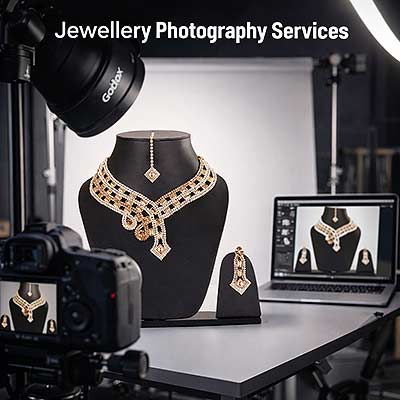
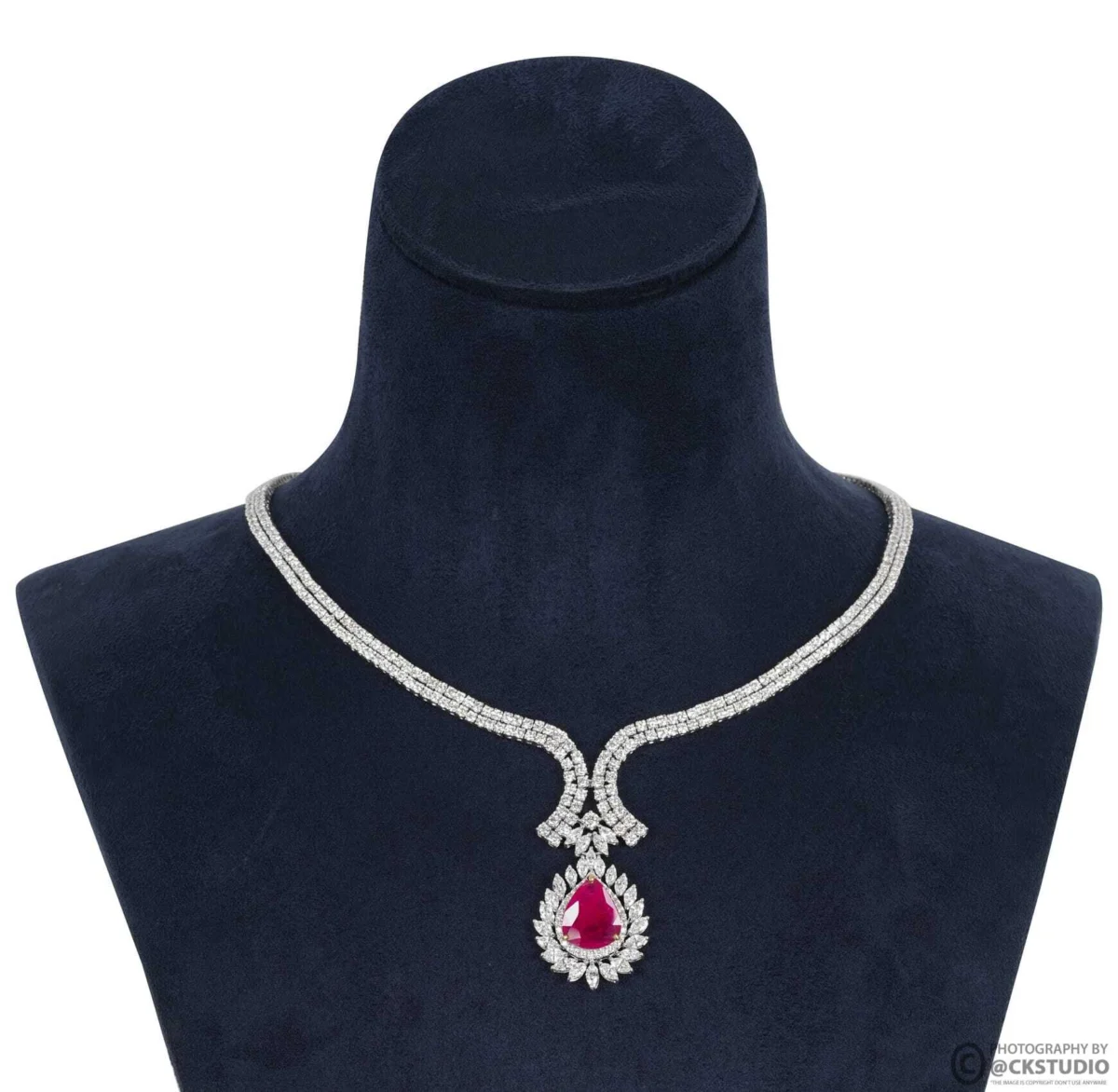
A bust display works best for necklaces with a strong drape, such as chokers, rani haars and layered sets, because it shows how the piece sits around a neck without the cost of a model. It is also the most consistent format across a large catalogue.
A good jewellery bust recreates the shape of the neck and collarbone, so the necklace falls into its natural curve. Flat, a long rani haar can look like a tangled rope; on a bust it shows its tiers and its true length. Busts also make it easy to place the matching earrings on small stands on either side, so a single frame shows the necklace and earrings together at their real relative sizes.
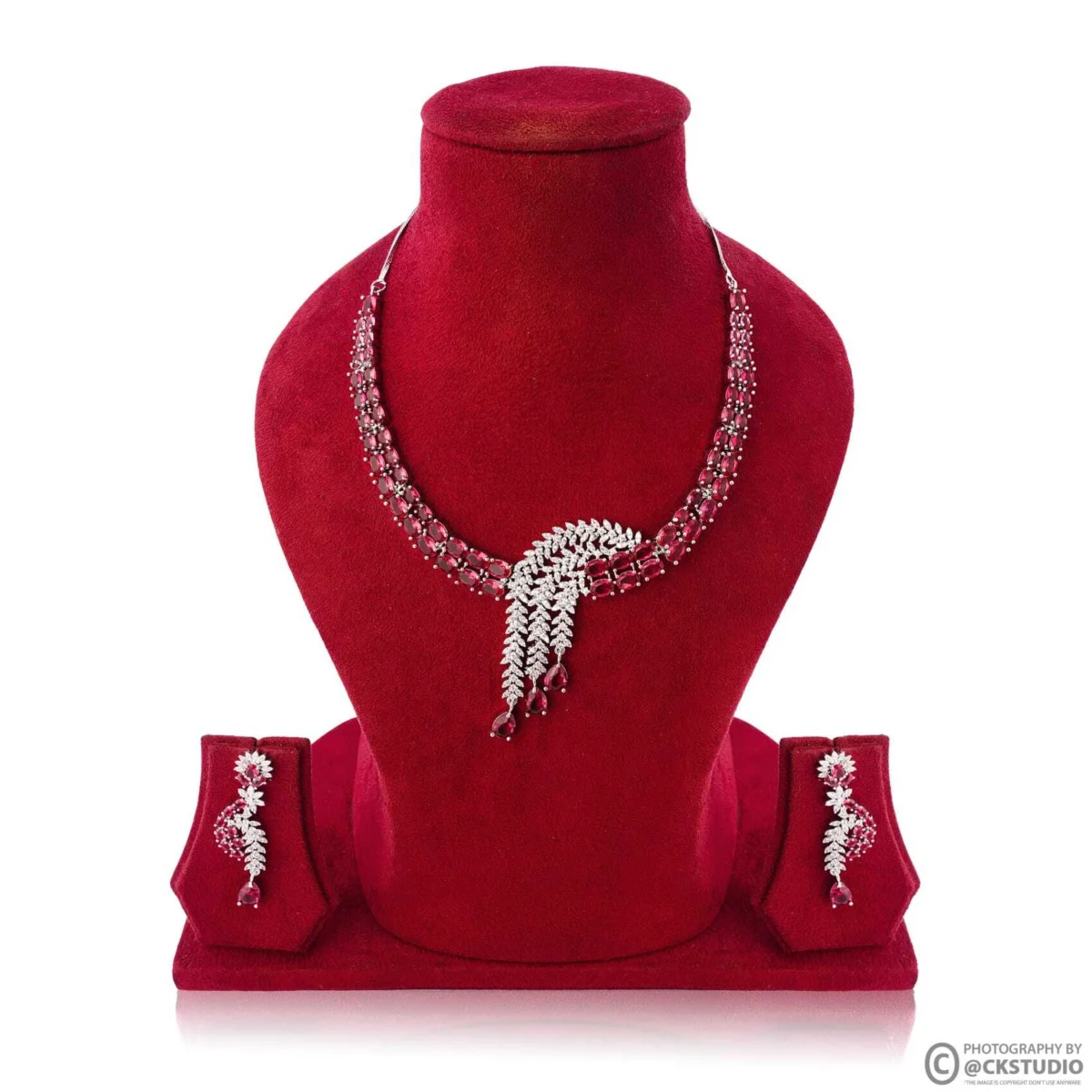
Bust colour changes how the set reads. Ivory or beige velvet keeps gold warm and suits polki and pearl sets. Deep maroon and red velvet feels bridal and makes white stones pop, but it can tint gold slightly red, so we correct that in the colour pass. Navy and black velvet give the strongest contrast for diamond-look and silver-tone sets. Whatever you choose, keep the same bust colour for an entire collection; mixing colours between listings makes a catalogue look disorganised.
Remember that many marketplaces want a pure white background for the main image. A bust on a white sweep can still meet that, as long as the background itself is clean white and the bust is treated as a display prop. Check your category style guide in Seller Central before you commit; some categories prefer the jewellery alone on white for the first image, with the bust shots in the secondary slots.
A bust cannot show a maang tikka, a passa, a nath or a haath phool in context, because it has no hair line, nose or hand. It also cannot show how heavy a set looks on a real person, which is the question most bridal buyers ask. That is why we never treat the bust as the whole story; it is the anchor shot for the necklace and earrings, and the head and hand pieces get their own flat or on-model frames.
For sellers with 50 or more SKUs, busts are the most efficient format: once the bust, lights and camera are locked, each set takes only a few minutes to swap and shoot, and every image in the catalogue matches in angle, crop and colour.
A flat lay works better when the set has many small pieces, such as tikka, nath, earrings and rings, that a bust cannot hold. Laid out flat from directly above, every piece is visible at once, which makes it the clearest “what is in the box” image.
The full-set flat lay is the image we recommend for slot 1 on most bridal listings. Shot top-down on a clean white or ivory surface, it removes all ambiguity about the contents and lets the buyer count the pieces. It also works well as a thumbnail, because the composition is compact and symmetrical.
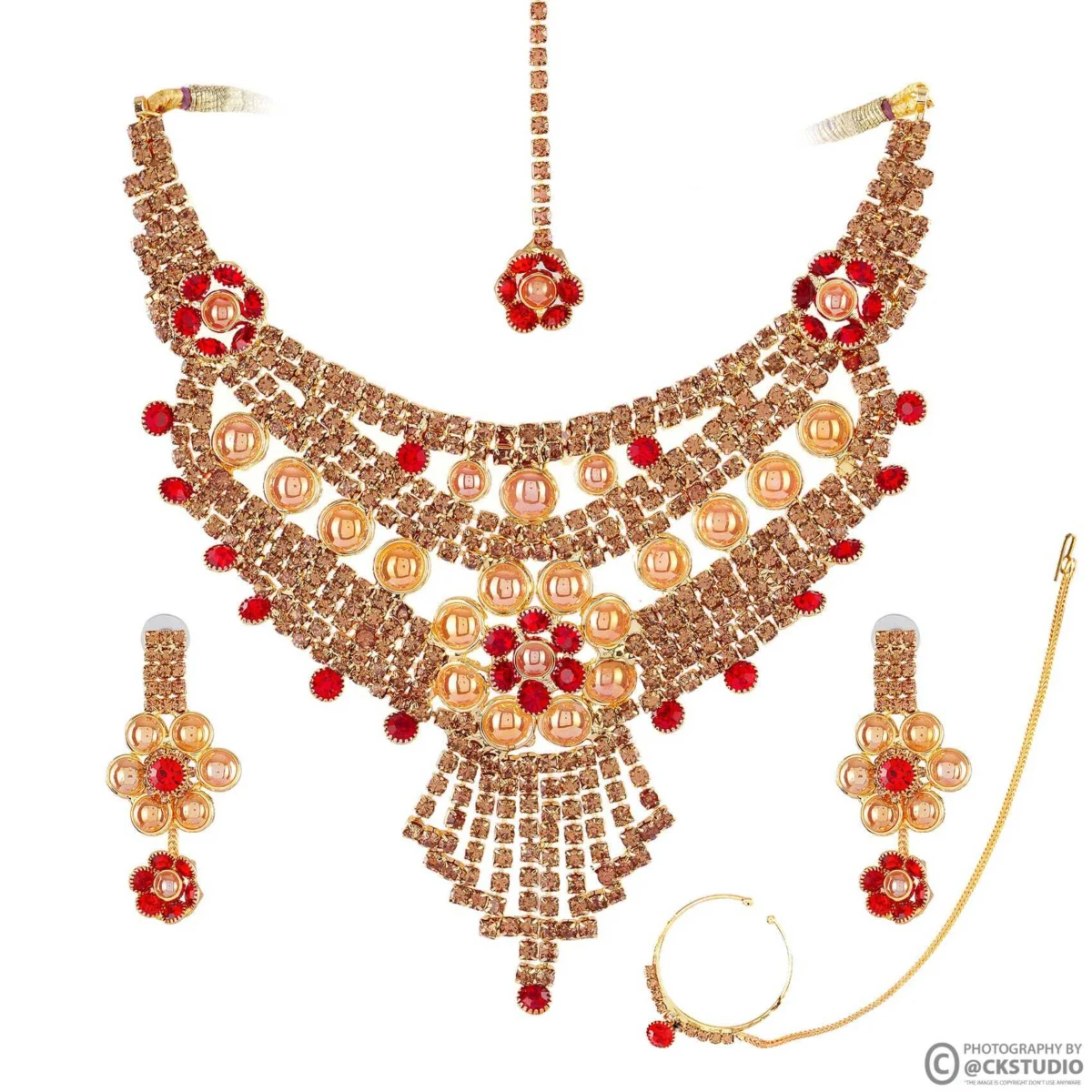
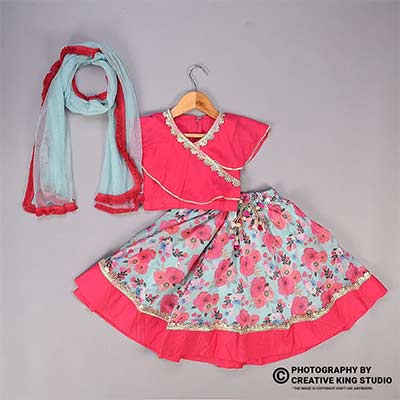
Arrangement is where flat lays succeed or fail. We place the necklace in a smooth U or V, centre the maang tikka above it, set the earrings at equal distances on either side and tuck the nath into the remaining space so it never overlaps another piece. Chains are combed straight with tweezers, and any dori threads are hidden beneath the necklace. When a set needs a styled variant, sellers who sell apparel alongside jewellery often extend the same look to their outfits; our flat lay photography team shoots lehengas and dupattas in matching layouts so the bridal story continues across categories.
From the studio floor
Our flat lays are shot from a camera on a horizontal boom arm, sensor exactly parallel to the table, using a 50mm lens at f/8 for the full set and a 100mm macro for the detail frames. The set lies on a 1.5 metre white acrylic sheet with a large diffusion panel overhead and two strip lights low on the sides at about 20 degrees to lift the stone edges. We place a colour checker in the first frame of every set, then remove it, and export at 2000 pixels on the long side in sRGB.
A flat lay flattens drape. A tiered necklace looks wider and shorter than it does when worn, and long chains can look tangled even after careful combing. Flat lays also need precise symmetry; a tikka set two degrees off centre is noticeable at thumbnail size. Use the flat lay to answer “what is in the box”, and use a bust or a model to answer “how does it fall”.
Props deserve restraint. A few marigold petals or a folded silk corner can add warmth to a secondary image, but they should never touch or hide the jewellery, and they never belong in the main image of a marketplace listing.
On-model shots are worth it when buyers need to judge scale, weight and styling, which is true for nearly every bridal set above a basic price point. One worn image showing the necklace, earrings and head piece together often does more for conversion than three extra product angles.
Bridal shoppers want to imagine the wedding day. A model wearing the full set, with hair parted for the tikka and a simple bridal neckline, answers questions no bust can: how far the earrings drop past the jaw, whether the choker sits high or low, how the passa frames the face. It is also the only honest way to show a nath and haath phool in use.
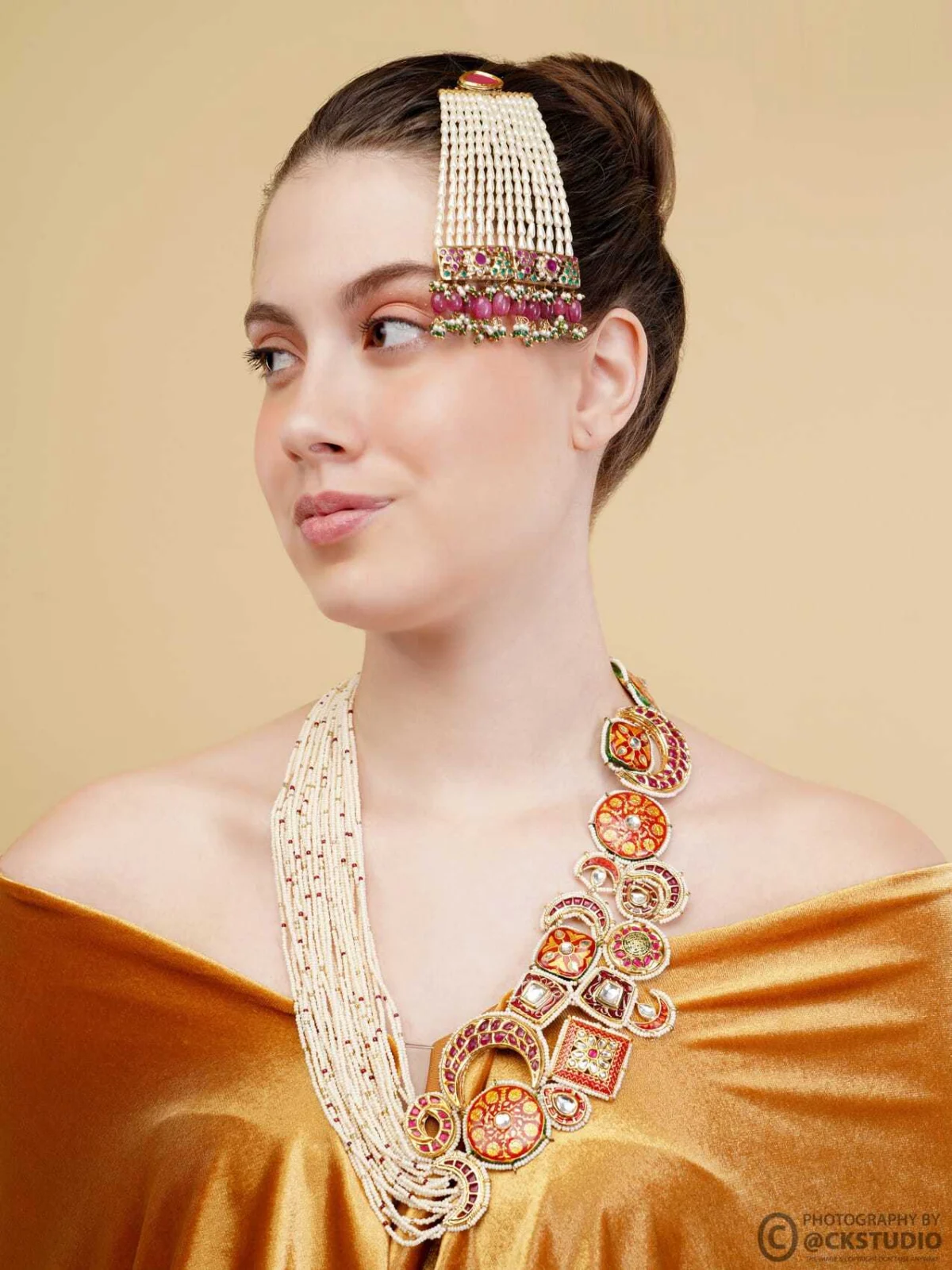
The styling has to serve the jewellery. On Ckstudio model days we keep the outfit plain, usually a solid satin or silk drape in a colour that complements the stones, and the make-up soft so the eyes do not compete with the tikka. Hair is pulled back to show the earrings fully. Crops run from just above the hairline to the collarbone for the full set, plus a tighter crop for the earrings and tikka. If you need a model team for this, our model photoshoot service handles casting, styling and the shoot itself.
Skin tones reflect warm light back onto gold, and gold reflects onto skin, so on-model frames drift warmer than bust or flat lay frames of the same set. We shoot a grey card in the model’s hand at the start of every look and match the jewellery colour to the product shots during retouching, so the buyer sees the same gold in slot 2 and slot 7.
The jewellery video below shows how a marketplace jewellery shoot runs in practice, from placing the pieces to the worn shots, and it is a good reference before you brief a model shoot.
One practical point: a model shoot is the slowest part of a bridal catalogue because each set needs hair and styling changes. Group sets by head piece type (tikka, passa, matha patti) so the hair only changes a few times per day.
Use all three for premium sets, a flat lay plus bust for mid-range sets, and a flat lay plus one worn image for budget sets. The format you drop should depend on which question your buyer asks most, not on which format is cheapest.
The decision table below compares the three formats on the criteria that matter for a bridal listing. Use it to decide where to spend your shoot budget per collection.
| Criterion | Bust display | Full set flat lay | On-model |
|---|---|---|---|
| Shows every piece at once | Partly (no tikka or nath) | Yes | Yes, if the crop allows |
| Shows drape and length | Yes | No | Yes |
| Shows real scale on a person | No | No | Yes |
| Consistency across 100 SKUs | Very high | High | Medium |
| Shoot time per set | Low | Low to medium | High |
| Best image slot | 2 and 3 | 1 | 6 to 8 |
| Best for | Chokers, rani haars, layered sets | Sets with 4 or more small pieces | Premium and wedding-edit sets |
Example scenario
Imagine a seller with a 40-set wedding collection: 10 premium polki sets, 20 mid-range kundan sets and 10 temple sets. A sensible plan is a flat lay and bust for all 40 sets, macros of the reverse for the 30 kundan and polki sets, and on-model frames only for the 10 premium polki sets plus 5 best-selling kundan sets. That keeps the model day to around 15 looks instead of 40, while every listing still answers the three key questions. These numbers are illustrative only, not a client brief.
If budget forces a choice between a bust and a model, ask what your returns data says. If buyers return sets because “it looked bigger in the photo”, invest in the model frame. If they complain that a piece was missing or different, invest in a clean flat lay and individual macros first.
Whatever mix you choose, keep it consistent within a collection. A buyer who sees a model on one set and only a bust on the next assumes the second set is lower quality, even when it is not.
Plan a fixed shot list per set, clean and prepare every piece before it reaches the table, shoot each format in batches, then retouch for colour match across the set before exporting to each marketplace’s size rules.
Marketplace rules decide the main image. Amazon’s product image requirements ask for a pure white background on the main image, the product filling most of the frame, and no text, logos or watermarks; images of at least 1000 pixels on the longest side enable zoom, which matters for intricate kundan work. For real gold bridal sets, buyers also look for proof of purity, so a macro of the hallmark and HUID stamp is worth including; the Bureau of Indian Standards administers hallmarking for gold jewellery in India.
| Requirement (Amazon main image) | What it means for a bridal set |
|---|---|
| Pure white background | Shoot on white sweep or clip the background to white |
| Product fills most of the frame | Tight crop on the full set; no empty space around a small tikka |
| No text, logos or watermarks | No “5-piece set” labels on the main image; use secondary slots |
| 1000 pixels or more on the longest side for zoom | Export at 2000 pixels so stone detail survives zoom |
Source: Amazon Seller Central India image requirements. Always recheck your category style guide before a shoot, and see our breakdown of Amazon jewellery image rules for category-specific detail.
From the studio floor
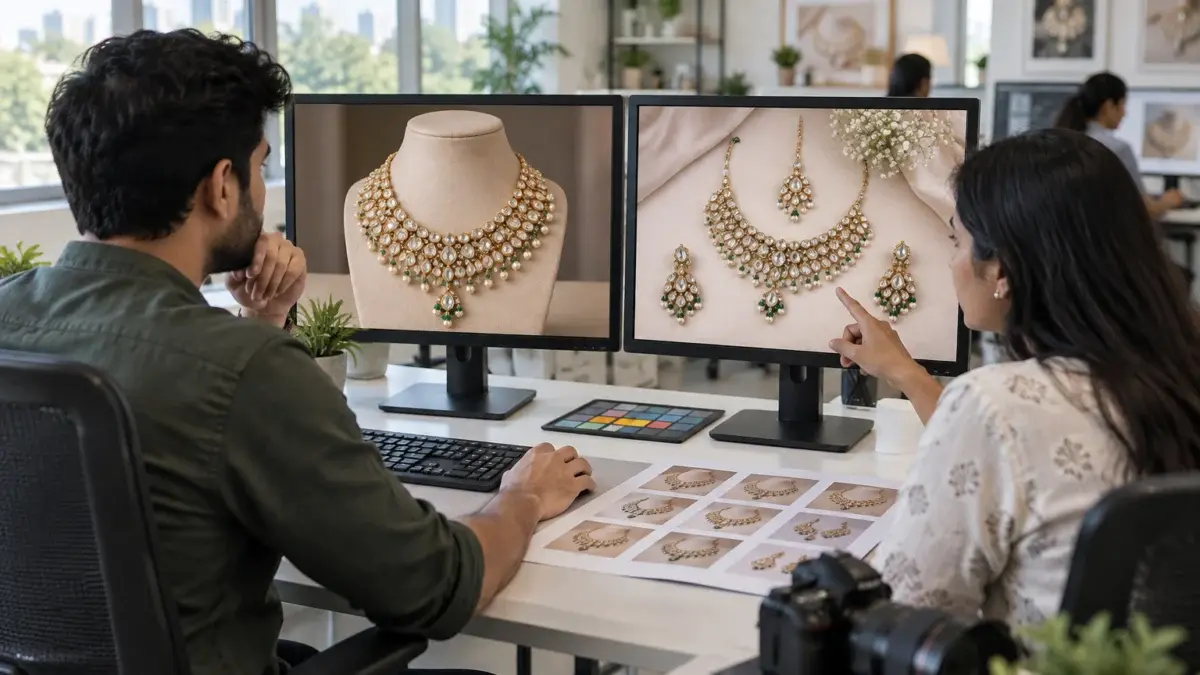
In the Ckstudio retouching room, every set gets a three-step QC. First, a side-by-side check of all frames of the set on a calibrated monitor so the gold reads the same hue in each. Second, a 100 percent zoom pass to remove dust, fingerprints and stray threads from the dori. Third, a thumbnail check at 200 pixels wide to confirm the main image still reads as a complete set on a phone. Files are exported as 2000 by 2000 pixel JPEGs in sRGB, under 2 MB each.
Need a hand with a wedding-season catalogue? Call +91-8700258773, message us on WhatsApp at +91-8700258773, or email [email protected] with your set count and we will suggest a format mix.
Pure white for the main marketplace image, then ivory, maroon or navy velvet for secondary bust shots. White keeps the listing compliant, while velvet adds contrast and a bridal feel in the gallery.
Both. Use a flat lay for the full set with tikka and earrings in slot 1, and a bust for the necklace drape in slot 2. Kundan chokers in particular look best on a bust.
Seven to eight is a strong target: full set, necklace, earrings, head piece, reverse side, clasp detail, worn look and a scale reference. Fewer than five usually leaves buyers guessing about contents or size.
Not for every SKU, but at least one worn image per collection helps buyers judge scale. Many sellers shoot models only for best-sellers and premium sets, and use flat lays and busts for the rest.
Set a custom white balance from a grey card for each set, avoid warm room light mixing with flash, and colour-match all images of a set together in retouching against a calibrated monitor.
They should not be. Uncut polki has a soft natural glow, and added sparkle makes it look like cubic zirconia. Clean dust, balance colour and lift shadows gently, nothing more.
The right format for a bridal set is rarely just one. A flat lay proves completeness, a bust proves drape, and a model proves scale, and the best listings use each where it answers the buyer’s question. Prince and the Ckstudio team plan that mix per collection before the first frame is shot, so the catalogue looks consistent from set one to set forty. To talk through your wedding collection, call +91-8700258773 or write to [email protected].
Next step: once your format mix is fixed, check the errors that quietly hurt jewellery listings in our guide to jewellery photography mistakes that cost online sales.
Ckstudio shoots kundan, polki and temple sets as flat lays, bust displays and on-model frames, colour-matched and exported to marketplace rules. Share your set count on WhatsApp at +91-8700258773 or see our jewellery shoot details.
Call Prince: +91-8700258773