Fashion Photography Services
E-commerce Photography
A conversion-focused Ckstudio framework for lingerie, bra, panty, bikini, babydoll and loungewear ecommerce catalogues — planned around fit clarity, visual trust and higher sales, with ecommerce catalogue photography starting from ₹349 per SKU.
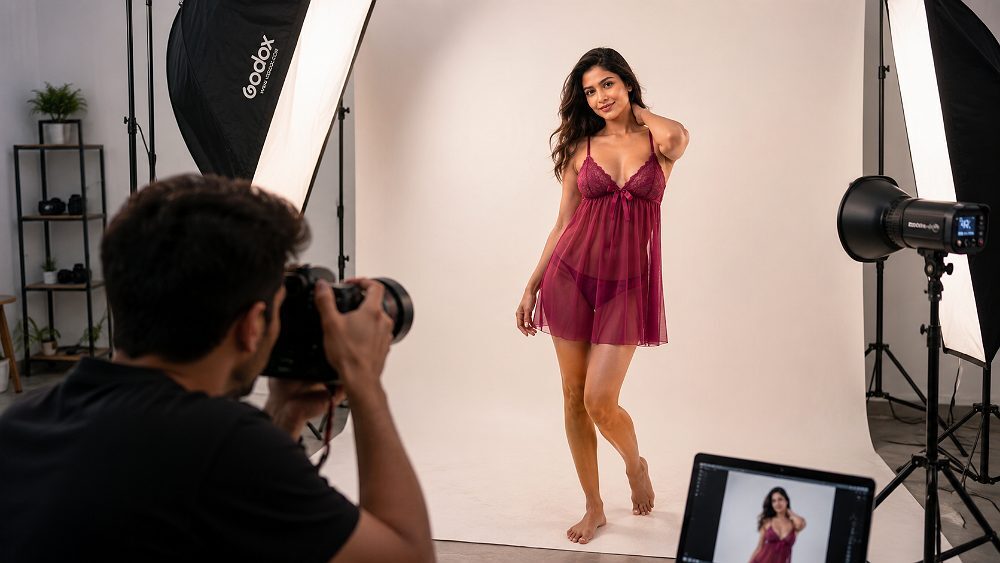
Selling intimate apparel online is a trust exercise, and lingerie product photography is where that trust is either built or lost inside the first three seconds of a product page. When a shopper cannot touch the fabric, adjust the straps or read a size tag on her own body, every buying decision has to travel through the images alone. At Ckstudio's dedicated lingerie photography services, Prince and the team shoot bras, panties, bikini sets, babydoll pieces, loungewear and shapewear the way successful D2C brands like Zivame, Clovia, Nykd by Nykaa and Amante now expect — as a controlled ecommerce workflow, not a fashion mood board.
This guide is deliberately narrow. Instead of repeating what our broader lingerie ecommerce photography complete guide already covers, we will focus on image sequencing, fit clarity, fabric proof and how each frame in a listing should quietly remove one purchase objection. If you sell on Amazon India, Myntra, Flipkart or your own Shopify store, this is the framework we use inside our ecommerce photography services to plan every lingerie catalogue shoot.
Lingerie product photography converts when it stops trying to look like a magazine editorial and starts answering the shopper's buying questions in order. Editorial imagery creates desire; lingerie product photography for ecommerce removes uncertainty. On a product page for an underwire bra or a satin babydoll, the shopper is quietly asking, "Will this fit me, look right on my body and feel like the material I'm paying for?" Every image should be planned to answer one of those questions honestly.
Global marketplaces have made this explicit. Amazon India's product image requirements demand a clean, product-focused main frame; Shopify's own guidance on product page imagery repeatedly emphasises multiple useful angles over a single hero shot. In short, the platforms already expect conversion-first images — brands that keep treating listings like campaign moodboards leak sales quietly.
Every frame we deliver from a Ckstudio lingerie ecommerce shoot is planned against four questions. First, what exactly does the product look like? This is the hero and clean views. Second, how does it fit? Front, side and back frames on a fit model or ghost mannequin. Third, what material and construction am I buying? Fabric close-ups, seam shots, elastic edge details. Fourth, can I trust the colour and quality? Consistent white balance, honest retouching and realistic body shape.
When a listing has one lovely campaign frame and seven repeats of the same angle, all four questions stay unanswered and the customer drops off. When each of those four questions is deliberately covered, add-to-cart and return-rate metrics both improve. Our deeper piece on how professional photography enhances brand perception discusses the same principle from the trust angle, and it applies double for intimate apparel.
Editorial lingerie work belongs on the campaign page, the homepage banner and the Instagram grid — that is where lookbook photography and fashion photography earn their fees. Product photography for lingerie sits on the product detail page, does a very different job and follows a completely different visual rulebook. Both are needed; conflating them is how ecommerce lingerie images silently underperform.
Prince often reminds new D2C founders during shoot planning that a strong catalogue almost always contains both: three or four hero and lifestyle frames driven by the brand story, and eight tightly controlled product-clarity frames driven by conversion logic. Our lookbook photography playbook for fashion brands covers the desire side; this guide is the trust side of the same coin.
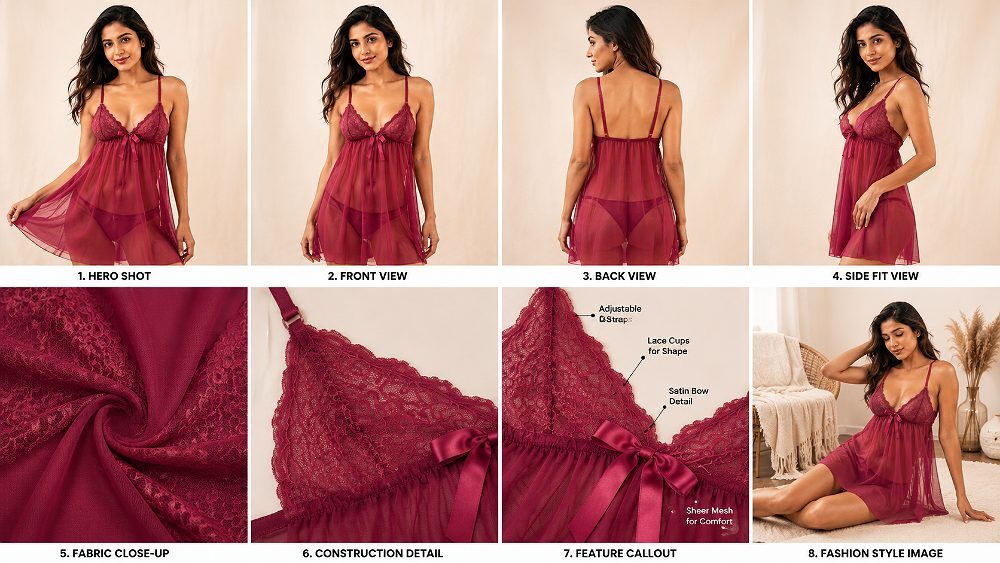
This is the core framework we plan every lingerie ecommerce shoot around. Instead of asking "how many photos do we need?", plan the eight jobs each image needs to do. When each of the eight jobs is covered, an average lingerie listing on Amazon, Myntra or Shopify feels dramatically more complete — because it actually is.
The hero frame is your listing's single most valuable pixel real estate. For a bra, it means clean front-on composition, both cups visible, straps symmetrical, product colour honest and background distraction near zero. For a bikini or panty set, hero the piece the customer would search for by name — the bra usually leads a set. This is where marketplace compliance also enters: Amazon India and Flipkart both prefer pure white or near-white backgrounds for the primary image, while brand D2C pages have more freedom.
Front and back frames prove the product exists as more than a decorative front panel. Back views matter especially for bras (racerback vs standard, hook count, band width), for babydoll pieces (tie closure, mesh back panel) and for bikini bottoms (coverage, tie style). This is also where ghost mannequin photography shines — the invisible mannequin gives customers a full 3D read on the garment without the distraction of a model.
Side and three-quarter angles do the heavy lifting on fit. For a bra, the side profile shows band position, wing height, cup projection and how the underwire actually sits. For shapewear or bodysuits, the side view proves the compression and coverage. For a babydoll or nightdress, the side confirms drape and length. Zivame and Amante both rely heavily on side-angle model frames to build fit confidence, and it is one of the highest-ROI additions to any lingerie ecommerce listing.
Detail frames are where trust is either quietly built or quietly lost. Hooks, adjuster sliders, elastic edges, underwire casing, gusset fabric, seam finish, strap junctions — these are the tactile checks a shopper would make in a physical store. Good lingerie product photography brings a well-lit macro of at least two of them into the listing. This is often the frame that separates a premium brand from a marketplace generic.
Lace, mesh, satin, cotton modal and stretch nylon all photograph differently, and each demands its own light treatment. A close-up on the lace pattern of a bralette, the sheen on a satin panty or the weave of a cotton brief communicates material honestly. Prince plans these frames on almost every catalogue shoot, because customers now zoom on mobile listings — pixelated fabric closes a purchase faster than a bad price.
Some product properties are invisible in a hero shot — removable pads, adjustable straps, seamless finish, wire-free construction, high back support, non-slip silicone strips. A single frame with a subtle callout, or a small feature grid, converts a feature list into a scannable visual. Our Amazon product infographic design service covers this format in depth.
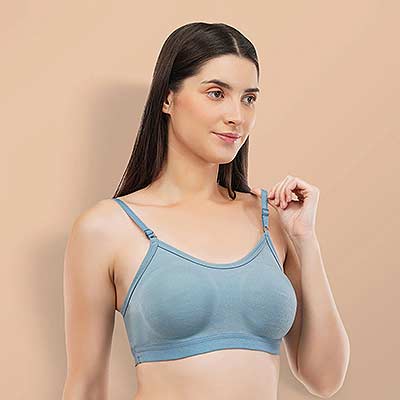
The model frame answers the emotional question the product frames cannot: "What does this look like on a real person?" For a Myntra or Nykd by Nykaa-style D2C listing, an honest on-model frame — natural fit, minimal retouching, realistic body — outperforms a heavily edited shot every time. Our detailed complete lingerie ecommerce photography guide covers model briefing in more depth.
The last frame ties the SKU into its family. A colour variant strip, a size chart image or a coordinating set shot (matching robe, matching brief, matching stockings) gives the customer confidence that she is picking the right variant. This is often the final push that closes an intimate-apparel purchase — she can see the whole family and does not feel she is guessing.
Every lingerie brand faces the same trade-off during shoot planning: budget, speed and product clarity all pull in different directions. Choosing the right method per product — sometimes per SKU — is one of the most cost-effective decisions in your catalogue. Here is how the four main methods compare for intimate apparel.
Flat lay is the workhorse for basic briefs, panty sets, sleepwear, bralettes and secondary marketplace angles. It is fast to shoot, cheap to produce and gives the shopper a clean bird's-eye read on the garment. Our flat lay photography service is where most Meesho and small-catalogue Amazon sellers start, because it produces a full catalogue at the lowest per-SKU cost.
The limit is fit. Flat lay cannot communicate how a garment sits on a body — cup projection, band tension, panty rise — so it works best in combination with a mannequin or model frame rather than as the only method for a lingerie listing.
Ghost mannequin is the sweet spot for structured bras, shapewear, bodysuits, camisoles and support wear. The invisible mannequin gives shape and silhouette without a person, which suits brands whose customers want a clean product view. Nykd by Nykaa, Enamor and Jockey Women use this style heavily on their marketplace listings for exactly that reason.
Ghost mannequin photography also compresses production cost per SKU compared with model shoots, while still selling the shape convincingly. It is also easier to keep colour and crop consistent across an entire catalogue, which matters when you have 200 or 500 SKUs.
Model frames are the strongest fit-communication tool available. For a premium D2C launch, a Myntra Fashion listing or a boudoir-adjacent brand, on-model imagery is essentially non-negotiable. Prince works with vetted fit models who understand how to pose bras, panties, babydoll and loungewear in a way that shows structure without turning the frame into a fashion shoot.
This method costs more — model fees, styling, longer hours — but it is what shoppers actually respond to on premium listings from Amante, Victoria's Secret India, Sinderella and comparable brands. Our detailed piece on preparing garments for an ecommerce model photoshoot covers what to send before shoot day.
Lifestyle frames — bedroom light, natural window backdrop, honest posture — are premium D2C territory. They belong on the homepage, on campaign landing pages and on Instagram, and they support the product frames rather than replace them. Our broader lifestyle product photography service handles this alongside the ecommerce work.
| Method | Best For | Fit Clarity | Detail | Relative Cost | Recommended Use |
|---|---|---|---|---|---|
| Flat Lay | Basic panties, sets, sleepwear, Meesho catalogues | Low | Medium | Low | Volume catalogues, secondary angles |
| Ghost Mannequin | Bras, shapewear, bodysuits, camisoles | Medium-High | High | Medium | Amazon & marketplace primary + D2C |
| On-Model | Premium D2C, Myntra fashion listings, boudoir | Very High | Medium | High | Fit-critical bras, babydoll, campaign SKUs |
| Lifestyle | Homepage, campaigns, social advertising | Low (mood-led) | Low | Highest | Brand storytelling, banners, ads |
Fabric is what customers are actually paying for in lingerie, so the lighting rig has to protect fabric texture above everything else. A blown-out highlight on satin, a crushed shadow on lace or a colour cast on a nude bra will lose more sales than a mediocre model choice ever will.
At our studio in Delhi NCR, Prince runs most lingerie product photography setups on a soft, diffused main light — usually a large 150cm octabox at 45 degrees — with a controlled fill to preserve depth. Lace demands a slightly harder rim light to bring out the pattern; satin needs a large soft source to control highlight roll-off; mesh needs a directional back light so the transparency reads without becoming muddy. Nude, ivory and blush colours are the hardest to keep neutral, and require a calibrated grey card at the start of every SKU.
Half the retouching bill on a lingerie catalogue comes from garments that arrived unprepared. Steam every piece, check strap symmetry, adjust cup padding evenly, snip loose threads and remove any lint from dark fabrics. For mannequin work, pin the back invisibly so the front reads clean. Our guide on preparing garments for an ecommerce model photoshoot gives a full pre-shoot checklist you can share with your production team.
The fit model must actually be in the correct size — nothing kills a lingerie listing faster than a size 32C being worn as a 34B for the sake of visual flattery. Strap length, band position and cup centre have to reflect real product shape. This is where an experienced ecommerce studio matters more than a fashion team: our job is to show the product honestly, not to sculpt the body.
The photograph should look better than the shopper expects — the product itself should look exactly as it will arrive in the box.
— Prince, Ckstudio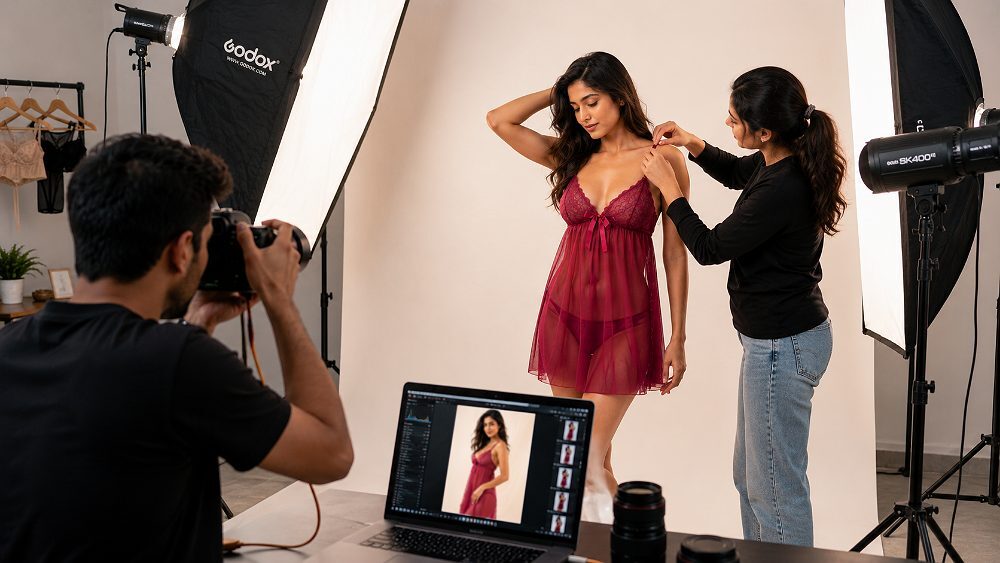
A predictable production workflow is what separates a studio that can deliver 30 SKUs in a week from one that quietly drops quality after SKU 40. Every Ckstudio lingerie ecommerce shoot follows the same three-step spine, and it is what allows us to run catalogue photography consistently at scale.
Every SKU is mapped: colour, size, required angles, model or mannequin, marketplace destinations, aspect ratios and file naming. This is the document that survives shoot day.
Camera tethered to a calibrated monitor, real-time review by the stylist and creative lead. Crop, exposure, colour and angle are locked before the next SKU touches the set.
Retouching, colour QC against reference, marketplace-safe crops, D2C-friendly wider crops, file naming for Shopify or the seller portal, then delivery.
The first step is the one most brands underinvest in. A properly built shot list — including notes on which SKUs need a ghost mannequin front, which need a model side view and which need a fabric close-up — is what makes a lingerie catalogue shoot repeatable across seasons. It is also what makes it possible to hand the catalogue to a growth marketing team without endless back-and-forth on missing images.
Tethered shooting is the second discipline that pays for itself. On a lingerie shoot you cannot afford to discover a stray thread, a rolled elastic edge or an off-centre cup two hours later on the desktop. Reviewing every frame on a big monitor, in real time, is how we protect the shot list from silent decay across the day.
Retouching lingerie product photos is where a lot of otherwise good shoots fall apart. The temptation to smooth skin aggressively, sculpt the body, boost saturation and "fix" the garment coverage is very real — and it is exactly how ecommerce lingerie images start to look untrustworthy, which drives up returns.
The rule we follow at Ckstudio is simple: retouch the photograph, never the product. That means we will remove dust, background dust bunnies, minor fabric wrinkles that would fall out in wear, stray hair, sensor spots and small styling distractions. We will not change the cup shape, the underband tension, the coverage of a panty, the drape of a babydoll, the model's body silhouette or the actual colour of the garment. Fabric texture on lace, mesh and satin is preserved rather than blurred.
Colour accuracy is the other retouching commitment. Every SKU is corrected against the physical sample under studio lighting; blush, nude, ivory and bright red — the four hardest colours in lingerie — get an extra QC pass before export. Our broader image editing services team handles the retouching queue so shoot days never bottleneck.
For an even wider view on the retouching vs reality trade-off in ecommerce, our piece on real photography vs AI-generated product images covers why authenticity is now a ranking signal customers respond to.
Good ecommerce retouching should make the photograph cleaner — not make the product different.
— Prince, CkstudioThe same eight product frames do not export the same way for every channel. Marketplaces have compliance rules; D2C websites reward brand storytelling. Planning both destinations up front — before shoot day — saves a full re-shoot later.
On Amazon India, Myntra, Flipkart, Meesho and Ajio, the hero image typically has to sit on a clean or near-white background, the product must fill most of the frame and secondary images can add fit, detail and lifestyle context. Each platform's official documentation is the source of truth — we always cross-check current specs at shoot planning, because platform requirements shift quietly. Our standards guide for Amazon, Flipkart, Myntra and Shopify keeps the latest per-platform notes in one place.
The Amazon lingerie listing tends to be the strictest — hero must show the product almost edge-to-edge on white, with model imagery in secondary slots. Myntra and Ajio give more freedom for on-model hero frames, which is why fashion-forward intimates brands often prefer them for premium launches.
Your own Shopify or WooCommerce store is where the brand can breathe. Hero frames can be moodier, model imagery can lead, cross-sell blocks can use lifestyle photography and the product page can include feature graphics, videos and lookbook links. We frequently pair a Shopify catalogue shoot with UGC video creation for ecommerce so the product page has both trust images and social-proof video in one delivery.
| Requirement | Marketplace Listing | D2C Website | Recommendation |
|---|---|---|---|
| Hero Image | Clean / near-white background, product edge-to-edge | Brand-led, moody backdrop allowed | Shoot both from same setup |
| Model Images | Secondary slots | Often lead the story | Plan crops for both destinations |
| Detail Shots | Required for trust | Zoomable galleries | Deliver square + wide crops |
| Feature Graphics | Amazon A+ / infographic slot | Product page modules | Reuse across both channels |
| Lifestyle | Limited | Homepage / campaign | Shoot alongside catalogue |
| Mobile Cropping | Portrait-safe | Portrait-safe | Plan 4:5 & 3:4 exports |
Across nine years of shooting bras, panties, bikini pieces, babydoll sets, loungewear and shapewear for D2C and marketplace brands, the same seven mistakes keep showing up on underperforming listings. Each one is completely fixable in the next shoot.
Fixing these seven is often a smaller project than founders expect — usually one focused re-shoot day for the top 20-30 SKUs, plus a retouching pass for the rest.
Lingerie product photography cost in India varies with SKU count, number of angles per product, choice of flat lay, ghost mannequin or model, styling requirements, retouching complexity and turnaround. For standard ecommerce catalogue work, a practical planning range is ₹349–₹749 per SKU, depending on the photography method and image count; premium lifestyle sets, specialist models, video and campaign production are quoted separately. For a full pricing breakdown, our dedicated product photography pricing guide for 2026 is the more detailed resource; the table below is a planning shorthand.
| Plan | Best For | Indicative Scope | Recommended Photography | Starting Rate |
|---|---|---|---|---|
| Starter Flat Lay | New sellers & basic catalogues | 20+ SKUs · up to 3 images per SKU | Clean flat lay + basic retouching + marketplace-ready exports | ₹349 / SKU |
| Marketplace Ghost | Amazon, Flipkart & Meesho catalogues | 20+ SKUs · up to 3 images per SKU | Ghost mannequin + front/back/detail coverage + standard retouching | ₹449 / SKU |
| D2C Detail | Growing Shopify & D2C brands | 20+ SKUs · up to 4 images per SKU | Ghost mannequin + fabric/detail frames + advanced catalogue retouching | ₹599 / SKU |
| Model Catalogue | Fit-critical bras, sets & Myntra-style listings | 20+ SKUs · up to 4 images per SKU | On-model catalogue photography + product/detail mix + standard retouching | ₹749 / SKU |
These rates are indicative starting prices for planned ecommerce catalogue batches and assume standard studio styling, clean or white-background setups, normal turnaround and the image counts shown above. Complex lace compositing, specialist models, premium styling, props, rush delivery, video and campaign usage are quoted separately. Reach out to Ckstudio at [email protected] with your SKU list and target marketplaces — we send a per-SKU quote rather than a rounded package.
Before any lingerie catalogue goes live on Amazon, Myntra, Flipkart or Shopify, we run every listing through the same checklist. Print it, share it with your production team, and use it as a QC filter on every SKU.
Related resources: our ecommerce image optimisation guide covers file naming, compression and CDN handling once the shots are approved, and the ecommerce photography workflow piece shows how this checklist plugs into an ongoing catalogue programme.
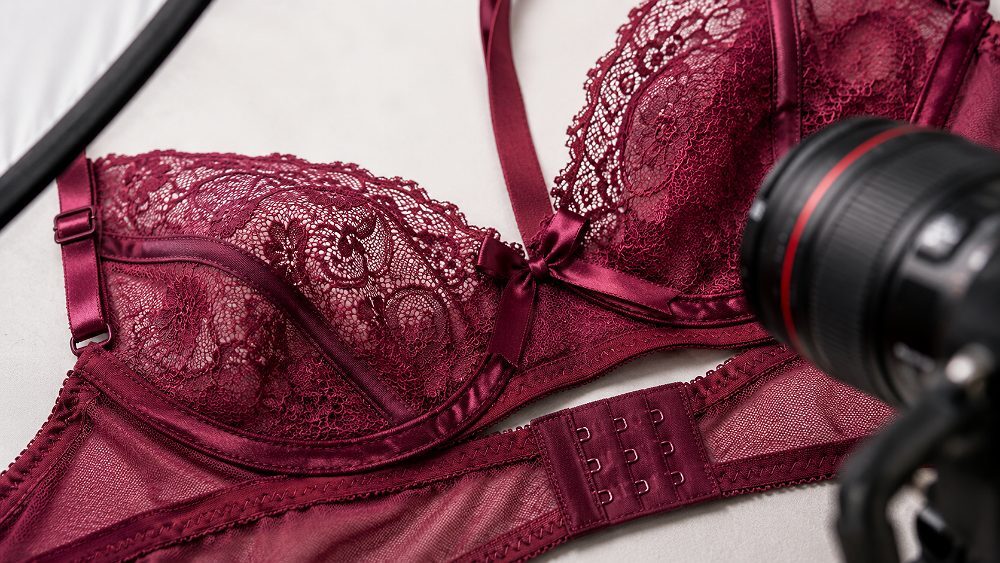
Professional lingerie product photography matters for the same reason a professional fit consultation matters in a physical store — intimate apparel sits closer to the customer than any other garment category, and every image has to earn her trust before her card is even considered. Repeatable catalogue standards, correct fit direction, colour accuracy, fabric-first lighting, honest retouching and consistent marketplace exports are all disciplines built on years of shoot-day repetition.
At Ckstudio, Prince and the team have run this workflow for D2C intimates founders, marketplace sellers on Amazon, Myntra and Flipkart, and undergarment manufacturers moving from wholesale into their own online storefront. If you are planning a lingerie ecommerce shoot in the next 30 days, the fastest way to a quote is a message on WhatsApp — send SKU count, categories and target marketplaces to +91-8700258773 on WhatsApp and Prince will send back an SKU-level plan.
For deeper reading, our professional lingerie photography services page covers scope, styles and previous work, and our full complete lingerie ecommerce photography guide is the pillar resource that sits above this article.
Five questions we hear on almost every intake call from D2C intimates founders and marketplace sellers. If you have a follow-up we have not covered here, drop us a message at [email protected] and we will fold it into the next update of this guide.
Lingerie product photography is specialised ecommerce photography used to clearly show intimate apparel like bras, panties, bikini sets, babydoll pieces and loungewear. Good lingerie product photography communicates fit, shape, fabric, construction, colour and detail through hero images, front and back views, close-ups and on-model or ghost mannequin shots.
A well-optimised lingerie ecommerce listing usually needs six to eight images: a hero image, front and back views, a side or fit image, a fabric close-up, a construction detail shot, a feature or benefit image and a model or lifestyle frame. Useful image variety matters more than repeating similar angles across the listing.
Ghost mannequin lingerie photography is excellent for clean bra, bralette and shapewear presentation, while model photography communicates fit, proportion and drape on real bodies. Strong D2C catalogues from brands like Zivame, Clovia, Nykd by Nykaa and Amante often combine both, depending on product type and marketplace.
Retouching for lingerie product photography should remove dust, background flaws and minor distractions while preserving accurate product colour, fabric texture, lace detail and realistic body or garment shape. Never change coverage, silhouette, cup shape or the colour a customer will actually receive in the box.
Lingerie product photography at Ckstudio starts from ₹349 per SKU for planned flat-lay ecommerce catalogue batches. Ghost mannequin plans start from ₹449 per SKU, detail-led D2C catalogue work from ₹599 per SKU, and on-model catalogue photography from ₹749 per SKU. Final pricing depends on SKU volume, images per product, garment complexity, styling, retouching and turnaround.