Fashion Photography Services
E-commerce Photography
A category-wise expert guide from an Indian standard ecommerce photography studio — built for D2C intimate wear brands, marketplace sellers and lingerie catalogue managers.
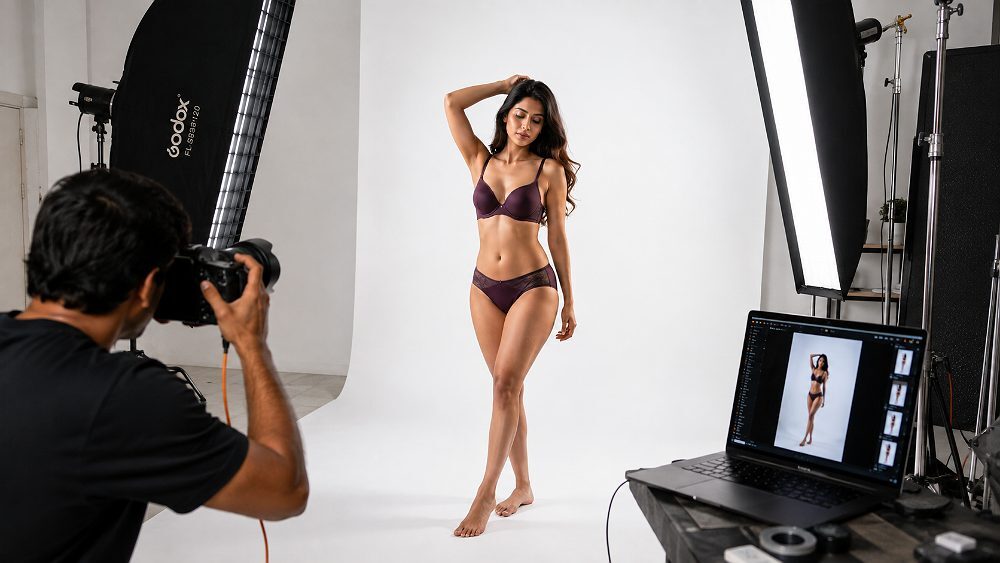
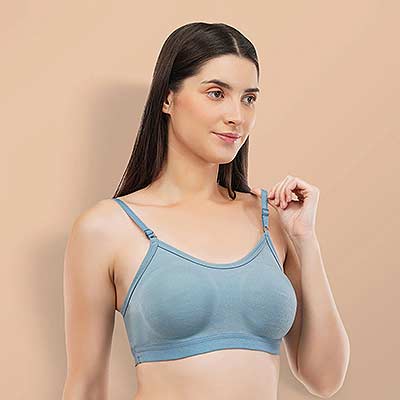
Building a lingerie catalogue for ecommerce is not the same problem as shooting a t-shirt or a saree. Lingerie photography services exist as a separate specialism because bras, panties, bralettes, shapewear and loungewear carry three variables that regular apparel does not: structural fit, sheer or lace fabric behaviour, and platform policy sensitivity around intimate wear. At Ckstudio, an Indian standard ecommerce photography studio, our team led by Prince has shot lingerie catalogues for D2C labels and marketplace sellers competing with brands like Clovia, Zivame, Nykd by Nykaa, Enamor, Amante and Shyaway. This pillar guide walks you through the exact 12-step production workflow, the 3-Layer Lingerie Imaging System, marketplace image specifications for Amazon, Myntra, Flipkart and Nykaa Fashion, and transparent per-image pricing in INR.
Regular apparel photography treats a garment as a flat surface — pattern, fit, silhouette. Intimate wear refuses that shortcut. A bra sells on cup shape, band tension and gore alignment; a panty sells on rise, cut and elastic finish; a bralette or babydoll sells on the way lace and mesh behave under light. Generic apparel advice — “use soft light, shoot flat, keep the background clean” — produces innerwear images that get rejected at marketplace QC or worse, ship at high return rates because online colour and delivered colour do not match. Lingerie photography services exist because those three failure modes need a dedicated production workflow, not a generic one. At an Indian standard ecommerce photography studio, we treat each intimate wear SKU as a small engineering problem before it becomes a photograph.
The stakes are higher than most sellers realise. Apparel return rates in Indian ecommerce sit uncomfortably close to 25–40%, and for innerwear categories fit and colour mismatch are the leading return drivers. A listing that shows fit accurately — and photographs its true colour under calibrated light — reduces returns, protects your account health on Amazon and Myntra, and cuts the reverse-logistics cost that quietly eats margin. Our team learned this the hard way across 500-plus SKU shoots for brands sitting alongside Zivame, Enamor and Sinderella on marketplace shelves. For a wider view of how apparel category imagery differs, our clothing product photography brand guide is a useful companion read alongside this pillar.
A bra is a piece of engineering. The underwire traces the ribcage, the moulded cup holds its shape without a body inside it, the band supplies 80% of the support, and the gore sits flat against the sternum. Photograph any of those wrong and the customer sees a limp, misshapen product that does not resemble what will arrive in the box. On flat lay, cups collapse and straps twist. On a bad mannequin, the wire buckles and the gore floats. This is why ghost mannequin photography exists as a technique — you build the shape on set with cup inserts and pinned straps, then remove the support in post so the bra appears to hold itself. Panties, boxers and shapewear have the same problem in a milder form: waistbands roll, gussets bunch, and unless the piece is prepped and pinned, the image lies about the fit.
Lace, mesh, satin and modal each punish a generic lighting setup. Lace collapses to a grey smear unless separated with a rim or backlight that pushes light through the trim from behind. Mesh introduces moiré patterns with the camera sensor at the wrong angle and produces muddy black wherever it doubles over itself. Satin refuses to sit flat and needs an oversized soft source to control specular highlights across the sheen. Cotton and modal, the workhorses of loungewear and everyday innerwear, look cheap under harsh light because texture disappears. We publish fabric-specific lighting recipes in our internal shot book and cover them properly in the lingerie ecommerce photography complete guide, but the short version is: lingerie lighting is a subtractive problem, not an additive one. You shape shadow to reveal texture, not flood the product with light.
Intimate wear is the only ecommerce category where the shoot floor itself needs a protocol. Model releases must specifically cover intimate apparel usage. NDAs protect samples that are still in pre-launch. The set runs closed — no wandering visitors, no unnecessary crew, a female stylist and hair-and-makeup lead where the range demands it. Ckstudio maintains a written consent-and-privacy protocol for every lingerie model photography booking, and we do not release behind-the-scenes footage without countersigned approval from both the model and the brand. For brands moving from an offline stockist model to their own D2C site — competing against Clovia, Nykd by Nykaa or Amante — this protocol is the difference between a shoot that goes public safely and one that becomes a legal problem. Prince and his team treat discretion as production infrastructure, not an afterthought.
Most competing guides teach lingerie photography as a single deliverable — “the product shot.” That framing is why listings underperform. At Ckstudio we run the 3-Layer Lingerie Imaging System: every intimate wear SKU is broken into three mandatory image layers that each answer a different customer question. Layer 1 proves the product exists in the shape and structure the listing claims. Layer 2 proves the quality, justifying the price. Layer 3 creates desire and gives the ad-creative team something to work with. The minimum viable set for a bra SKU is 4 Structure + 2 Texture + 1 Context = 7 images. For a panty or boxer 3-pack, 3 Structure + 1 Texture + 1 Context = 5 images. Layers 1 and 2 are highly batchable across a large SKU sheet, which is what makes bulk lingerie catalogue photography commercially viable.
Structure is the hero image on any marketplace listing. It is a ghost mannequin photograph — bra or bralette on a torso form, cups filled, straps pinned, band tension set, then composited in post so the mannequin disappears and the garment hangs correctly on invisible support. Front, back, 45° and a strap-detail crop cover the shape story. For panties, shapewear and loungewear, Structure often means flat lay on a pure white sweep with the elastic tension corrected. Our ghost mannequin photography team specialises in soft-cup and bralette work, which is genuinely difficult because there is no wire to hold the shape — the cup has to be built with inserts before the shutter fires. Sellers competing with Jockey Women, Enamor and Zivame live and die on Layer 1 execution.
Texture is where price is defended. A macro shot of lace trim, hook-and-eye closure, elastic finish, underwire tape or stitching answers the silent customer question: is this cheap or is it worth the money? Shot with a 100mm macro lens at f/8 to f/11, with a large soft source raked across the fabric to reveal weave and thread. Focus stacking is used where the depth of field is not enough to keep the whole detail sharp. Ckstudio’s macro pass is a specific station on the shoot floor, not something photographers eyeball between wide shots — it runs with its own lighting card and its own colour reference. Our ecommerce photography services team estimates Layer 2 lifts perceived value materially on premium D2C listings, particularly for babydolls, chemises and lace bralettes.
Context is where desire lives. This is the lingerie model photography or lifestyle image — on a real body, in a real environment, styled to signal how the brand wants to be understood. Context is the layer that creates Instagram ads, Nykaa Fashion brand-store banners, Myntra hero panels and PDP top-of-page campaign imagery. It is also the most expensive layer per SKU, which is why we recommend limiting Layer 3 to the top 10–15% of hero SKUs unless the brand is a premium label competing directly with Victoria’s Secret India. Our lookbook photography for fashion brands workflow gives a good sense of how Context shots translate into ad creative and social-first campaigns.
Studio setup for bra panty photography and undergarment photography is where most in-house attempts go wrong. The camera body barely matters above 24 megapixels — what matters is lens choice, the size and shaping of the key light, colour management discipline, and whether the shoot is running tethered so an art director can approve colour in real time. At an Indian standard ecommerce photography studio, we treat lighting hardware as consumables and colour tools as the actual expense that cannot be compromised. Our full product photography services setup includes redundant capture, calibrated monitors and a physical sample review station beside the workstation.
Two camera bodies run the floor — a full-frame mirrorless for hero and Structure work, and a second body dedicated to the macro Texture station. Lens allocation matters more than most sellers expect. A 100mm macro handles Layer 2 detail with edge-to-edge sharpness; an 85mm covers Layer 1 Structure without perspective distortion on cups; a 50mm handles Layer 3 lifestyle. Aperture sits between f/8 and f/11 for depth of field across textured lace, ISO stays at 100 to protect fabric detail, and shutter locks at 1/125 or the strobe sync speed. Every session runs tethered into Capture One for colour QC — that single decision cuts reshoot rates on high-SKU jobs more than any other change.
Lingerie lighting is fabric-first, not garment-first. The same push-up bra shot in satin, lace and cotton needs three different setups because each fabric interacts with light differently. Our baseline rig is two softboxes as the key, a strip light as rim for separation, and a white V-flat as fill — but that baseline gets modified per fabric. The point is not the specific brand of light; it is that a repeatable recipe exists before the sample arrives on set. Sellers who try to use one lighting setup for a whole intimate wear catalogue end up with a mix of good satin frames and grey lace frames, and the inconsistency shows immediately across a listing gallery.
Lace trim and sheer mesh panels demand a backlight that pushes light through the fabric from behind. Without that separation, the pattern collapses into a grey smear against the white sweep and the customer cannot see what they are buying. A strip softbox at 45° behind the product, feathered so it does not spill into the lens, is the standard fix. Front fill stays deliberately low to protect the backlit texture.
Satin and silk want the largest possible soft source so the specular highlight becomes a controlled gradient rather than a hot patch. A 150cm octabox close to the product, angled to graze the surface, produces the classic satin falloff. Anything smaller creates hotspots that read as cheap synthetic fabric — the exact opposite of what a premium babydoll or chemise SKU needs.
Cotton and modal — the fabric backbone of everyday innerwear photography services — need flat, even light that preserves weave texture without over-brightening. A two-softbox setup with a 1:1 key-to-fill ratio, a mild rim for edge separation, and no aggressive shadow shaping. The trick is keeping the fabric looking soft rather than plasticky.
Ghost mannequin work is only as good as the rig underneath it. We use flexible torso forms with adjustable cup inserts, invisible fishing line to hold straps at correct tension, and a separate back-and-neck plate for compositing the interior of the garment in post. For soft-cup bralettes and babydolls, cup stuffing is built up with tissue and archival foam to hold the shape without stretching the fabric. All of this is corrected out in post using a clean clipping path and a background composite so the final image reads as the garment floating on pure white. Sellers listing on Amazon and Flipkart against Amante and Sinderella use this technique because it is the only way to show fit accurately without paying for a model on every SKU.
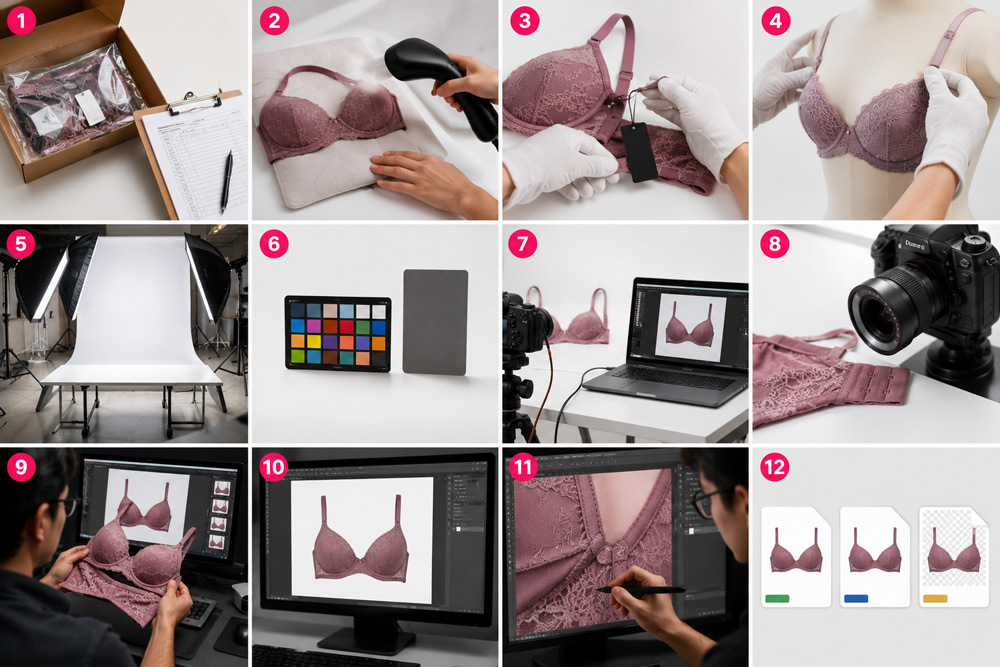
Below is the exact 12-step production workflow Ckstudio runs on every intimate wear catalogue shoot, from sample intake to marketplace-ready export. This is not a theoretical framework — it is what our team executes on the floor, in this order, on shoots ranging from a 40-SKU boutique bralette range to a 500-SKU shapewear catalogue. The workflow makes lingerie photography services predictable in cost and turnaround, which is the single most requested outcome from every D2C founder who briefs us.
Average shoot time per SKU at Ckstudio sits at 8–14 minutes for Layers 1 and 2 combined once the workflow is warm and the shot list is locked. This is what makes bulk lingerie photography for ecommerce sellers commercially viable at published rates.
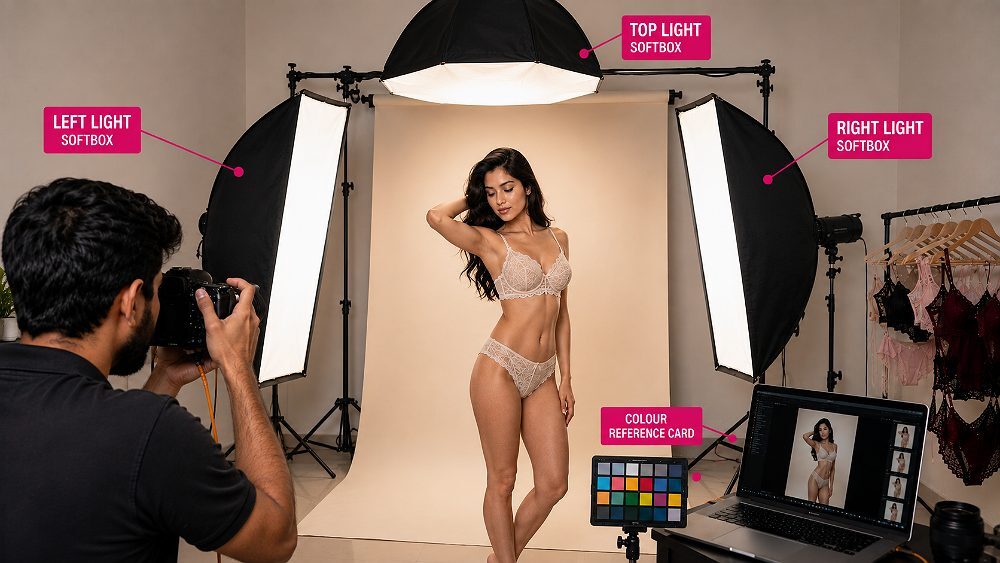
Colour is the single biggest gap between what customers expect and what arrives in the parcel — and for intimate wear, it is the leading driver of returns after fit. Nude is not one colour; an Indian intimate wear catalogue typically carries four to eight nude and skin-tone variants, from fair to deep tan. Blush, powder pink, dusty rose and champagne all drift into each other on an uncalibrated screen. Black lace loses shadow detail the moment exposure is pushed for the white background. And every one of those failures traces back to a mixed light temperature on set, a missing grey card, or a phone-screen colour approval. Ckstudio treats colour as the primary technical deliverable of every intimate wear shoot — not a nice-to-have.
An X-Rite ColorChecker frame at the start of every fabric batch, custom white balance set from a physical grey card, and a hardware-calibrated monitor at the review station — that trio solves 90% of nude-shade drift. The remaining 10% comes from monitoring the sample under the same colour temperature the customer will experience it at home, which is why we keep a mixed 5000K–5600K review lamp beside the QC station. For intimate apparel product photography, the discipline is: photograph, then match against the physical sample under controlled light, then export. No shortcut survives contact with a nude range across skin tones.
Black lace and deep-tone shapewear are the second-hardest exposure problem in intimate wear. If you expose for the white background, the black falls into shadow and the lace pattern disappears. If you expose for the black, the background blows out. The fix is a controlled rim light at the back edge of the garment to separate it from the sweep, an underexposed background lit independently at 255-255-255, and shadow-detail retention prioritised over highlight roll-off. On lace bralettes and black boyshorts, that separation is what turns a listing image from “cheap synthetic” into “premium fabric.”
Every Indian marketplace publishes its own image spec for apparel and innerwear, and intimate wear categories often carry additional restrictions beyond the general apparel rules. A single image set uploaded to every platform will fail QC on at least one of them. Our production preset library carries per-platform export settings, verified against live specs before each shoot cycle. Always confirm the live specification before you shoot — see the official Amazon product image requirements and the Flipkart Seller Hub guidelines before locking your shoot list.
Amazon India requires a pure white background (RGB 255-255-255) on the main image, the product filling roughly 85% of the frame, and a minimum of 1600 pixels on the longest side — 2000 pixels or more is recommended to enable the zoom feature. Additional images may show alternate angles, detail crops, and lifestyle context, but the main image must remain policy-compliant. For bra photography for Amazon, we recommend the ghost mannequin Structure shot as the main image and the macro Texture as the second gallery slot. Our Amazon product photography services team maintains a live spec sheet against every apparel sub-category.
Myntra leans portrait aspect ratio and prefers on-model imagery for apparel and intimate wear catalogues, with product filling the frame vertically. Nykaa Fashion is lifestyle-forward on hero and cleaner on secondary — closer to a magazine editorial feel than a pure marketplace grid. Flipkart and Ajio both mandate white-background main images with multiple angles required. For sellers competing with Zivame, Nykd by Nykaa and Enamor on these platforms, the shot list has to be planned upfront with per-platform crops in mind. Our Myntra product photography and ecommerce model shoot workflow builds those crops from a single master capture.
Meesho carries a lighter image spec but its aggressive compression punishes low-contrast lace, sheer mesh and dark-tone shapewear during upload — details that look fine on the master file collapse on the live listing. The fix is to boost mid-tone contrast slightly on Meesho-specific exports and to prefer flat lay over ghost mannequin for value-tier panty multipacks and cotton boxers. Reseller catalogues serving Meesho and similar value platforms are cost-first, so the shot list keeps Layer 3 minimal.
Quick side-by-side of the specs we lock into our export presets. Verify against live platform documentation before every new shoot cycle since these do change.
| Marketplace | Main Image BG | Min Resolution | Aspect Ratio | Model Allowed | Video Supported |
|---|---|---|---|---|---|
| Amazon India | Pure White 255-255-255 | 1600 px (2000+ for zoom) | 1:1 preferred | Yes, with restrictions | Yes |
| Myntra | On-model preferred | 1080×1440 or higher | 3:4 portrait | Yes, preferred | Yes |
| Nykaa Fashion | Lifestyle hero | 1500 px longest side | 3:4 portrait | Yes, editorial | Yes |
| Flipkart | Pure White | 1500 px longest side | 1:1 preferred | Yes | Yes |
| Ajio | White or on-model | 1500 px longest side | 3:4 portrait | Yes | Yes |
| Meesho | White | 1024 px longest side | 1:1 or 3:4 | Yes | Limited |
Specifications verified as of August 2026. Confirm current guidelines on each platform’s seller documentation before shoot brief lock.
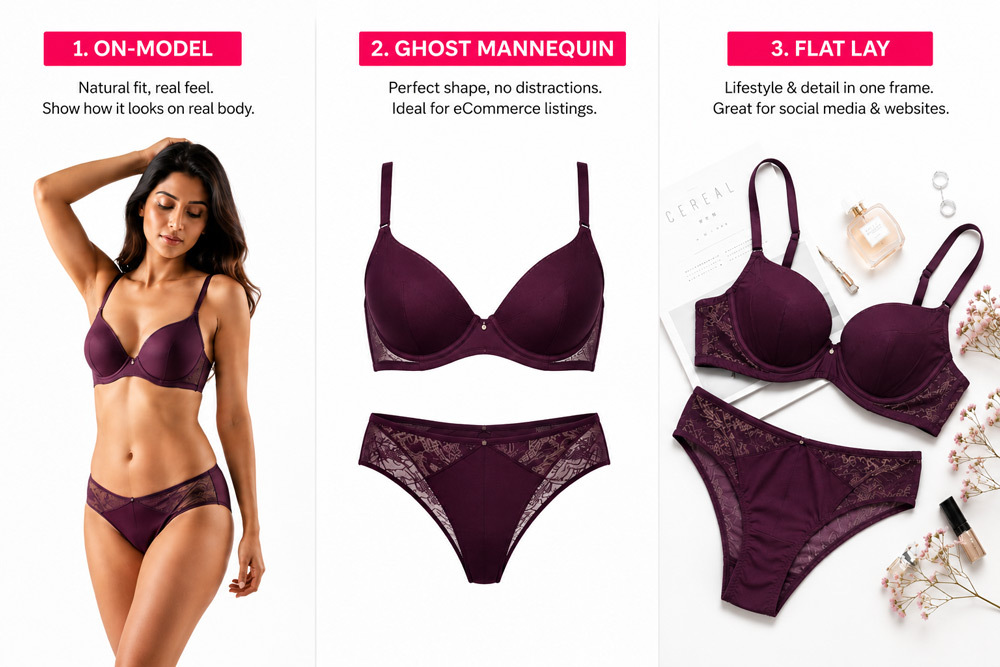
The single biggest cost lever in an intimate wear catalogue is the mix of shooting methods across the SKU sheet. Flat lay is the cheapest per SKU and the fastest to produce, but it flattens structured bras and lies about fit. Ghost mannequin is the correct default for most bra, bralette, camisole and shapewear SKUs because it shows shape without model cost. On-model is the highest cost per SKU and only pays back on hero pieces that will be pushed in ads, on the brand-store banner, or on the PDP top image. The right mix for most Indian D2C intimate wear brands is roughly 60% ghost mannequin, 30% flat lay, and 10–15% on-model reserved for hero SKUs and campaign pieces.
Flat lay is the correct choice for panty multipacks, boxers, socks, thermal innerwear and unstructured loungewear basics. It photographs quickly, retouches cleanly and stacks well on category pages. Where flat lay kills conversions is on structured bras — the cups collapse, the underwire buckles, and the customer cannot judge fit. If your listing analytics show a high bounce rate on bra SKUs shot flat, that is the diagnosis. Our flat lay photography workflow handles the volume side of catalogues where flat lay is the right technique.
Ghost mannequin is the default for every bra, bralette, camisole, shapewear piece and structured babydoll. It shows the cup shape and band tension the listing is selling, at roughly one-third of on-model cost per SKU. Ghost mannequin is also the only method that scales cleanly to a 300-SKU catalogue without a corresponding model budget. Sellers competing with Clovia, Shyaway and Amante on price and range depth almost always run ghost mannequin as their production spine.
Model imagery is worth the cost for hero SKUs — the top 10–15% of the range that drive most of the traffic and revenue. It is also non-negotiable for shapewear photography services where the before-and-after fit is the entire selling proposition, and for brand-campaign work where the product is the excuse and the mood is the message. If your brand is competing at the premium end where Victoria’s Secret India, Nykd by Nykaa or Enamor sit, on-model is not optional. If your brand is a value marketplace seller, on-model is a waste of budget on 90% of the range.
| Method | Best For | Shows Fit? | Cost Per SKU | Speed | Marketplace Fit |
|---|---|---|---|---|---|
| Flat Lay | Panties, boxers, socks, loungewear | Poor for structured | ₹ | Fastest | Amazon, Meesho |
| Ghost Mannequin | Bras, bralettes, camisoles, shapewear | Excellent | ₹₹ | Fast | All platforms |
| Mannequin/Form (visible) | Budget Structure shots | Good | ₹₹ | Fast | Own website only |
| On-Model | Hero SKUs, campaigns, shapewear | Best | ₹₹₹ | Slowest | Myntra, Nykaa Fashion |
| Hybrid Mix | Most D2C intimate wear brands | Excellent | Variable | Balanced | All platforms |
Ckstudio publishes intimate wear photography rates openly because hidden pricing wastes both sides’ time. Our lingerie photography services price per image in India ranges from ₹149 for basic flat lay to ₹399 for on-model premium work, with enterprise catalogues above 300 SKUs starting from ₹99 per image. The lingerie photography cost per product in India depends on layer mix, retouching complexity, model requirements and turnaround urgency. Our Delhi NCR studio serves clients across India with sample pickup, remote art direction and marketplace-ready delivery in 5–7 working days on standard packages.
Four variables move the per-image price. SKU volume — bulk catalogues drop to enterprise rates above 300 units. Layer mix — a listing running 3 Structure images is a different price to one running 4 Structure + 2 Texture + 1 Context. Retouching complexity — ghost mannequin composites and high-end frequency-separation retouching sit above standard clipping-path work. Model cost — on-model shoots add per-day model fees, styling and hair-and-makeup that get amortised across the images produced that day. Sample logistics and turnaround urgency also affect the final quote.
Four transparent tiers, published so brands can budget before enquiring. All rates are exclusive of GST and valid for pan-India courier sample pickup coordinated from our Delhi NCR studio.
| Package | Ideal For | Images/SKU | Method | Turnaround | Price/Image |
|---|---|---|---|---|---|
| Basic — Flat Lay Starter | New brands, panty multipacks, under 50 SKUs | 3 | Flat lay on pure white | 4–5 working days | ₹149 |
| Standard — Ghost Mannequin Catalogue ★ | D2C brands and marketplace sellers, 50–200 SKUs | 6 | Ghost mannequin + flat lay + 1 macro | 5–7 working days | ₹249 |
| Premium — On-Model Lingerie Photography | Premium D2C, Nykaa Fashion, Myntra brand stores | 10 | Full 3-Layer System with model | 7–10 working days | ₹399 |
| Enterprise — Bulk Catalogue Programme | Manufacturers, exporters, 300+ SKUs | Custom | Custom mix, dedicated team | Weekly batch SLA | From ₹99 |
Prices exclusive of GST. Valid for Delhi NCR pickup and pan-India courier. Updated August 2026. Send two sample pieces for a free evaluation shoot.
Not sure which package fits your catalogue? Send two samples to our team — we shoot them free so you can judge quality before you commit. Call Prince: +91-8700258773 or WhatsApp +91-8700258773
Every reshoot Ckstudio has been called in to fix over nine years traces back to a small number of repeat mistakes. The ten below are drawn from real client QC logs across D2C brands and marketplace sellers competing with the top names in Indian intimate wear. Any one of these can trigger a listing rejection, an inflated return rate or a full-catalogue reshoot bill that dwarfs what a professional shoot would have cost in the first place.
Product video and 360° spin are no longer optional on Myntra and Nykaa Fashion apparel listings, and they materially lift conversion on Amazon India apparel PDPs where the seller opts in. For intimate wear, short-form vertical video answers the fit question in a way no still image can. Ckstudio shoots video and stills in one pass on the same set, which halves the incremental cost and keeps lighting continuous between formats. The lingerie video shoot for ecommerce product page deliverable is typically a 10–15 second vertical loop showing the garment from multiple angles under consistent light.
Behind-the-scenes of a lingerie catalogue shoot at our Indian standard ecommerce photography studio, covering ghost mannequin setup for bras, macro texture capture and marketplace-ready export for Amazon India, Myntra and Nykaa Fashion.
The honest answer is that in-house intimate wear photography rarely wins below roughly 1,000 finished images per year. Below that volume, the total cost of hardware, software, forms, calibrated monitors, physical studio space, retoucher salary and the learning curve on lingerie-specific technique exceeds the outsourced per-image rate — and that ignores the opportunity cost of a founding team running a shoot floor instead of running the brand. Where in-house does make sense is on high-frequency social content for Instagram Reels and TikTok-style short video, where turnaround speed matters more than production polish. A hybrid model — outsource Layers 1 and 2, keep Layer 3 social content in-house — is what most successful Indian D2C intimate wear brands settle on.
| Factor | In-House Setup | Professional Studio |
|---|---|---|
| Upfront cost | ₹6–15 lakh for minimum viable rig | Zero — pay per image |
| Cost per SKU at scale | Low only above 1,000 images/year | Predictable at any volume |
| Turnaround | Depends on internal bandwidth | SLA-backed 5–7 days standard |
| QC failure risk | High during learning curve | Low — spec-mapped exports |
| Colour accuracy | Requires ongoing calibration | Included in workflow |
| Scalability | Capped by team size | Elastic across shoot days |
Print this before your next intimate wear shoot. Fourteen points that catch 90% of the problems that trigger reshoots on a lingerie catalogue. Ckstudio runs this exact sheet before every session.
Lingerie photography services in India typically cost ₹149–₹399 per image. Flat lay starts around ₹149, ghost mannequin around ₹249, and on-model shoots around ₹399 per image. Bulk catalogues above 300 SKUs can drop to roughly ₹99 per image on enterprise programmes.
Yes. Most lingerie is photographed using ghost mannequin or flat lay techniques instead of a model. Ghost mannequin preserves cup shape and band structure on bras, while flat lay works well for panties, camisoles and multipacks at a much lower cost per SKU.
Amazon India requires a pure white background (255-255-255) on the main image, the product filling roughly 85% of the frame, and a minimum of 1600 pixels on the longest side — 2000 pixels or more enables the zoom feature. Always verify current category-specific innerwear policy on Seller Central before you shoot.
Cup shape is built on set, not in Photoshop. Ckstudio uses moulded torso forms with cup inserts, straps pinned to correct tension and the gore aligned flat, then removes all visible support in post-production using a ghost mannequin composite for a clean floating result on pure white.
A 100-SKU lingerie catalogue typically takes 5–7 working days end to end at our studio, including sample prep, shooting, retouching and marketplace-ready export. Larger catalogues above 300 SKUs are delivered in weekly batches against an agreed SLA under our enterprise programme.
A great intimate wear catalogue is not the result of one great photograph — it is the compounding effect of a repeatable production system across every SKU. The 3-Layer Lingerie Imaging System gives you Structure, Texture and Context in a defined mix per SKU. The 12-step workflow gives you predictable cost and turnaround. Marketplace-mapped export presets keep Amazon, Myntra, Flipkart and Nykaa Fashion QC clean. Ckstudio has run this playbook across boutique bralette ranges, high-volume shapewear catalogues and premium D2C launches from our Delhi NCR studio. If you are ready to build a lingerie catalogue that converts, our lingerie photography services team is a call away.
Ready to shoot your intimate wear catalogue? Talk to Prince and the Ckstudio team about your SKU count, timeline and marketplace mix.
Call Prince: +91-8700258773 WhatsApp: +91-8700258773 Email: [email protected]
Visit: ckstudio.in/boudoir-and-lingerie-photography to see the portfolio.