Fashion Photography Services
E-commerce Photography
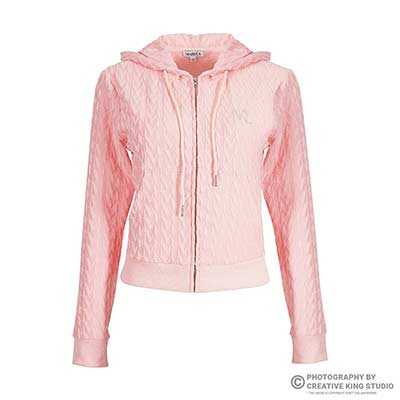
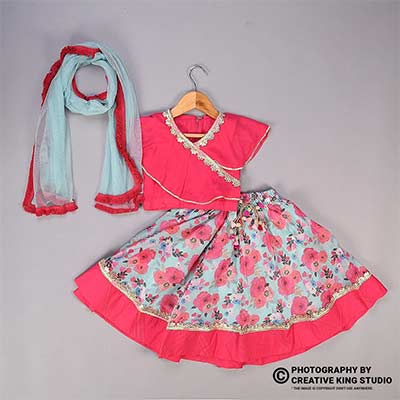
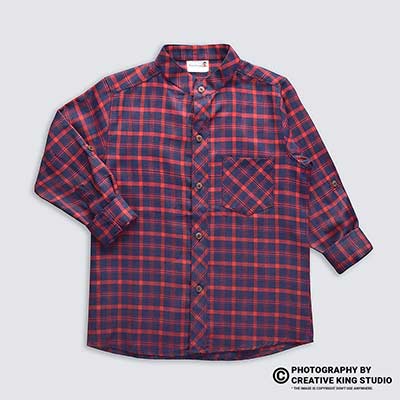
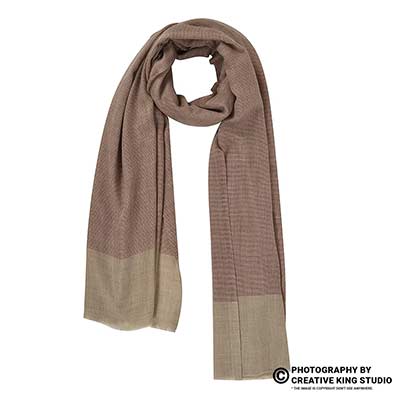
A practical, production-first guide from Ckstudio — how fashion brands and Myntra sellers can plan model casting, garment fit, styling, hair and makeup, posing and creative direction that actually communicates the product.
Myntra Fashion Model Photography combines professional model casting, accurate garment fitting, controlled styling, clean grooming and product-focused creative direction to create consistent fashion catalogue imagery that communicates both product fit and brand identity. On Myntra, the model is not the hero — the garment is, and everything else exists to sell it.
Every fashion brand launching on Myntra eventually learns the same lesson: photography is only one component. What actually decides whether a catalogue looks premium or generic is the sum of decisions made before the camera is even switched on. Casting, garment fit, styling, hair and makeup and creative direction together determine how the customer perceives your brand. At Ckstudio, our fashion-shoot workflow is built around that exact principle. This guide breaks down 11 practical steps for planning stronger Myntra Fashion Model Photography — the same framework we apply to real client catalogues in our Delhi NCR studio. For platform-specific technical rules, we will link out to a dedicated resource so this piece stays focused on creative production.
Selling on Myntra is different from selling on a purely product-first marketplace. Myntra shoppers browse the way they browse fashion magazines — they scroll for aspiration, and they buy when the garment on the model looks like something they would wear. That is why Myntra Fashion Model Photography sits between two disciplines: sharp ecommerce catalogue clarity on one side, and fashion-brand storytelling on the other. At Ckstudio, we treat every fashion shoot as a hybrid production, not a copy of Amazon-style flat product photography.
Product readability still matters. Fit, silhouette, fabric behaviour and construction details must be visible in every frame. What changes on Myntra is the surrounding presentation: styling, expression, movement and creative direction all need to earn their place. Anything on set that hides the neckline, breaks the drape or distracts the eye from the garment is working against you. If you also need the strict specification side — sizes, angles, upload rules — cover that in a dedicated resource like our Myntra apparel photography requirements guide, and keep this article focused on creative production. For the broader creative context around fashion imagery on the platform, our Myntra photoshoot cost guide and Myntra clothing photoshoot guide are strong companion reads.
Basic ecommerce photography is transactional — the shopper wants to see the object clearly and decide. Myntra Fashion Model Photography, on the other hand, is persuasion at scale. The model, the styling and the expression together build the brand story, while the garment stays at the centre of every frame. The difference shows up most clearly in fashion catalogue photography where a series of SKUs needs to feel like one collection, not a random set of studio images. Our internal notes on this comparison also inform our fashion catalogue vs ecommerce photography breakdown for brand managers.
| Feature | Basic Ecommerce Photography | Myntra Fashion Model Photography |
|---|---|---|
| Model importance | Low — often ghost mannequin | High — face and body support brand |
| Garment fit | Approximate is acceptable | Must be precise, per SKU |
| Styling | Minimal or none | Curated, category-specific |
| Expression | Not required | Aligned to brand tone |
| Pose direction | Standard angles | Directed per silhouette |
| Brand identity | Neutral | Deliberate and consistent |
| Catalogue consistency | Nice-to-have | Essential across collection |
| Creative direction | Optional | Non-negotiable |
Try this thought experiment: give the same ₹1,500 kurta to two different production teams. Team A photographs a strong-featured model in a rushed studio, no styling brief, standard poses. Team B casts a model whose proportions suit the silhouette, runs a proper fitting, keeps jewellery minimal, and directs a confident three-quarter stance. The garment is identical. Yet Team B’s images will read as premium, and Team A’s will read as budget. That is the entire argument for treating Myntra Fashion Model Photography as a production discipline. It is also why brand positioning has to be decided before a model is even shortlisted — a lesson we cover in more depth inside our Myntra catalogue model photography workflow.
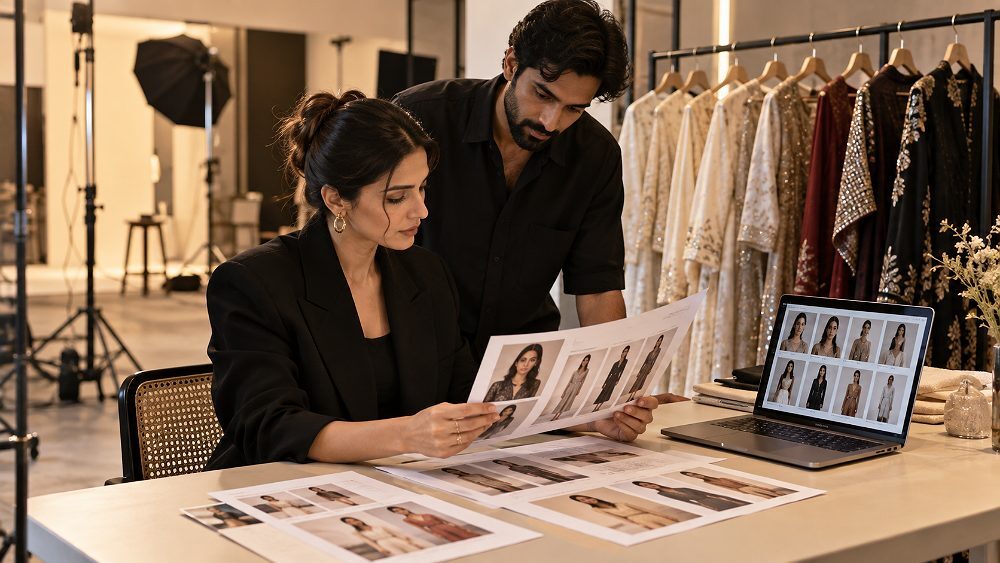 Pre-production casting review — the model is chosen for the customer and the garment, not the other way around.
Before you audition a single model, answer six questions on paper. Who is the customer? What price point are you selling at? What garment category is this collection? What lifestyle does the customer aspire to? What is your brand personality — quiet luxury, high-energy streetwear, refined ethnic, professional workwear, playful youth? And how aspirational should the imagery feel versus how relatable? Every subsequent decision — model, styling, HMU, poses, expressions — flows from these answers. This is the single biggest mindset shift we push on brands when they walk into Ckstudio for the first time.
A ₹799 mass-market kurti and a ₹3,999 premium designer kurta may share fabric, colour and silhouette. Their photography, however, should look almost nothing alike. The mass-market piece rewards bright, approachable, energetic direction — a smiling model, natural daylight-style lighting, relatable poses. The premium piece rewards controlled, confident, minimal direction — softer expression, restrained jewellery, elegant three-quarter stances, editorial-influenced framing. Copying a competitor’s poses without asking where their brand sits is how catalogues end up looking generic. This is also why we recommend brands read our related notes on choosing the right fashion ecommerce background before locking any set.
In nearly every reshoot request we audit, the original team skipped positioning and jumped straight to casting. When we rebuild the shoot, positioning is where we start — and it usually cuts our shot list by 20–30% because we stop chasing frames that don’t fit the brand.
A one-page creative brief prevents 80% of on-set arguments. It should list: collection name, target audience, marketplace, garment category, brand colour palette, model profile, styling direction, HMU direction, required poses, brand references, an avoid list, and deliverables. Share it with everyone — photographer, stylist, HMU, model, art director, brand team — before the shoot day. This one document is the difference between a shoot that flows and a shoot that stalls every 30 minutes for approvals.
A working mood board should include: model references, hair references, makeup references, pose references, garment styling references, accessory direction, lighting reference, crop and framing reference, and brand tone examples. Keep it visual, keep it tight, and keep it on the wall through the shoot so the whole crew stays aligned. For a fuller pre-production toolkit, see our fashion catalogue shoot planning guide.
Model casting is where most brands overspend and underperform. The mistake is casting on face alone. For Myntra Fashion Model Photography, casting has to weigh eleven variables: target customer alignment, garment category fit, current sample measurements, model proportions, height, body type, age appearance, expression range, posing ability, ecommerce experience and brand personality. When you get those inputs right, a mid-tier model outperforms a celebrity-tier model, because the garment actually fits and the poses actually work. This is also why male model photography for menswear brands needs its own casting criteria, separate from womenswear.
Frame every casting decision as: best model-product-customer match. Not most attractive model. This single reframe eliminates the reshoot cycle where a brand loves a model, hires them, then discovers halfway through the day that half the garments don’t sit well on their shoulders or hip line. If you are also planning parallel content pieces — reels, UGC, lookbooks — the same casting logic informs our fashion lookbook photography approach.
Different Myntra categories reward different casting profiles. A young western-wear label targeting 18–24 year olds needs a model whose energy matches that customer — expressive, relaxed, camera-comfortable. A premium ethnicwear brand for a 28–40 year old customer needs poise, refinement and expression control. A workwear label reads best on a model whose posture and expressions communicate quiet confidence. A menswear label needs a model whose face and physique carry the collection’s masculinity narrative — sporty, editorial or classic — without contradiction. An athleisure label needs an athletic body type and genuine movement ability, not a static fashion model faking a stretch.
The garment decides the body type — not the other way around. Oversized silhouettes need proportion balance so the garment doesn’t swallow the model. Fitted dresses need clean shoulder-to-hip lines and consistent bust and waist measurements to your sample. Structured shirts need shoulder architecture in the model, otherwise the garment collapses on camera. Kurtas and kurtis need waist definition to show the shape. Sarees need height and drape ability. Lehengas need volume-capable posture. Trousers need the correct trouser break at the ankle, which is a height and proportion issue. Activewear needs actual athletic proportions. Forcing every SKU onto one unsuitable body type is how you produce a catalogue that looks like a costume department, not a fashion collection. Our garment preparation guide covers this handover in more detail.
| Factor | What to Check | Why It Matters | Red Flag |
|---|---|---|---|
| Measurements | Bust, waist, hip, shoulder | Sample fit depends on it | >1.5" deviation |
| Proportions | Torso-to-leg ratio | Silhouette read | Wrong garment category |
| Age appearance | Matches customer age band | Aspiration alignment | Too young/old on camera |
| Expression range | Smile, neutral, confident | Brand tone match | One-note face |
| Posing experience | Ecommerce, not just runway | Fit-showing angles | Only editorial poses |
| Brand alignment | Personality on set | Team dynamics | Off-brand attitude |
| Sample fit | Live test | Reshoot prevention | Visible pulling |
| Availability | Full window locked | Continuity | Partial-day only |
Planning a casting round for your next Myntra collection? Prince and the Ckstudio team can coordinate model shortlisting, fitting sessions and creative direction from one production point. Call +91-8700258773 or WhatsApp +91-8700258773.
Every reshoot we audit at Ckstudio traces back to one of two things: wrong model or wrong fit. Fit is the one that gets ignored the most, because it feels like a stylist’s job. It is actually a creative director’s job. Before shoot day, samples must be inspected physically. Assume nothing about size labels — Indian apparel sample tolerances are wide, and a labelled M can behave like an S or an L in reality. Check shoulder line, waist placement, sleeve length, trouser break, neckline sit, bust and chest fit, garment symmetry and drape. Steam every piece. If a piece fails on more than two of those checks, either alter it or drop it from the shoot list. This discipline is the single fastest way to lift catalogue quality — and it is baked into our ecommerce apparel workflow as well.
For any Myntra shoot with more than 15–20 SKUs, a pre-shoot fitting is non-negotiable. The fitting sequence we use at Ckstudio runs six steps: check hero silhouettes first because they set the collection tone; identify tight or loose samples and mark them; assign garments to models based on live fit; identify temporary alterations that a tailor can handle overnight; photograph fitting references for continuity; and lock final styling notes per SKU. A two-hour fitting the day before a shoot routinely saves 4–6 hours of production time on the shoot day itself. For teams that want a documented framework, our Myntra model photography workflow guide lays it out step by step.
Some fit issues are legitimately fixable on set: clips outside the frame to tighten a back panel, minor pinning, temporary hemming with fashion tape, lint removal and steaming. What is not fixable is a genuinely wrong sample size, a broken zip, permanent stains, severe construction defects, a visibly wrong colour sample versus the production run, or a missing garment component. Photographing these anyway produces images the QC team will reject and the customer will return. Reject the sample, reshoot later, protect the catalogue.
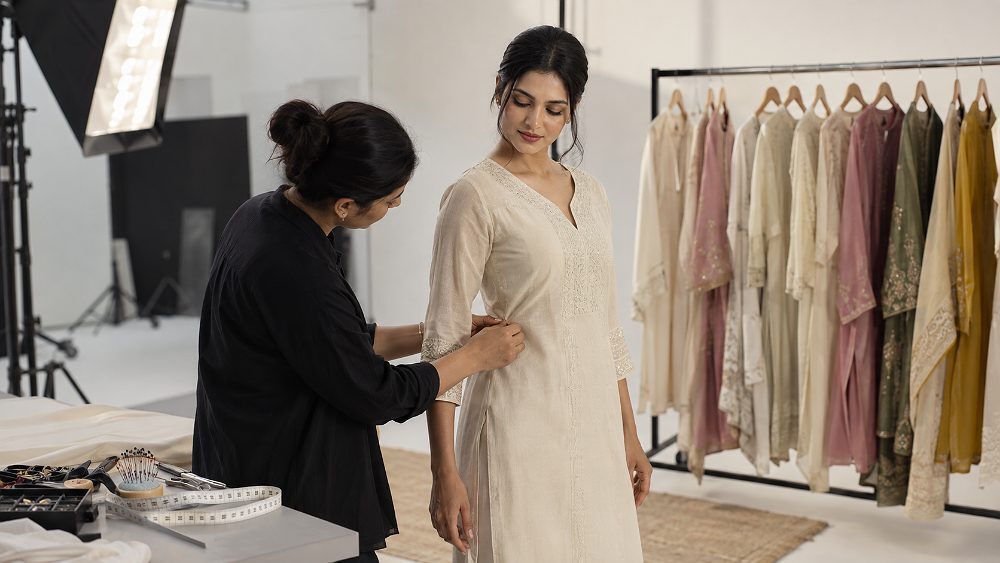 Fitting sessions decide catalogue quality — most fit problems are cheap to fix the day before, expensive to fix on the shoot day.
The central rule of styling for Myntra Fashion Model Photography is simple: the garment being sold must remain the hero. Every styling decision should either support the garment or get cut. That means treating accessory hierarchy as a real design decision — one statement piece per look, at most. Footwear should complement the garment’s palette without becoming the focal point. Jewellery should stay off the neckline for pieces with neckline detail. Belts should not compete with garment silhouette. Bags should not cover the front of the garment. Layering should reveal, not hide. Colour coordination should follow the brand palette, not the model’s personal taste. And styling continuity across SKUs is what makes a catalogue look like a collection instead of a series of unrelated shoots.
Two quick before-and-after examples we use in Ckstudio creative reviews. Bad: an oversized bag styled in front of a kurta, covering half the embroidery. Better: the same bag placed at the model’s side, embroidery fully visible. Bad: a heavy statement necklace on a kurta with a keyhole neckline, hiding the exact detail that justifies the price. Better: minimal drop earrings, neckline visible, product story preserved. Styling should reveal the reasons the customer would buy the piece. If the styling is hiding the reasons, the styling is wrong.
A styling continuity sheet is a one-page document that tracks decisions across the collection: which shoes were used for kurtas versus dresses, which jewellery goes with ethnic versus western, tucked or untucked styling rules, sleeve roll conventions, button-up rules, dupatta position standards, belt use decisions, jewellery rules by neckline, and hair placement standards. Update it live during the shoot. Six months later, when the brand launches a follow-on collection, this sheet is what makes the new catalogue feel like the same brand. This is one of the systems we build into our ecommerce photography workflow for repeat clients.
| Category | Styling Priority |
|---|---|
| Kurta / Kurti | Neckline, sleeve, dupatta, trouser pairing |
| Saree | Drape, pleats, blouse visibility |
| Lehenga | Dupatta treatment, jewellery restraint |
| Western dress | Silhouette and footwear |
| Menswear | Tuck, collar, cuff, trouser break |
| Athleisure | Movement + product functionality |
Hair and makeup exist to polish the model without becoming the subject. On a Myntra fashion catalogue shoot, HMU decisions should be locked before the first frame — skin finish (matte, satin or dewy depending on garment category), eye makeup weight, lip tones aligned to the palette, facial shine control, flyaway management, hair placement and neckline visibility, and consistency across a long shoot day. The single most common HMU mistake we see on client shoots is HMU that looks great on the model in isolation but competes with the garment on camera. Product-focused HMU is slightly under-styled on purpose.
Long hair is a styling variable, not a fixed element. Hair covering collars, shoulders, back-yoke embroidery, spaghetti straps, necklines or shoulder cutouts is one of the top reasons frames get rejected in QC review. Plan hair placement per shot: hair back for neckline detail, hair forward for shoulder-detail garments, half-up half-down for versatile shots. Direct the model to reset hair between takes. A five-second hair reset saves a five-hour reshoot.
Long shoot days destroy makeup consistency if nobody is watching. At Ckstudio, we shoot an approved HMU reference frame at the start of production and print it on set. Every two hours, the HMU artist compares the model’s current look to the reference and adjusts. This one habit keeps a 60–80 SKU catalogue looking like it was shot in a single continuous session, even when it wasn’t. The same discipline is what makes premium fashion photography feel cohesive at scale.
Creative direction is the layer most brands underinvest in, and it is exactly where premium catalogues are made. On a well-directed set, the photographer or creative director is calling posture, weight distribution, shoulder placement, hand position, chin angle, eyeline, expression, garment movement, pose transitions and pace — frame by frame. Vague instructions like "do something fashion" or "look natural" are how you get frames that don’t sell. Precise direction — "drop your left shoulder half an inch, weight on your back foot, chin slightly down, eyes to the corner" — is how you get frames that do.
Every SKU in a Myntra Fashion Model Photography set needs six pose objectives. Front pose shows silhouette. Three-quarter shows dimension and drape. Side shows profile and fit. Back shows rear construction — critical for kurtas, jackets, dresses and lehengas. Movement shows fabric behaviour, which sells fluid pieces. Detail shows craftsmanship. Skip any of these and the customer’s questions go unanswered, which raises return rates. This shot list is baked into our Myntra model photoshoot poses and angles resource for brand teams. Related pose logic also shows up in our Myntra model poses for clothing listings notes.
Body-language mistakes are the tell of an undirected shoot. Hands stuffed into pockets that hide construction. Elbows locked at unnatural angles. Excessive hip tilt that distorts silhouette. Hunched shoulders that flatten the garment. Stiff fingers that make an otherwise elegant frame look tense. Garment pulling that misrepresents fit. Asymmetry that reads as awkward instead of dynamic. Every one of these is fixable in real time with a calm creative director on set who knows what to call out. This is the layer where our team’s ecommerce catalogue background — the same rigour we bring to ecommerce photography services — carries into the fashion shoot.
Facial expression is where brand positioning becomes visible. A premium minimal brand rewards controlled, confident expressions — mouth closed or barely open, eyes steady. A youth streetwear label rewards relaxed, energetic expressions — half-smiles, movement, engagement with camera. Ethnic festive collections read best with warm, refined expressions — soft eyes, elegant carriage. Workwear needs confident, approachable expressions — a real smile is fine, as long as the posture stays professional. Athleisure needs active, focused expressions that match the movement in the garment. Directing expression is a skill, not a mood. Practice it on set the way you practice lighting.
For a practical look at how our team directs a garment model shoot end-to-end — lighting, styling and pose direction — this behind-the-scenes example from a recent brand production shows the workflow in action.
Myntra rewards a hybrid style. Pure catalogue photography sells the garment but rarely builds the brand. Pure editorial photography builds the brand but often hides the garment. The winning approach on Myntra is catalogue with editorial polish: product-first clarity in every frame, with restrained editorial techniques — confident expression, subtle movement, polished styling, brand-consistent lighting — layered on top. Get the balance wrong toward editorial, and QC flags the images. Get it wrong toward catalogue, and shoppers scroll past. Get it right, and both metrics improve.
The catalogue side of the balance is about giving the customer the information they need to buy: silhouette, fit, construction, fabric behaviour, front and back visibility, and category-consistent framing. These frames answer the customer’s practical questions before they ask them. On a Myntra shoot, roughly 70–80% of your frames should sit firmly on this side.
The remaining 20–30% is where restrained editorial influence adds brand personality — through expression, subtle movement, styling polish and lighting quality. Restrained is the operative word. An editorial frame that looks great on Instagram but hides half the neckline detail does not belong in your Myntra listing set. It belongs on your Instagram feed, or your fashion lookbook photography deliverables.
| Factor | Catalogue Approach | Editorial Approach | Recommended Myntra Balance |
|---|---|---|---|
| Poses | Standard fit-showing | Expressive, angular | Fit-first with attitude |
| Expressions | Neutral / approachable | Moody, editorial | Confident and warm |
| Styling | Minimal | Statement-led | Restrained accents |
| Accessories | Rare | Central | One per look |
| Lighting | Even, clean | Directional, dramatic | Soft with edge control |
| Movement | Static | Kinetic | Subtle motion frames |
| Product visibility | High | Variable | High throughout |
| Brand storytelling | Low | High | Woven into every set |
The workflow below is the exact production sequence we run at Ckstudio for a mid-to-large Myntra fashion catalogue. It scales from a 20-SKU capsule to a 200-SKU seasonal drop with the same eleven checkpoints. Skipping any of them tends to show up on the shoot day, not before.
Tethered shooting — camera piped live to a laptop or monitor — is the single most valuable investment on a fashion shoot. On the monitor, the creative director checks for creases, hair placement, symmetry, accessory position, hand placement, garment colour rendering, crop and pose consistency in real time. Every issue caught tethered is an issue that never becomes a reshoot. Our catalog consistency at scale playbook covers the QC side of this in more depth.
Pricing for Myntra Fashion Model Photography is a function of scope, not a fixed rate card. Real cost variables include: number of SKUs, model tier and fee, shoot duration, stylist involvement, hair and makeup, photographer level, studio requirements, number of final edited images, creative direction depth, retouching complexity, whether video or reels are added, and usage rights (marketplace only, marketplace plus social, or full commercial). A shoot quoted at ₹59 per edited image or roughly ₹300 per garment for a standard multi-angle model set can work for straightforward SKUs, while premium creative productions with dedicated casting and styling sit at a different tier entirely. Detailed benchmarks live in our Myntra photoshoot charges guide and our broader product photography pricing guide for India.
Final project pricing depends on model, garment count, styling, HMU, production requirements and usage. Email [email protected] or WhatsApp us with your SKU count and garment category for a scope-based quote rather than a per-image estimate.
A low per-image cost becomes expensive fast if the model is unsuitable, samples are poorly fitted, styling is inconsistent, or the output requires a reshoot. Brands that budget by production requirement — casting quality, fitting time, stylist and HMU inclusion, shoot duration, tethered QC, retouching hours — get a stronger catalogue for the same total spend, and rarely need a reshoot. If your first Myntra catalogue underperformed, review the production line items, not just the per-image cost.
Ckstudio has been running fashion and ecommerce production for nine-plus years out of Delhi NCR — servicing brands across Amazon, Flipkart, Myntra, Ajio and Meesho with a repeatable catalogue workflow. Our production stack includes professional model coordination, in-house styling and HMU coordination, tethered studio setups, marketplace-experienced creative direction, and a documented QC process that keeps 100+ SKU shoots consistent. We are accessible from Delhi, South Delhi, Noida, Gurgaon, Faridabad and Ghaziabad, and we plan shoots around your launch calendar, not the other way around. This is also the same core methodology that powers our dedicated Myntra product photography and ecommerce model shoot service.
Planning a Myntra collection shoot? Share your garment count, category, sample sizes and expected launch date with Prince for a production recommendation. Call +91-8700258773, WhatsApp +91-8700258773, or email [email protected].
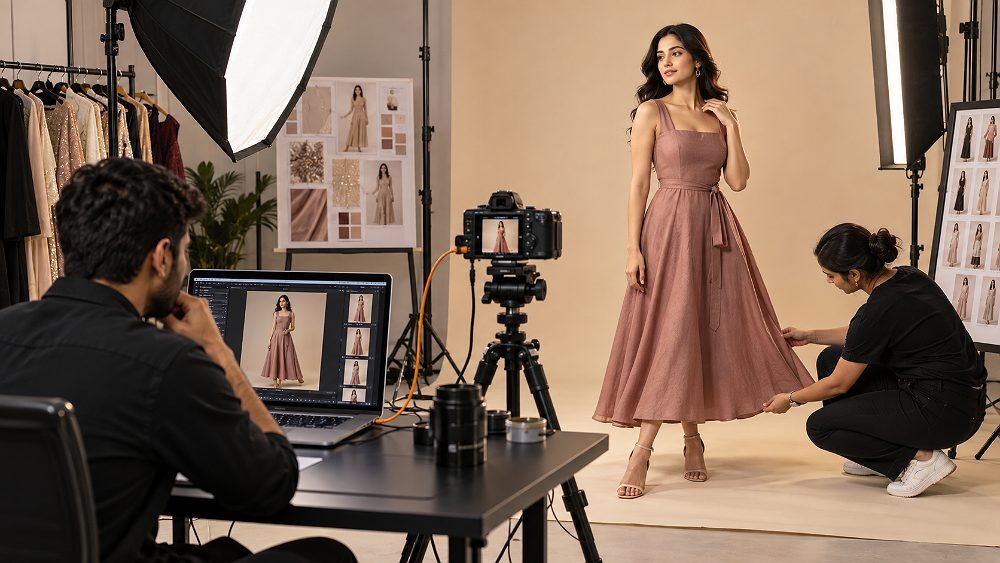 Tethered shooting with live creative-direction review — the difference between catalogue-clean frames and generic ones.
Common questions we get from brands and Myntra sellers planning their first — or their tenth — fashion catalogue shoot.
Choose a model whose measurements, proportions, age appearance and overall personality match both the garment sample and your target customer. Product fit and brand relevance are more important than selecting a model purely by appearance.
Garment fitting is essential because incorrect shoulder, waist, sleeve or trouser proportions can make even a professionally photographed product look poorly designed. A pre-shoot fitting also reduces styling delays and reshoots.
Myntra catalogue photography can borrow controlled editorial elements such as confident expressions, polished styling and movement, but the garment should remain clearly visible and accurately represented.
For professional or high-volume fashion shoots, a stylist and hair-and-makeup professional help maintain garment presentation, accessory consistency, grooming and visual continuity across the full catalogue.
Pricing depends on garment count, model fees, shoot duration, styling, makeup, studio requirements, image quantity and retouching. High-volume catalogue shoots generally have a different cost structure from premium creative productions.
Casting attracts attention. Fit builds trust. Styling communicates taste. Creative direction creates consistency. And through all of it, the garment must remain the hero. That is the entire discipline of Myntra Fashion Model Photography in one line. Brands that internalise this stop chasing single-shoot wins and start building fashion catalogues that hold up across seasons. Talk to Ckstudio about planning a Myntra fashion model shoot for your next collection — call +91-8700258773 or email [email protected].