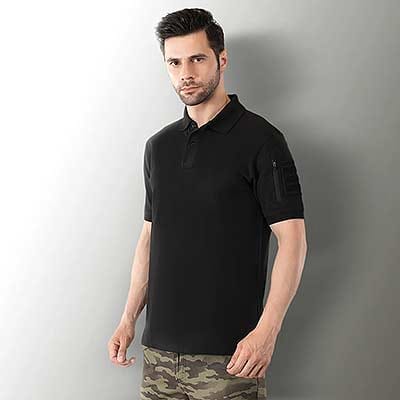



Fashion Photography Services
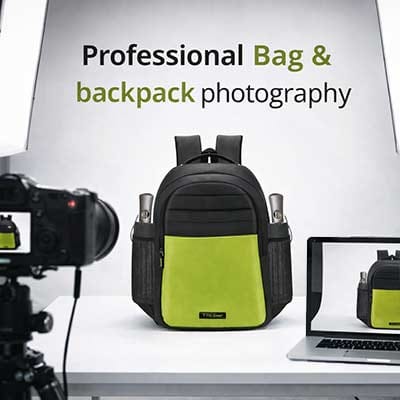

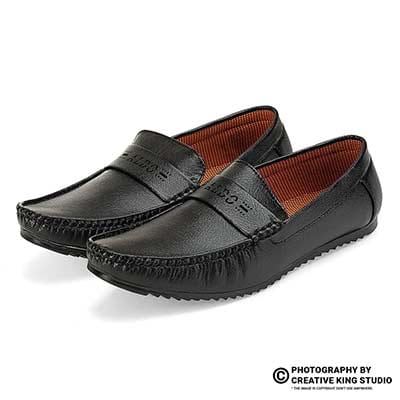

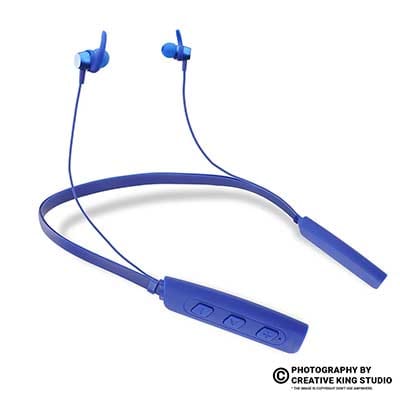
E-commerce Photography

A complete, India-first Product Photography Guide covering lighting, equipment, editing, white background and marketplace specs for Amazon, Flipkart and Myntra — written from the studio floor at Ckstudio.
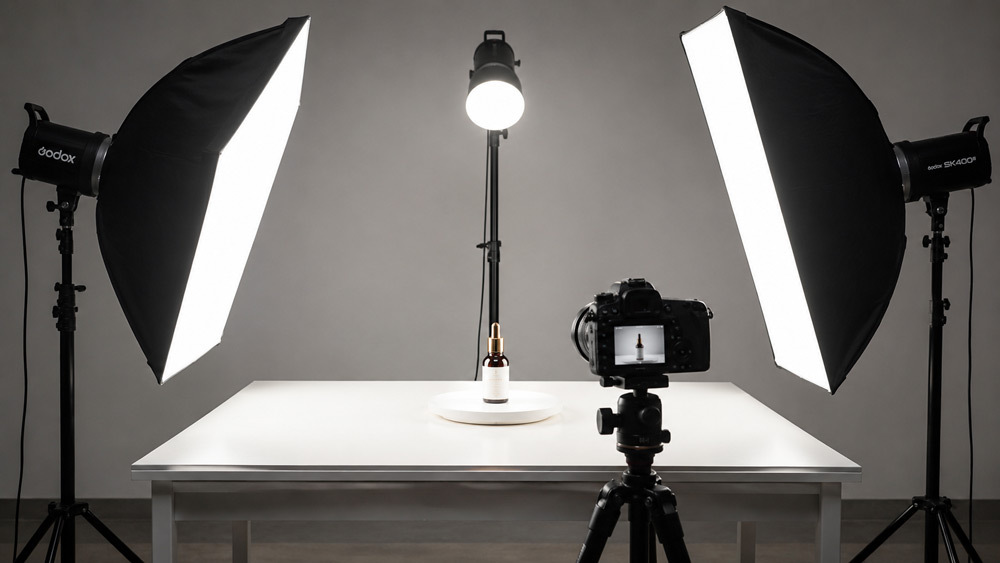
Product images influence more than 75% of online purchase decisions, which means your photos are doing the selling long before your price or description ever gets read. This Product Photography Guide is the single, India-first resource we wish every seller had — built from thousands of catalogue shoots at Ckstudio, our Delhi studio led by Prince. You will learn the exact types, lighting, equipment, editing and marketplace specifications that turn browsers into buyers on Amazon, Flipkart and Myntra.
At its core, product photography converts a physical item into a trustworthy digital preview. When a shopper cannot touch your product, your images become the entire experience, which is why professional ecommerce product photography consistently lifts conversion. Studies of listing performance repeatedly show that clear, well-lit images reduce hesitation and returns, and our own reshoots at Ckstudio echo the same pattern across categories.
There is also a growing question every seller now asks: real photos or AI-generated ones. Our position, tested daily on live listings, is unambiguous — real professional photographs sell better because they represent the actual product a customer will receive, and we explain the full comparison in our breakdown of real photography versus AI-generated product images. Accurate visuals protect both your rating and your return rate.
Before you touch a camera, decide what kind of shot each listing needs. Most Indian catalogues rely on a mix of the following, and choosing the right type per product is the first real skill in any Product Photography Guide.
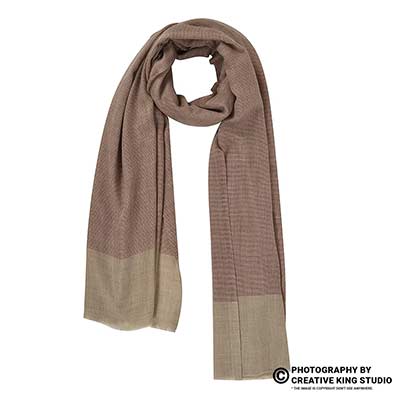
This is the marketplace default — a pure, clean backdrop that isolates the product for the main listing image. It demands even lighting and careful editing to hit true white, and it is the format Amazon and Flipkart expect for primary images. For catalogues at scale, this discipline is exactly what our Amazon product photography team standardises shot after shot.
Lifestyle frames place the product in a real-world context — worn, used or styled in a setting — to build emotional connection and show scale. These images shine in secondary slots and social ads, and pairing them with clean mains is a proven combination we detail through our lifestyle product photography work.
Shot from directly above, flat lays arrange products, props and packaging into a tidy composition — ideal for apparel sets, cosmetics and gifting bundles. Neat flat lay photography communicates a full range in one frame and keeps a brand feed cohesive.
Interactive 360° spins and tight macro detail shots answer the questions a customer would otherwise ask before buying. They are essential for jewellery, watches and textured goods, and our 360° product photography setup captures fabric weave, finish and craftsmanship that flat images miss.
| Type | Best For | Difficulty | Relative Cost |
|---|---|---|---|
| White Background | Marketplace mains | Medium | ₹ |
| Lifestyle | Ads & social | Medium–High | ₹₹ |
| Flat Lay | Sets & bundles | Low–Medium | ₹ |
| 360° Spin | Jewellery, watches | High | ₹₹₹ |
| Macro Detail | Texture & finish | High | ₹₹ |
A dependable kit starts with a full-frame DSLR or mirrorless body, though a good crop-sensor camera shoots excellent catalogue work too. Lens choice follows the product: a macro focal length for jewellery detail and a standard prime for general goods. Add a rigid tripod for pin-sharp, repeatable framing, and you already have a professional foundation.
Camera manufacturers publish detailed specification sheets, and it is worth checking the official Sony India camera range to match a body to your product type before buying. For small businesses that would rather not build a studio, our commercial photography services already cover every piece of this kit.
Think of light in three roles. The key light shapes the product, the fill light softens the shadows the key creates, and a backlight or rim separates the item from the background. Diffusing each source through a softbox spreads the light and eliminates the hard edges that make cheap images look, well, cheap.
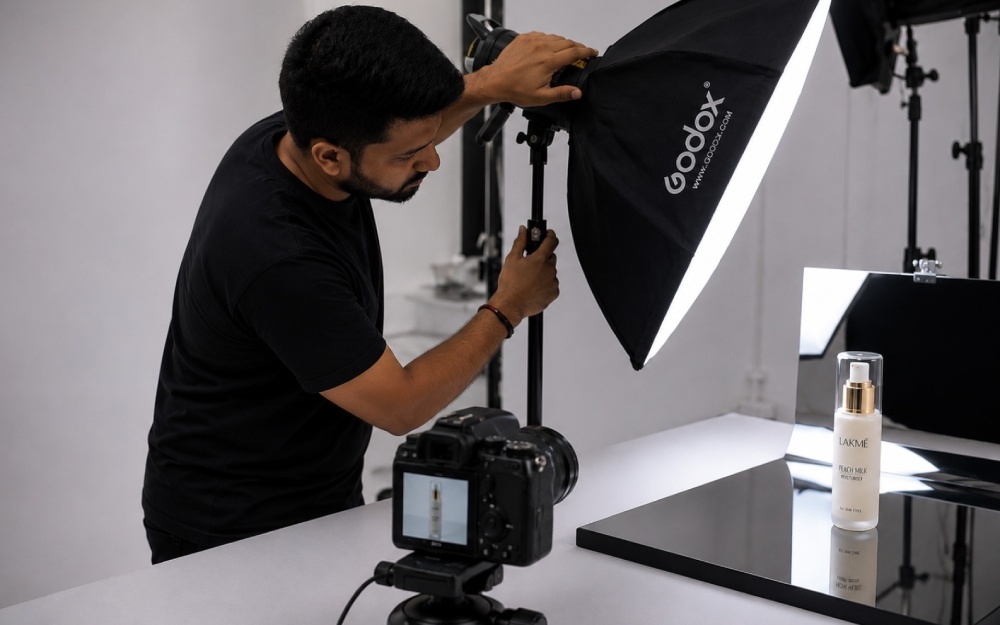
Position the key at roughly 45 degrees, add fill on the opposite side at lower power, and use the third source to lift the background or edge-light the product. This same principle scales from a single-product tabletop to a full model photoshoot, where controlled light keeps skin tones and fabric colours honest.
Window light is free and flattering for small, occasional shoots, but it shifts with the weather and time of day — a real problem when you need a hundred matching frames. Studio strobes give you total control and repeatability, which is exactly what large catalogues demand. For a live walkthrough of a clean setup, the embedded tutorial below shows the workflow end to end.
Most marketplace main images require a clean white background, so this is a compliance skill as much as an aesthetic one. Light the backdrop separately from the product so the sweep reads bright, expose slightly to the right, then finish the white in editing while protecting a crisp, accurate edge. This precision is central to our image editing services.
Cleaner mains do more than look tidy — they measurably cut confusion and returns, a link we unpack in our guide on how to reduce returns on Flipkart and Amazon with better images.
Capture is only half the job; editing is where a good frame becomes a sales-ready asset. A disciplined post-processing workflow covers background cleanup, retouching, colour correction and export at the right resolution — done consistently across every SKU so your storefront looks like one coherent brand.
Professionals build workflows around Adobe Photoshop for detailed retouching and a catalogue tool for batch consistency. The software matters less than the repeatable process you wrap around it.
Honest retouching removes dust and distractions without misrepresenting the product, a clean clipping path isolates it for any background, and accurate colour correction ensures the shade a buyer sees is the shade they receive. Getting colour right is a returns issue as much as a quality one, and it is a core reason sellers move their bulk work to a dedicated studio rather than juggling freelancers.
Amazon expects a pure white main image with the product filling most of the frame, Flipkart has its own resolution and background norms, and Myntra demands high-resolution fashion shots that show colour and fit accurately. Getting these right first time is exactly what our Flipkart product photography and Myntra fashion photography teams handle every day.
| Platform | Main Background | Focus | Special Rule |
|---|---|---|---|
| Amazon | Pure white (#FFFFFF) | Product fills ~85% frame | No text or props on main |
| Flipkart | White / clean | High resolution | Multiple angles preferred |
| Myntra | Clean / model | Accurate colour & fit | On-model apparel shots |
Marketplace rules change, so it pays to verify against the source — sellers can confirm current image policies directly on Amazon Seller Central India before a shoot. When specs are met precisely, listings go live without friction.
No single lighting recipe fits every product. The categories below each need a slightly different approach, and matching technique to category is what elevates a competent catalogue into a converting one.
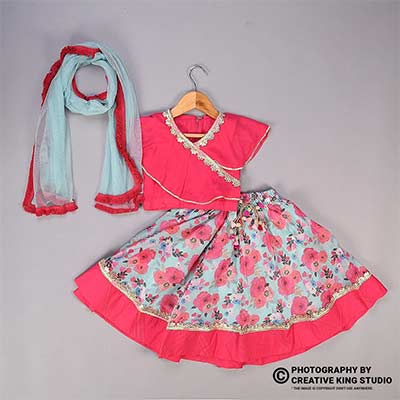
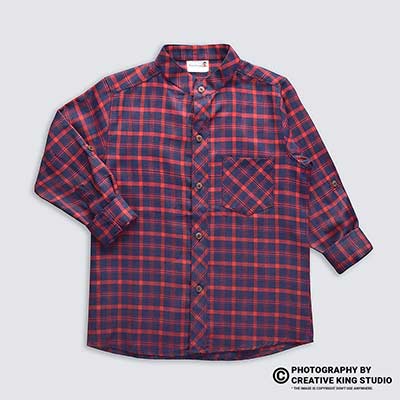
Apparel needs accurate colour, clean drape and either crisp ghost-mannequin or on-model presentation. Ghost-mannequin work gives a clean hollow-man effect for marketplace mains, and our ghost mannequin photography is a staple for apparel sellers.
Reflective packaging and precise brand colours make cosmetics deceptively tricky, demanding controlled reflections and true-to-life tones — the focus of our beauty and cosmetic photography.

Jewellery lives on sparkle and detail, which means dark or reflective surfaces, careful macro focus and light shaped to bring out facets — captured in our jewellery photography setups.
Large machinery, spare parts and factory goods call for a documentary-grade approach with depth of field and even light across big surfaces, which is where our industrial photography expertise comes in.
DIY makes sense for a handful of products when budgets are tight and you enjoy the craft. But as SKUs multiply, the hidden cost of your time, inconsistent results and marketplace rejections quickly outweighs the studio fee. This trade-off becomes obvious the moment you try scaling, as we explain in scaling from 50 to 500 SKUs.
For sellers in the capital region weighing this choice, our Delhi studio team is happy to walk you through what fits your volume and budget.
Rather than a flat figure, think in tiers: basic white-background images sit at the affordable end, while styled lifestyle, on-model and interactive 360° shoots command more. For a complete, transparent breakdown of rates and what drives them, see our dedicated product photography cost in Delhi guide, and compare pan-India benchmarks in our 2026 India pricing guide.
| Package | Includes | Best For |
|---|---|---|
| Basic | White background + basic edit | New sellers, simple SKUs |
| Standard | + Lifestyle + advanced retouch | Growing D2C brands |
| Premium | + Model / 360° + fast turnaround | Fashion & high-value goods |
| Enterprise | Bulk catalogue + dedicated manager | Large catalogues at volume |
Ckstudio is Delhi’s product photography studio, led by Prince with 9+ years of marketplace experience. Get a custom quote for your catalogue today.
A product photography guide explains how to shoot, light and edit product images for ecommerce — covering equipment, techniques and marketplace specs so brands get sales-ready photos that convert and comply.
It varies with shoot type, editing depth and volume — from an affordable per-image rate for white-background work to a premium for model and 360° shoots. Ckstudio offers custom packages for bulk catalogues; call +91-8700258773 for a quote.
Softbox-based three-point lighting is best — it gives even, shadow-free illumination and true colour. Natural window light works for small setups, but studio softboxes ensure the consistency a catalogue needs.
Light the backdrop evenly and separately, expose slightly bright, then edit the background to true #FFFFFF while keeping a clean product edge — meeting Amazon’s white-background requirement for main images.
Yes. Real professional photographs represent the actual product a customer receives, which builds trust and lowers returns. AI-generated images risk inaccuracy that hurts both ratings and refunds.
A strong Product Photography Guide comes down to a few disciplined habits: choose the right shot type, light it softly and evenly, hit true white where the marketplace demands it, and edit honestly for accurate colour. Do that consistently and your listings will earn more clicks and fewer returns. When you would rather hand the whole pipeline to specialists, Ckstudio and Prince are one message away — reach us on email at [email protected] or WhatsApp on +91-8700258773.