
Fashion Photography Services


E-commerce Photography
Read every return reason, keep the right proof, dispute what is not your fault and fix the catalogue gaps that cause fit and colour returns.

AJIO seller returns are the single biggest leak in most fashion catalogues on the platform, and almost every one of them traces back to three things: what the shopper expected, what arrived, and what proof you kept. This guide sits under our AJIO seller hub, which covers onboarding, image rules and business models, and it focuses on the post-sale problem: handling return complaints, fighting quality disputes and cutting the returns you cause yourself.
At Ckstudio we shoot fashion catalogues for brands selling on AJIO, Myntra and Flipkart, and we see the other side of returns: the reshoots ordered after a style comes back again and again for colour or fit. Prince, founder and lead photographer, has written this as a working manual. You will learn how to read return reasons, what evidence to keep at packing and at receipt, how to raise a dispute inside the claim window, and how better catalogue images and size charts reduce AJIO seller returns before they start.
In this guide
AJIO seller returns are orders a customer sends back after delivery, either as a voluntary return inside the return window or as a complaint about quality, damage or a wrong item. AJIO’s published policy sets the customer window; your business model and the seller policies decide who carries the cost.
The customer side is public. AJIO’s returns and refunds policy lists a 10-day return period for fashion and lifestyle products such as apparel, accessories and footwear, and it says that some products and brands carry different rules, with the product page as the final word. The same page says refunds are processed within 7 to 10 business days from the date AJIO receives and verifies the returned product. Read it once a quarter, because AJIO has shown different windows on different help pages over the years.
The seller side depends on how you sell. Under the marketplace model you own the stock and the return comes back to you. Under sale-or-return and outright arrangements, stock ownership and unsold risk move differently, so a return touches your payout in a different way. Your seller agreement and the policy documents inside Seller Central are the only source for those terms; never plan margins from a blog summary, including this one.
| Rule | What AJIO publishes | Why it matters to sellers | Source |
|---|---|---|---|
| Customer return window | 10 days for apparel, accessories and footwear; some brands and products differ | Returns can arrive up to two weeks after dispatch once transit is added | AJIO returns and refunds policy |
| Product page authority | The product page shows the applicable return terms | Mark non-returnable styles correctly in your template | AJIO returns and refunds policy |
| Customer refund timing | 7 to 10 business days after AJIO receives and verifies the return | Verification happens before your claim clock is relevant | AJIO returns and refunds policy |
| Damaged-return claim window | Claim within three days of receiving the return cargo | Evidence must be captured on the day the return lands | AJIO Commerce seller FAQ |
| Claim evidence | Refund of loss after review, with documentation as per the Seller Protection Fund policy | No photos or video, no claim | AJIO Commerce seller FAQ |
Treat this table as a starting map, not a contract. If a value inside your Seller Central policy differs, the panel wins. What does not change is the logic: the shopper’s window is generous, your claim window is short, and the seller who documents both ends of the parcel journey loses far less money to AJIO seller returns.
Most fashion returns on AJIO fall into five buckets: wrong fit, colour or look not as shown, perceived quality, wrong or missing item, and damage. The first three are usually catalogue problems you can fix; the last two are dispute problems you win with proof.
Sort every return reason into one of two families before reacting. Expectation returns happen when the garment is exactly what you shipped but not what the shopper pictured: the kurta is a shade darker than the photo, the fabric looks thinner in hand, or the medium fits like a small. Integrity returns happen when something went wrong between your packing table and the customer, or when the item coming back is not what you sent. The fix for the first family is in your catalogue; the fix for the second is in your evidence.
| Return reason | Usual root cause | Listing or process fix | Evidence that helps |
|---|---|---|---|
| Size or fit issue | Size chart in body sizes, no model size stated | Measured garment chart, model height and size in the description | Size chart screenshot, measurement sheet |
| Colour not as shown | Uncalibrated shoot, heavy saturation edits | Colour-checked shoot, true-colour swatch | Grey-card frame from the shoot |
| Quality not as expected | No fabric detail, sheen hidden by lighting | Macro detail shot, fabric attribute filled correctly | Detail image on the live listing |
| Wrong item received | Picking error or swapped return | Barcode scan at packing | Packing photo with style code and tag |
| Damaged or used return | Transit damage or wear before return | Better poly bag and carton spec | Unboxing video of the return parcel |
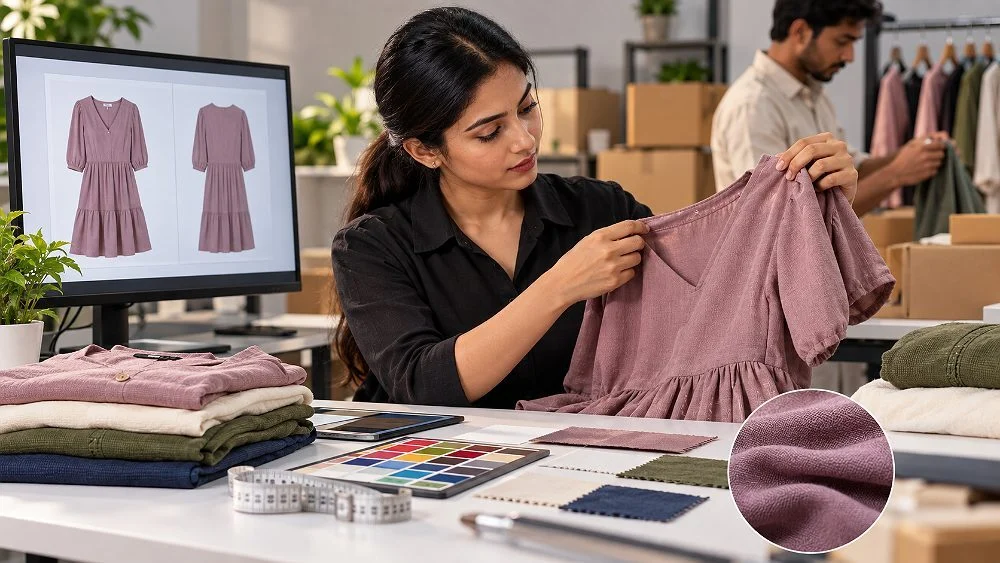
Expectation returns are where photography earns its fee. A style shot with honest colour, a visible fabric texture and a fit image on a model whose size is stated answers the questions that otherwise turn into a return slip. If your current catalogue was shot on a phone under mixed light, professional garment photography with a fixed light setup is usually the cheapest permanent fix, because the same reason codes stop repeating across every size and colour of the style.
Integrity returns need a different mindset. You cannot photograph your way out of a swapped product or a torn carton, but you can make sure that when one arrives you hold timestamped proof of what left your warehouse. Section four covers exactly what that proof looks like.
Export the returns data from Seller Central every week, group it by style code and return reason, and read the customer comments for the top offenders. The pattern across a style matters far more than any single angry review.
Menu names inside AJIO Seller Central vary by business model and change between panel updates, so look for the returns, reverse logistics or claims report rather than a fixed path. Whatever it is called, it should give you the order or sub-order ID, style code, size, return reason and, for some returns, a free-text customer comment. Download it as a sheet; working inside the panel one order at a time hides the patterns.
Add three columns to the export: family (expectation or integrity), fixable by (catalogue, packing, courier, dispute) and action date. Then pivot by style code. A style with four fit returns in one week is a size chart problem; a style with one damaged return is a packing question; a style whose returns are mostly colour complaints needs its images checked against the actual garment under daylight.
Quality complaints deserve a separate read. Words like “thin”, “transparent”, “rough” or “cheap” in customer comments usually mean the listing oversold the fabric, not that the product is defective. Compare the complaint with your fabric attribute, your GSM claim if you made one, and the detail image. If the listing promises more than the garment delivers, fix the listing; disputing these returns rarely succeeds and wastes your three-day windows on cases you cannot win.

Finally, connect returns to money. Every return shows up later as a reversal or deduction in your payout file, so reconcile the two each cycle. Our walkthrough of the AJIO settlement statement and payout checks shows how to match return reversals line by line, which is how many sellers first notice a claim they forgot to raise.
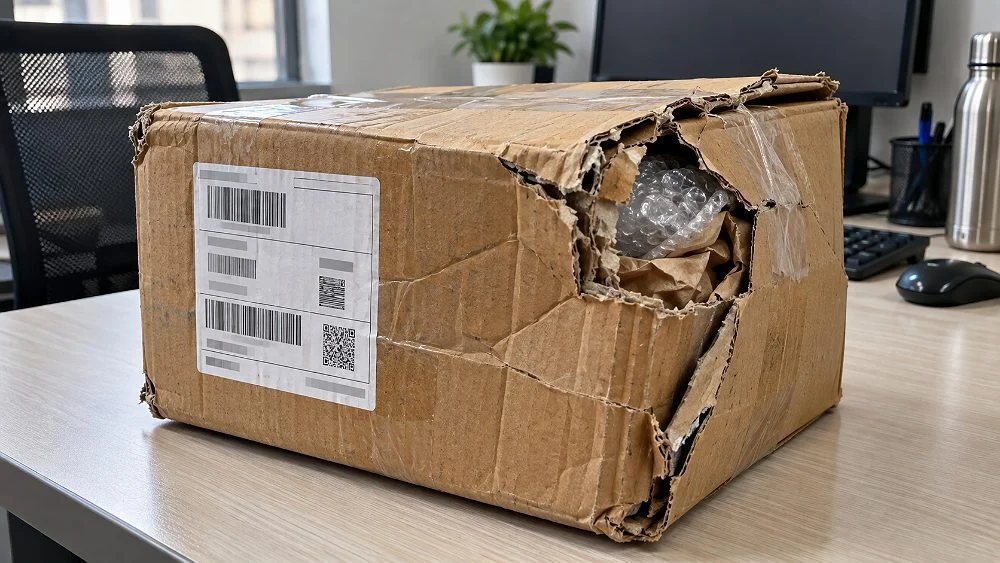
Keep proof at both ends of the parcel journey: packing photos or video showing the exact item, tags and seal before dispatch, and an unbroken unboxing video of every return parcel with the label visible. Without both ends, a dispute is your word against the customer’s.
The AJIO Commerce seller FAQ says a claim for a damaged return must be submitted within three days of receiving the return cargo, and that losses are refunded after review provided you have supplied the documentation required under the Seller Protection Fund policy. Three days leaves no time to look for evidence afterwards. It has to be captured as a routine, on every order, not only on the ones you suspect.
From the studio floor
When Ckstudio sets up a packing evidence station for a fashion brand, the rig stays simple: a phone on a fixed overhead arm about 60 cm above a white table, one daylight-balanced LED panel at 5600K to avoid yellow casts, and a printed A4 grid on the table so the garment always sits in the same place. Videos record at 1080p, which keeps a 60-second clip near 100 MB and easy to upload. The same rig doubles as the inbound unboxing station, so every return is filmed under identical light and colour.
Name files by order ID and date, and keep them for at least the full return window plus your claim period. A shared drive folder per month, with sub-folders for outbound and inbound, is enough for most brands shipping a few hundred orders a week.
Inspect the return on the day it arrives, decide in minutes whether it qualifies as damaged, used, wrong or incomplete, and raise the claim with seller support inside the three-day window with your outbound and inbound evidence attached. Then track it to closure.
Write claims like a quality inspector, not like a complainant. “Order 1234: return received 4 Nov with brand tag removed and a foundation stain on the collar; packing video of 28 Oct shows tag attached and garment clean; unboxing video attached” is far easier to approve than three paragraphs of frustration.
Example scenario
Imagine a brand with a 60-style kurta catalogue that logs 40 returns in a month. After triage, 24 are fit, 7 are colour, 4 are quality perception and 5 are integrity cases: 3 used or stained, 1 wrong item and 1 crushed parcel. Only those 5 are dispute candidates, and only the ones with packing and unboxing video are worth filing. The other 35 point to two actions: a measured size chart for the 6 styles carrying most fit returns and a reshoot of the 3 styles carrying the colour complaints. These numbers are illustrative, not data from any real seller.
The example shows the real lesson: disputes recover money on a small slice of AJIO seller returns, while catalogue fixes shrink the whole pile. Do both, but put most of your energy into prevention.
Images cut returns when they show the true colour under neutral light, the real fabric texture in a close detail frame, and the garment at a scale shoppers can judge. Every one of those is decided at the shoot, not in editing.
Colour complaints are the most avoidable category of AJIO seller returns. They usually come from three habits: shooting under mixed daylight and tube light, pushing saturation in editing to make a style “pop”, and using one hero image across colour variants. AJIO’s own hub guidance asks for a true-colour swatch in the SWATCH field, and that swatch is only honest if the shoot was colour-managed from the start.
From the studio floor
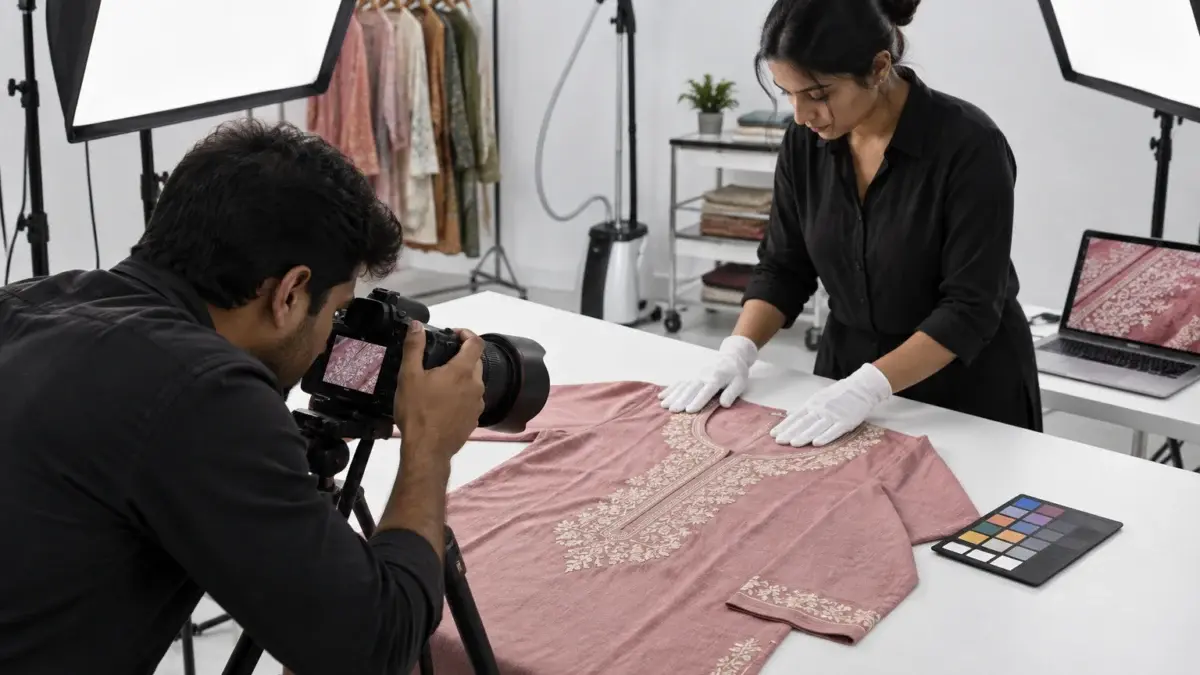
For an AJIO apparel set at Ckstudio we place a grey colour card in the first frame of every colour variant and set custom white balance from it. Lighting is two large softboxes at 45 degrees plus a strip box behind for edge separation on dark fabrics. Detail frames use a 100mm macro at f/8 so the weave stays sharp edge to edge. Files are exported as sRGB JPEG at 1600 × 2000 px, the 1:1.25 frame AJIO asks for, and checked against the physical garment under 5600K light before delivery.
Quality perception is the second lever. A buyer who sees the weave of a cotton slub, the backing of an embroidery panel or the sheen of a viscose blend in a 100% fill detail frame knows what will arrive. Brands that run all of this through dedicated ecommerce photography services get one consistent light setup across every style, which is what stops a navy and a black variant from looking identical on screen.
This short film from a fashion shoot shows how lighting and styling decisions translate into images that look like the garment in hand, which is the whole point when you are trying to stop colour and quality returns.
Yes, in our experience the edit is where many honest shoots go wrong. Keep retouching to dust, lint, loose threads and crease removal. Never shift hue, never smooth fabric texture away, and never use a single colour variant’s photo for another by recolouring it in software.
Fit returns fall when the size chart lists measured garment dimensions instead of generic body sizes, and when on-model images state the model’s height and the size worn. Shoppers then compare numbers instead of guessing.
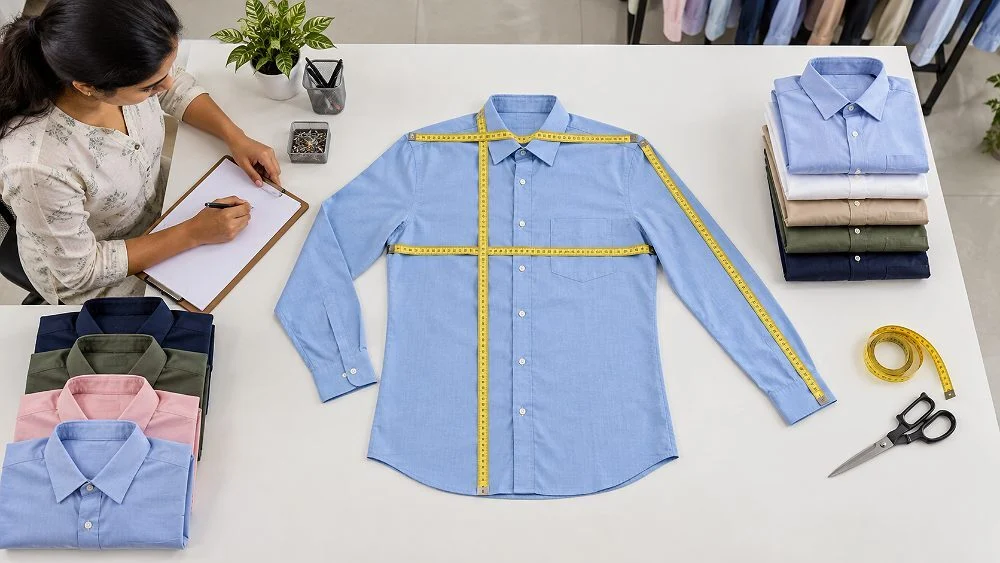
AJIO builds size buttons and the size chart from your template values, so a typo or a copied chart becomes a return later. Measure every size of a new style flat, not just the sample size: chest at one inch below the armhole, length from the highest shoulder point, sleeve from shoulder seam, waist and hip for bottoms. Grading errors between sizes are common in small-batch production, and only measuring each size catches them.
From the studio floor
Before an apparel shoot the Ckstudio team steams each sample, measures it flat in centimetres and inches, and records 5 measurements for tops and 6 for bottoms on a sheet keyed to the style code. The model’s height, bust or chest and the size worn go on the same sheet, so the catalogue team can write a line such as model height 5 ft 7 in, wearing size S into every listing without guessing.
Fit images close the loop. A front, side and back sequence on a model, plus one movement frame for flowing garments, shows length, drape and how the hem sits. For fit-sensitive categories like kurta sets, dresses and denim, a professional on-model photoshoot with stated model measurements does more for fit returns than any line of copy.
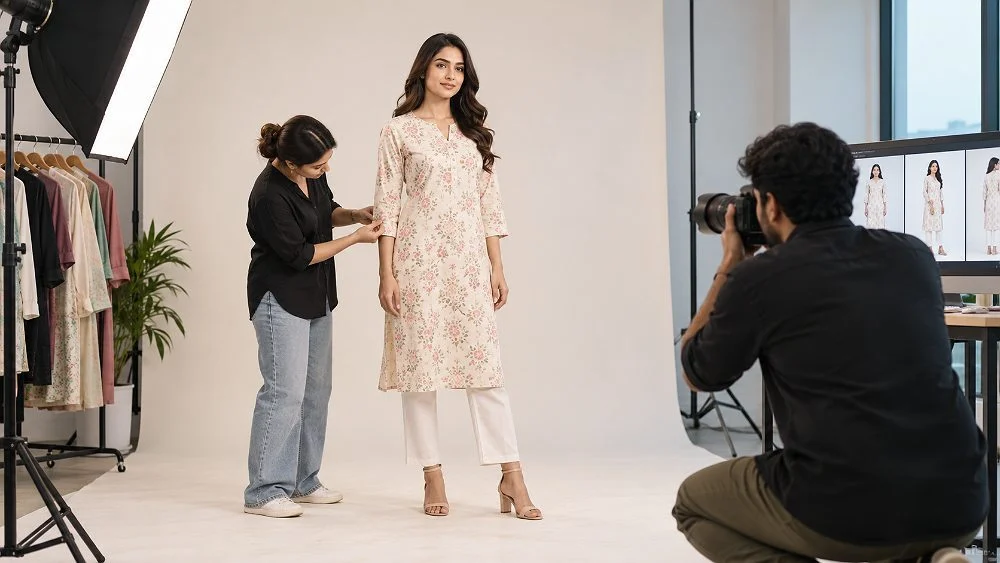
A clean listing video helps too, because movement shows stretch and drape. This apparel shoot shows how a short marketplace clip demonstrates fit across angles.
Variant structure matters as well. If sizes and colours are mapped wrongly, a shopper can order the right size from a listing showing the wrong colour. Our guide on AJIO size and colour variant mapping covers how to keep each colour’s images, swatch and sizes tied together.
The costliest mistakes are missing evidence, late claims, disputing returns you caused, and fixing listings by editing copy while leaving misleading images live. Each has a simple process fix.
| Mistake | What it costs | Fix |
|---|---|---|
| Packing without photos or video | Integrity claims cannot be proved | Fixed evidence station, every order |
| Opening returns before filming | Unboxing proof is lost | Returns go to the camera table first, unopened |
| Checking returns once a week | Three-day claim windows expire | Daily returns inspection slot |
| Disputing fit and colour returns | Time spent on claims that fail | Route them to catalogue fixes instead |
| Body-size chart copied across styles | Repeat fit returns per style | Measured garment chart per style |
| Saturated or recoloured images | Colour-not-as-shown returns | Colour-managed reshoot of each variant |
| No detail frame for fabric | Quality-perception returns | Macro detail at 100% fill |
The first is reading returns as a percentage of the whole catalogue. A 15% overall rate can hide one style at 40% and twenty styles near zero; fix the outliers first. The second is fixing a listing and then never checking whether the reason code changed. Note the date you replaced images or the size chart, and compare the next four weeks of returns for that style against the four weeks before.
A last trap is treating the customer comment as noise. Short phrases like “colour darker”, “runs small” or “fabric see-through” are the most specific feedback you will ever get on your catalogue, free of charge. Paste the top five comments for each problem style into your reshoot brief so the photographer knows exactly what the images must show.
A good weekly routine has four parts: daily return inspection with video, a weekly export and triage, claim follow-up, and a monthly catalogue fix list built from the top return reasons.
Looking ahead, expect e-commerce marketplaces to lean harder on evidence and on catalogue accuracy, because returns are expensive for the platform too. Sellers who already run colour-managed shoots, measured size charts and a filmed packing routine will spend less time arguing and more time selling. For a brand starting from scratch, the order is clear: build the evidence routine this week, fix the worst five styles this month, and reshoot the catalogue in batches as returns data shows where the gaps are.
If you want help planning that reshoot, call +91-8700258773, send a WhatsApp message to +91-8700258773 or email [email protected] with your style list and return reasons. Ckstudio will tell you which styles need new images and which only need a better size chart.
AJIO’s returns and refunds policy lists a 10-day return period for apparel, accessories and footwear, with some products and brands on different terms. The product page shows the terms that apply to each style, so check it before you plan AJIO seller returns stock.
The AJIO Commerce seller FAQ says a claim for a damaged return must be submitted within three days of receiving the return cargo, with documentation as per the Seller Protection Fund policy. Confirm the current terms inside your Seller Central.
Proof from both ends: a packing photo or video showing the item, tags and sealed parcel against the order ID, and an unbroken unboxing video of the return with the label visible. Together they show what left and what came back.
Yes, for expectation returns. Colour-managed images, a fabric detail frame and on-model shots with the model’s size stated answer the questions behind colour, quality and fit returns. They do not prevent damage or swapped items; evidence handles those.
Usually not. A garment returned for fit in saleable condition is a valid customer return. Use those returns to correct the size chart and fit images for that style, and save your claim effort for damaged, used or wrong-item returns.
Inspect physical returns daily because of the short claim window, export and triage the data weekly, and turn the top return reasons into a catalogue fix list every month.
Returns will never reach zero on a fashion marketplace, but the share you cause yourself can shrink month after month. Keep the evidence routine tight, read your reason codes by style, and let Prince and the Ckstudio team handle the images when the data says the catalogue is the problem.
Next step: once returns are under control, make sure new styles clear review on the first upload with our guide to fixing AJIO catalogue QC rejection errors.
Ckstudio shoots colour-managed, AJIO-ready apparel sets with measured size data on every style. Share your return reasons and we will plan the reshoot around them. Call +91-8700258773, WhatsApp +91-8700258773 or email [email protected].
Call Prince: +91-8700258773