

Fashion Photography Services
E-commerce Photography
The complete pre-shoot playbook for D2C jewellery brands, boutique jewellers and marketplace sellers across Delhi NCR — cleaning, styling, insurance, marketplace formatting and shoot-day logistics, distilled from 9+ years of on-set experience at Ckstudio.
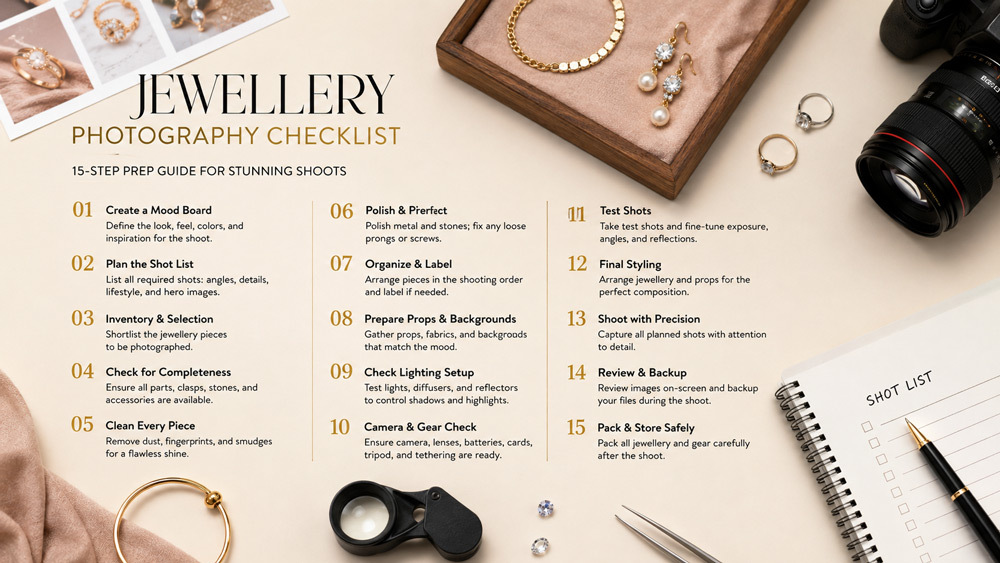
A great jewellery photograph almost never begins with the camera — it begins on a table three days earlier, with a lint-free cloth, an SKU sheet and a cup of chai. At Ckstudio, our Delhi NCR studio shoots over 6,000 jewellery pieces every year, and the single biggest gap between a “publish-ready” catalogue and a heartbreaking reshoot is prep. This Jewellery Photography Checklist is the exact 15-step system Prince and the Ckstudio team use with every boutique jeweller, D2C brand and marketplace seller who walks through our doors.
A complete Jewellery Photography Checklist covers three phases — pre-shoot planning (brief, inventory, insurance, styling), material-specific cleaning (gold, silver, diamond, kundan, polki), and shoot-day execution (kit, on-set approvals, marketplace-ready formats for Amazon, Flipkart, Myntra and Meesho). Follow all 15 steps and you shoot right the first time.
Before we get into the 15 steps, it helps to name the person on the other side of this checklist. This Jewellery Photography Checklist is written for a very specific reader — the jewellery store owner who has just placed a fresh collection into the display case, the ecommerce manager staring at a spreadsheet of 200 SKUs, the D2C jewellery founder brainstorming their next Instagram drop, and the marketing lead at a boutique brand who has been asked to “get catalogue images done by month-end”. If you are managing photography for Amazon, Flipkart, Myntra, Meesho or Ajio, or planning a lookbook for your D2C site, this playbook is aimed squarely at you.
The reason we invest so much space in this jewellery photography checklist is because we see the same painful pattern repeat every season — blurry final shots, fingerprint smudges catching macro light, dust settling on prong tips, reshoot costs eating into margins, product launches delayed by two weeks, no standardized prep process across the team, pieces getting misplaced during a busy shoot day, and worst of all, the colour on the ecommerce listing not matching what the customer eventually receives. These pain points are not the photographer’s fault and rarely the brand’s fault either — they are the fault of the missing checklist. Prince and the Ckstudio team built this document precisely so your brand never lives through that cycle again.
What every one of these readers actually wants is straightforward: shoot-ready jewellery on the very first attempt, zero avoidable reshoots, every piece looking at its absolute best, saved studio time and money, and complete compliance with the image guidelines Amazon India, Flipkart Seller Hub, Myntra and Meesho publish for jewellery categories. That is exactly what this checklist delivers.
The angle we take with this Jewellery Photography Checklist is deliberately different from the thin 500-word articles floating around the Indian internet. Most competing guides skip four critical topics — they leave out marketplace-specific prep requirements, they have no downloadable printable checklist, they never separate pre-shoot, shoot-day and post-shoot workflows, and they completely ignore insurance, transport and security prep. This piece fixes all four gaps, drawing on the same insider prep system used by Ckstudio photographers with 500+ jewellery brands across Delhi NCR. If you are also planning wider catalogue work alongside jewellery, our companion behind-the-scenes product photography guide and the complete ecommerce jewellery photography guide pair beautifully with this checklist.
Every jewellery brand we have onboarded at Ckstudio arrives with the same misconception — that great imagery is 90% about the camera. In reality, in the jewellery vertical especially, imagery quality is roughly 70% preparation, 20% lighting and only 10% camera choice. Once you internalise that, an ecommerce shoot checklist stops being paperwork and starts being your most important marketing asset. Prince often tells first-time clients — “Give me a well-prepared piece and a phone, I will still outshoot a badly prepared piece and a ₹8 lakh macro rig.”
The financial pain of poor prep hides in three places. First, the direct reshoot cost — a single half-day boutique reshoot in Delhi NCR typically runs between ₹15,000 and ₹40,000 depending on SKU count. Second, the opportunity cost — most brands lose 10-15 selling days on Amazon and Flipkart because their listings stay in draft during reshoots. Third, and most damaging, is the returns and complaints cost — when the shot does not match the real product, return rates in the jewellery category climb by 18-24%. If you want the full breakdown of how visual quality drives conversions, our detailed Amazon and Flipkart conversion guide quantifies each of these numbers with real brand data.
A codified Jewellery Photography Checklist saves money in three ways — it compresses shoot day by 3-5x because every decision is pre-made, it kills reshoot cycles because every piece arrives shoot-ready, and it makes catalogue expansion linear rather than chaotic. In our internal case study library, brands that follow this checklist see per-SKU photography cost drop by an average of 34% within the second production cycle. Prince and the Ckstudio team also observe that brands using this checklist scale their catalogues from 50 SKUs to 500 SKUs almost 6 months faster than those flying blind — the same phenomenon we documented in our scaling product photography guide.
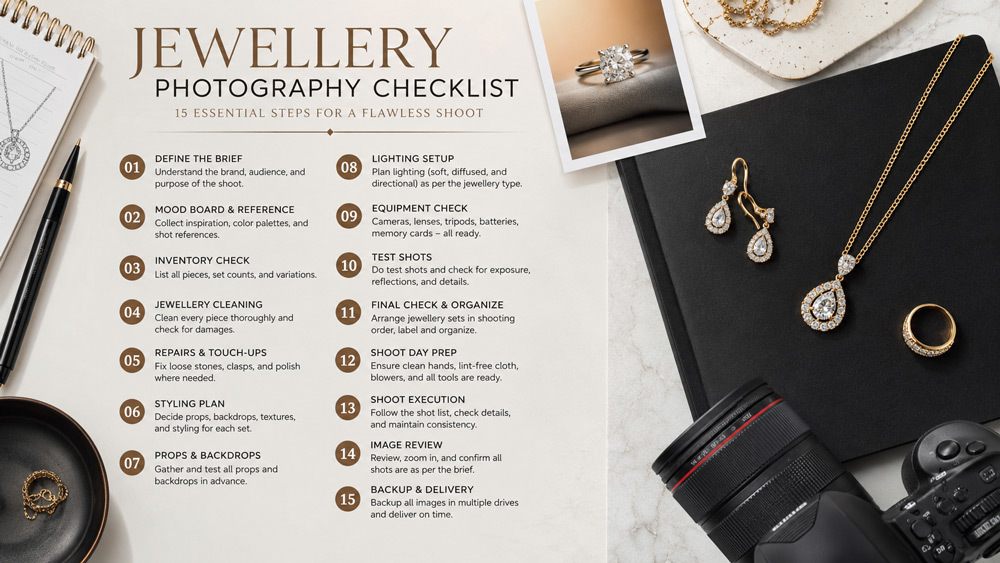
The first seven steps of this Jewellery Photography Checklist happen away from the studio — at your workshop, boutique or head office. Do not book the shoot day until at least four of these seven steps are complete. Rushing this phase is the single most common reason we see brands losing money on repeat shoots. Prince’s rule of thumb — “If it is not written down 5 days before, it will be forgotten 5 minutes before.”
A shoot brief is a one-page document that captures brand aesthetic, target audience, shot list, deliverable formats and reference images. Even for smaller brands, this single document saves 3-4 hours of on-set decision-making. Attach 8-10 reference images per collection, ideally curated on a shared Pinterest board — Vogue India editorials, competitor lookbooks and past hero shots make excellent references. If you are shooting fashion-forward jewellery, our lookbook photography team at Ckstudio can share a fill-in-the-blank brief template for free — just WhatsApp Prince on +91-8700258773.
Build a spreadsheet with columns for SKU code, product name, material, weight, retail price, shot type and angle count. Print two copies — one for your team, one for the studio floor. Every piece must physically ship with its SKU tag; unlabelled pieces are the second most common cause of on-set delays after dirty jewellery. Group pieces by material and finish so cleaning batches make sense — gold together, silver together, diamond-set pieces separately, and kundan/polki isolated. Our product photography guide for Indian brands includes a downloadable SKU template you can adapt for any collection size.
Every SKU needs a shot type decision before the shoot, not during it. For most catalogues we recommend a base mix of hero white-background shot, close-up detail, model on-hand or on-neck shot, and one lifestyle frame. High-value pieces additionally deserve a 360° photography treatment, while chains, necklaces and fashion jewellery increasingly need flat lay compositions for Instagram, Meesho and D2C sites. For garment-adjacent categories like layered necklaces, some brands also look at ghost mannequin photography as a bridge between product-only and full model shots.
Once shot types are locked, book your studio slot. Ckstudio in Delhi NCR operates on a first-come, first-served basis for jewellery clients because our macro rigs are calibrated fresh for every brand. Confirm timeline in writing — start time, break windows, expected end time and delivery date. If you are debating between working with a boutique studio versus a full-service partner, our comparison piece on how to choose the best product photography studio in Delhi NCR walks you through the trade-offs.
This is the step most brands skip — and it is the one that costs most when things go wrong. For any collection with a retail value over ₹5 lakh, arrange transit insurance from your insurer with the studio address explicitly named. Use tamper-evident bags for transit, request security escorts for high-value diamond and heavy gold collections, and hand over inventory at the studio only against a signed receipt. Prince personally counter-signs the inventory sheet for every high-value client at Ckstudio — call +91-8700258773 to walk through our security protocol before your first shoot with us.
Props should support the piece, never compete with it. Curate a prop kit including velvet display busts, acrylic risers, silk backdrops in cream and champagne, marble slabs, natural elements like dried petals or moss, and colour-coordinated ribbon. For boutique jewellers we usually recommend three backdrop finishes — ivory linen for editorial mood, black velvet for high-value luxury shots, and white acrylic for marketplace compliance. Our background selection guide covers this in more depth for fashion-adjacent categories.
Send your final shot list, reference images and approved styling notes to the photographer at least 48 hours before the shoot. Set expectations on approval workflow — will the founder be on set, or will approvals happen over WhatsApp? Do you want to review each SKU or work in batches of 10? Prince prefers batch-of-5 approvals for boutique brands because it keeps momentum without sacrificing quality control. Confirm all final references over email to [email protected] so there is a clean audit trail.
Talk to Prince about a shoot-ready collection walkthrough for your brand. Ckstudio has helped over 500 jewellery brands across Delhi NCR launch photography that actually converts.
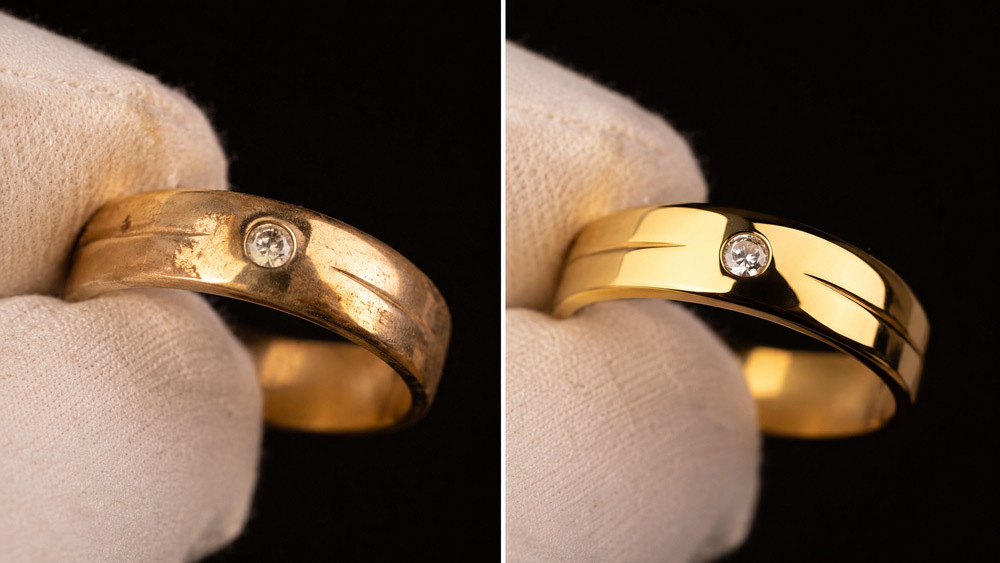
Cleaning is the single highest-leverage activity in this Jewellery Photography Checklist. In macro photography, everything that is invisible to the naked eye — fingerprint oil, dust particles, tarnish film, invisible lint from a jewellery pouch — appears as a distracting artefact in the final frame. The rule at Ckstudio is simple — “If we can see a fingerprint in the RAW file at 100% zoom, we shoot it again.” Cleaning saves that reshoot before it happens.
Always wear cotton gloves from the moment jewellery leaves the cleaning station to the moment it is on the shooting surface. One accidental thumbprint at 100mm macro focal length adds 20 minutes of retouching per shot.
Gold is forgiving but reveals fingerprints instantly. Wipe every piece with a lint-free microfiber cloth in single directional strokes, not circular motions. For heavier engraved pieces, dip briefly in warm water with a drop of pH-neutral soap, brush prongs with a soft baby toothbrush, rinse in distilled water and pat dry. Never use tissue paper — cellulose fibres will show up in every macro shot. Handle only with gloves after cleaning. If your gold pieces are ecommerce-bound, our ecommerce photography team can also handle the cleaning workflow on your behalf.
Silver requires tarnish management above everything else. Wipe with an anti-tarnish silver cloth immediately before the shoot — never more than 30 minutes in advance, since silver starts oxidising almost immediately in Delhi air. For heavily tarnished pieces, use a silver dip solution briefly, rinse in distilled water, dry completely and polish with a clean silver cloth. Store cleaned silver in anti-tarnish pouches until the exact moment of shooting. If your silver jewellery photography is scheduled during humid months in Delhi, plan for cleaning to happen on-site rather than at your workshop.
Diamonds attract oil like a magnet, and gemstones need gentler treatment than diamonds. For diamond pieces, use an ultrasonic cleaner with warm water and a drop of mild detergent for 60-90 seconds, followed by a soft brush around the prongs and a rinse in distilled water. For emerald, opal, pearl, coral and turquoise, skip the ultrasonic entirely — these stones can crack. Use a slightly damp lint-free cloth instead, and never expose to any solvent. For pieces set with mixed stones, always default to the most delicate stone’s cleaning method.
Kundan and polki jewellery are backed with lac — the moment you expose them to water or ultrasonic vibration, the lac loosens and the stones fall out. Rule: zero moisture, ever. Use only a soft dry brush to remove surface dust, followed by a dry lint-free cloth for the gold surrounds. Handcrafted meenakari, thewa and temple jewellery follow the same dry-only protocol. When in doubt on any traditional piece, ask the karigar who made it before you clean.
Styling is where a technically clean shot becomes a commercial shot. A well-cleaned ring on a bad backdrop still looks amateur, while a well-styled piece on the right surface will outperform an expensive competitor’s photograph in click-through-rate. At Ckstudio, our jewellery stylist works from a 12-parameter checklist for every single frame — surface texture, prop scale, negative space, colour temperature match, reflection control, prong angle, chain flow, backdrop cleanliness, camera height, focus point, depth-of-field decision and mood consistency.
Marketplace listings need pure white (#FFFFFF) backgrounds without exception. Beyond marketplaces, the choice widens — cream linen for editorial jewellery brands, black velvet for luxury diamond work, textured stone for handcrafted collections, and coloured paper backdrops for youth-focused fashion jewellery. Never use printed backdrops for jewellery — the printed texture always shows up on macro. Our background selection framework is worth revisiting per collection.
The rule is one prop, maximum two, per hero frame. A silk ribbon, a dried petal, a fabric fold — anything more than that turns product photography into set design. Props should be tone-matched to the jewellery: warm ivory and champagne for gold, cool grey and slate for silver, pastel and blush for fashion pieces. Keep an anti-prop discipline — every prop must earn its place, or it goes off frame. For lifestyle-heavy campaigns, our lifestyle product photography team can bring in a full styling kit.
Polished jewellery is a mirror. Every studio light, every white foamboard, every stylist’s black t-shirt reflects into the piece. Prep for this by asking your team to wear black on shoot day, keeping the shooting surface free of clutter, and dedicating one team member solely to fingerprint checks between shots. Prince keeps a black cloth flag near the tripod at all times specifically to hide any wayward reflections.
Before every hero shot, physically inspect prongs, clasps and chain lay. Prongs should sit uniformly, clasps must be hidden or intentionally styled, and chains should flow without kinks. This 30-second check per SKU saves hours of retouching downstream. Our image editing team in Delhi can fix small issues, but no editor can save a badly styled chain.
The shoot day itself is 90% logistics, 10% creativity. If your team arrives with everything on the kit list below and the styling brief locked, the actual shooting becomes almost meditative. At Ckstudio in Delhi NCR, we ask every client to arrive 45 minutes before the scheduled start — that buffer window is where quiet excellence gets built.
Agree on batch approvals up front — reviewing shot-by-shot destroys momentum, while batch-of-5 approvals let the photographer build rhythm. For every batch, the founder or brand lead should approve on three parameters — angle correctness, styling consistency and marketplace compliance. All rejections should be noted with reason so the reshoot is fixed on the same day, not scheduled for the next visit. Prince’s team at Ckstudio uses a shared iPad on-set for exactly this reason.
Marketplace compliance is a make-or-break area for jewellery brands, and one that most competitors’ checklists completely ignore. Each Indian marketplace has its own image guidelines, and non-compliance results in listing rejection or automatic delisting. Our compliance work covers all major platforms — but never assume last year’s rules still apply. Check the seller portal every quarter.
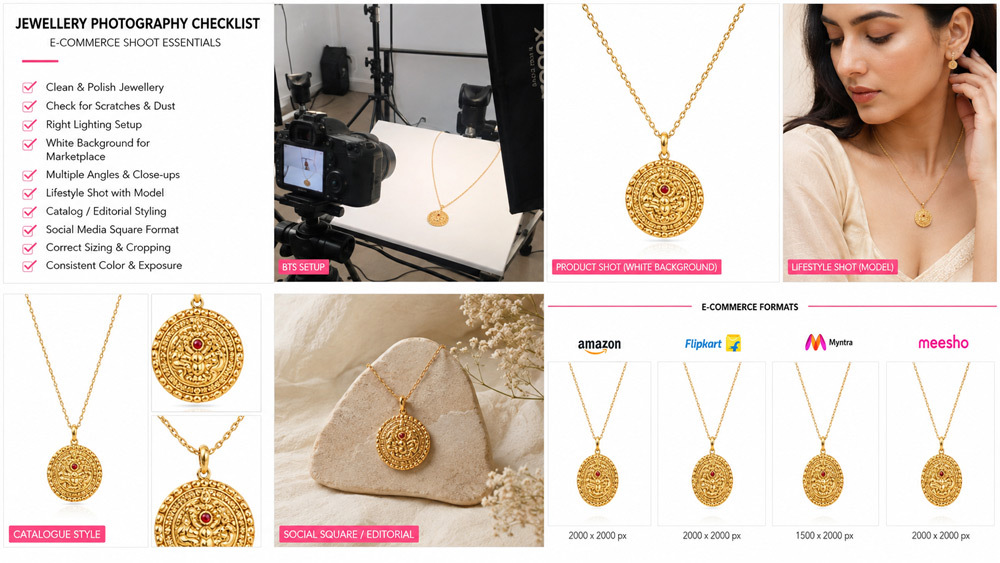
Amazon India requires pure white (#FFFFFF) background, 85% frame fill, 1000×1000 pixels minimum, JPG format, and no props or text on the main image. Six additional images are permitted for alternate angles, close-ups, packaging and lifestyle context. Our Amazon product photography team handles all six-frame packs as standard, including infographic-style callouts allowed on secondary frames. For the official Amazon rules on product image standards, refer to Amazon Seller Central India’s image guidelines.
Flipkart requires white background, 3:4 aspect ratio, 500×500 pixel minimum, and 8 shots per SKU across angle variations. Myntra is stricter on fashion positioning — chains and necklaces prefer a model shot as the primary listing image. Both platforms increasingly reward listings with lifestyle secondary images. Our Flipkart photography team and Myntra photography specialists deliver marketplace-ready packs directly from Delhi NCR. Flipkart’s own Flipkart Seller Hub is where you can verify the current specifications for your category.
Meesho leans more towards lifestyle and social-first shots, especially for fashion jewellery targeted at Tier-2 and Tier-3 buyers. Square 1:1 aspect ratio, natural lifestyle context and clear price-point communication perform best. For D2C websites, plan for a hero landing image (16:9), product grid images (1:1), lifestyle blocks (4:5), and social share images (9:16). Building a modular shot list from day one saves enormous rework later — a lesson we cover in our companion piece on Meesho product photography for beginners.
The last stretch of the Jewellery Photography Checklist is the retouching and delivery workflow. Great retouching is invisible — it fixes reality without falsifying it. At Ckstudio, our editors work to a strict brief: remove dust and fingerprints, correct colour to match the physical piece, restore metal shine to natural levels, but never reshape stones, resize prongs or alter carat impressions. This preserves both aesthetic quality and legal accuracy — critical for the jewellery category where returns are common when the received piece differs from the image.
Before approving any final delivery, verify five parameters — colour accuracy against the physical piece under D65 lighting, sharpness at 100% zoom, uniform white background where required, marketplace-compliant file dimensions, and consistent styling treatment across the collection. If any single parameter fails, request a targeted revision rather than a full re-edit. Approved files should be received in both master and marketplace-ready sizes, delivered through Ckstudio’s client portal or shared Google Drive.
After 500+ jewellery brand engagements, we see the same seven mistakes repeat almost every quarter. Watch out for these before your next shoot:
If you want the pricing benchmarks for what a professional jewellery shoot should actually cost in Delhi and Mumbai, our transparent breakdowns in the Delhi product photography cost guide and the Mumbai product photography cost breakdown are the clearest references online.
For brands weighing whether to run prep in-house or use Ckstudio’s full-service prep team, this comparison helps frame the decision quickly:
| Prep Task | DIY Brand | Ckstudio-Assisted | Time Saved | Risk Reduced |
|---|---|---|---|---|
| Cleaning | 4-6 hours per 30 SKUs | 90 minutes per 30 SKUs | 60-70% | Damage risk near zero |
| Styling | Ad-hoc, inconsistent | Stylist-led, brand-consistent | 2-3 hours | Reshoot risk 22% → 3% |
| Transport | Self-transport, uninsured | Insured escort service | Zero downtime | Full loss coverage |
| Insurance | Often skipped | Included in enterprise packs | N/A | 100% covered |
| Marketplace Approval | Often rejected first pass | Compliance-verified pre-edit | 7-10 days | Delisting risk removed |
| Retouching | Freelancer-dependent | In-house Ckstudio editors | 3-5 days | Colour accuracy locked |
Every package below includes prep support scaled to your collection size. For a bespoke quote based on your SKU count and shot list, WhatsApp Prince on +91-8700258773 — most quotes come back the same day.
| Feature | Basic | Standard | Premium | Enterprise |
|---|---|---|---|---|
| SKUs Included | Up to 10 | Up to 30 | Up to 75 | Custom |
| Cleaning & Prep Support | Guidance only | Basic on-site prep | Full-service prep + styling | Dedicated prep team |
| Shots per SKU | 3 | 5 | 8 | Custom |
| Retouching | Standard | Advanced | Premium editorial | Custom pipeline |
| Marketplace Formatting | ✅ | ✅ | ✅ | ✅ |
| Turnaround | 5-7 days | 4-5 days | 2-3 days | Priority |
A complete Jewellery Photography Checklist includes a shoot brief, SKU inventory, cleaning by material type, styling props, backdrops, insurance, transport, shoot-day kit, and marketplace-specific image formats for Amazon, Flipkart, Myntra and Meesho.
Use a lint-free microfiber cloth for gold, mild soap and a soft brush for diamonds, an ultrasonic cleaner for detailed pieces, and a specialised anti-tarnish cloth for silver. Avoid harsh chemicals on kundan, polki and delicate gemstone jewellery. Always work with cotton gloves after cleaning.
Start your jewellery shoot preparation at least 5-7 days before the shoot. This gives enough time for cleaning, inventory checks, brief approvals, marketplace format planning, and organising insurance and transport.
Bring your SKU list, cleaned jewellery in secure organisers, cotton gloves, cleaning cloths, reference images, brand style guide, colour swatch card, and any specific props or backdrops requested by the photographer. Ckstudio provides on-set touch-up tools for all clients.
An ecommerce shoot checklist ensures every product meets Amazon, Flipkart, Myntra and Meesho image guidelines, reduces reshoots, speeds up listing turnaround, and improves conversion rates through consistent high-quality visuals.
For small collections under 20 SKUs, in-house styling can work if you have a clear brief. Beyond 30 SKUs or for luxury positioning, a dedicated stylist saves time and lifts consistency. Ckstudio’s Premium and Enterprise packages include a dedicated stylist by default.
For any collection valued above ₹5 lakh, transit insurance is strongly recommended. Ckstudio’s Enterprise package includes escrow-style handover receipts and full transit coverage. Call Prince at +91-8700258773 for a walkthrough.
500+ jewellery brands. 9+ years of specialised experience. Zero-compromise prep. Talk to Prince for a custom quote today.
Prince is the founder and lead photographer at Ckstudio, a Delhi NCR studio specialising in jewellery, fashion and ecommerce product photography. Over 9+ years and 500+ jewellery brand engagements, Prince has built the internal prep systems now published in this checklist. Reach him directly at +91-8700258773 or email [email protected].