




Fashion Photography Services





E-commerce Photography



A seller-first guide to commission, fixed fees, collection, shipping, GST, settlement and real SKU profit — with current public rate-card examples and an interactive calculator.

Flipkart seller fees in 2026-27 are not one universal percentage. A seller can face a mix of commission, fixed/platform opportunity fee, collection fee, shipping or logistics fee, GST on applicable marketplace services, return-related adjustments and other account-specific deductions. The key business question is therefore not only “what is the commission rate?” but “what amount will actually settle to the bank, and what profit remains after COGS and operating costs?”
As of 2 October 2026, Flipkart’s public standard-rate page shows current examples for fixed, collection and shipping fees, while category commission remains seller/category specific. Flipkart also announced 0% commission for eligible products below ₹1,000 in November 2025 and expanded zero commission across all fashion categories and price points in July 2026. Sellers should still verify the live rate card in the Seller Dashboard before pricing a SKU.
New sellers can pair this economics guide with the Flipkart seller eligibility guide and the Flipkart seller registration guide. For sellers working across platforms, the planned Myntra seller hub provides a separate path for Myntra-specific account and catalogue topics.
For Flipkart seller fees, the total depends on product category, selling price, fulfilment method, chargeable shipping weight, delivery zone, payment mode and the seller’s current rate-card conditions. Some eligible products can have 0% commission, but other Flipkart seller charges can still apply. The only reliable final figure is the rate and settlement detail shown for the seller’s own account and SKU.
Flipkart seller fees are not a single charge. The cost stack can include marketplace commission, a fixed fee or closing fee (shown by Flipkart as a platform opportunity fee), payment collection cost, shipping fee, applicable GST on marketplace services, and adjustments for returns or reverse logistics. Selling price or average selling price (ASP), category, fulfilment and shipping geography can change the outcome.
Flipkart’s official fees and commission page says its public tables are standard-rate guidance and may change. The seller rate card shown inside Flipkart Seller Hub and the Seller Dashboard should therefore be treated as the final source for account-specific fees. This matters because an old blog table can make a profitable-looking SKU unprofitable.
| Fee / deduction | What it covers | How it is calculated | Main variable | Can it vary? | Verify in |
|---|---|---|---|---|---|
| Commission fee | Marketplace commission for the product category | Applicable rate × eligible selling value | Category + selling price | Yes | Seller Hub / rate card |
| Fixed fee | Platform opportunity / closing fee | ₹ amount by ASP and fulfilment bracket | ASP + FBF/NFBF | Yes | Seller rate card |
| Collection fee | Payment collection for prepaid or Cash on Delivery (COD) | Fixed or percentage of final selling price | Payment mode + ASP | Yes | Seller Dashboard |
| Shipping fee | Logistics fee for delivery | Chargeable weight + local/zonal/national geography | Actual/volumetric weight + zone | Yes | Rate card / shipment |
| GST / tax on services | Tax shown on applicable marketplace-service invoice lines | Base service fee + applicable GST | Service/tax treatment | Yes | GST invoice |
| Returns / reverse logistics | Return movement, refunds or account adjustments where applicable | Order-level adjustment | Return reason + policy | Yes | Settlement report |
| Ads / optional services | Advertising or value-added seller services | Usage/campaign based | Seller choice | Yes | Ads/service dashboard |

Flipkart announced a zero commission model for eligible products below ₹1,000 in November 2025. In July 2026, it expanded zero commission across every fashion category and price point. These changes materially alter Flipkart seller commission economics, especially for value products and fashion brands. When modelling Flipkart seller fees, keep the zero-commission rule separate from every other cost line.
However, Flipkart zero commission does not automatically mean zero total Flipkart seller fees. Fixed fee, collection fee, shipping fee, GST on applicable services, returns, reverse logistics, advertising and other marketplace deductions may still affect the final settlement. That distinction is central to accurate Flipkart seller margin calculation.
For eligible products priced below ₹1,000, the commission component can be 0%. A seller should still calculate the applicable fixed fee, payment collection and shipping cost for that SKU. The threshold also makes selling price strategy important: moving a SKU above or below a price band can change multiple parts of the cost stack, not only marketplace commission.
From July 2026, Flipkart says zero commission applies across fashion categories at every price point. For apparel and D2C clothing sellers, that makes packaging efficiency, returns, ad spend and catalogue quality more visible drivers of product margin. Sellers investing in fashion photography or garment photoshoot production should treat those content costs as business inputs rather than assuming zero commission equals cost-free selling.
| Scenario | Commission treatment | Other charges possible? | Seller must check |
|---|---|---|---|
| Eligible product below ₹1,000 | 0% commission under announced model | Yes | Current eligibility, fixed, collection, shipping, tax lines |
| Fashion product at any price point | 0% commission under July 2026 expansion | Yes | Category mapping, logistics, payment and other deductions |
| Non-fashion product above ₹1,000 | Category-specific commission may apply | Yes | Live category rate in Seller Hub |
| Shopsy product | Shopsy is positioned as a zero-commission platform | Yes | Current Shopsy rate card and seller conditions |

Flipkart seller commission remains category-specific where zero-commission treatment does not apply. Flipkart’s public fee page does not present one universal commission table; it tells sellers to check the current rate in their account because market conditions, seller ecosystem, category and other variables can change the rate. This is why a 2024 or 2025 commission table should not be copied into a 2026 pricing model. Accurate Flipkart seller fees start with the live category rate, not a recycled percentage.
For example, the current official fee page uses a Non-FBF juicer mixer grinder sold at ₹2,000 with a 5% commission in its illustrative calculation. That example is useful for understanding the formula, but it is not a universal 5% Flipkart commission rate. Use the actual category rate shown for the SKU in Flipkart Seller Hub.
The Flipkart fixed fee is shown on the public seller page as a platform opportunity fee, also described as a closing fee. Unlike a commission fee, it is a rupee amount tied to the average selling price band and fulfilment type. For low-ticket products, a fixed rupee charge can consume a larger share of product margin even when commission is zero. Within Flipkart seller fees, this fixed component can be material for value SKUs.
The table below reproduces the public standard-rate figures visible on 2 October 2026. Flipkart states that these values are subject to change, so use them for planning and then confirm the seller-specific rate card before listing or repricing.
| Average selling price (ASP) | FBF fixed fee | NFBF fixed fee |
|---|---|---|
| ₹0–₹300 | ₹14 | ₹16 |
| ₹301–₹500 | ₹14 | ₹16 |
| ₹501–₹1,000 | ₹30 | ₹30 |
| Above ₹1,000 | ₹50 | ₹55 |
A Non-FBF SKU selling at ₹799 falls in the ₹501–₹1,000 bracket, where the current public standard fixed fee is ₹30. If that SKU is eligible for zero commission, the ₹30 fixed fee still remains a cost line before collection, shipping, taxes and any return adjustment. This is the practical reason zero commission and zero seller charges should never be treated as synonyms.
Flipkart collection fee covers payment collection and varies by final selling price under the public standard rate card. The seller page distinguishes prepaid orders such as UPI or net-banking from Cash on Delivery (COD), but the published standard amounts are currently the same across the two payment modes for the listed ASP brackets.
| Order value | Payment type | Collection rule | Estimated cost / rule |
|---|---|---|---|
| ₹0–₹750 | COD | ₹12.50 | Fixed amount under the standard rate card |
| ₹0–₹750 | Prepaid | ₹12.50 | Fixed amount under the standard rate card |
| Above ₹750 | COD | 2% of final selling price | Percentage grows with ASP |
| Above ₹750 | Prepaid | 2% of final selling price | Percentage grows with ASP |
For a ₹1,499 order, a 2% collection rule produces ₹29.98 before any applicable service-tax line. The margin impact grows with selling price, so sellers should not model collection fee as a fixed ₹ amount for all SKUs. When calculating Flipkart seller fees, keep collection as its own line item. The current Seller Dashboard remains the final verification point.
Flipkart shipping fee is driven by chargeable weight and delivery geography. The official fee page states that shipping uses actual weight or volumetric weight, whichever is higher. A lightweight product in oversized packaging can therefore cost more to ship than a denser product packed efficiently. Shipping can therefore be one of the most variable Flipkart seller fees for bulky SKUs.
Local shipping means intracity movement, zonal shipping means movement within a zone, and national shipping means inter-zone movement. Under the current standard table, the first 0.5 kg is shown at ₹47 local, ₹54 zonal and ₹68 national, with additional weight buckets charged incrementally. Sellers should check precise packed dimensions and the live shipping rate before estimating Flipkart seller fees.
| Shipping type | Typical geography | Weight basis | Main margin risk |
|---|---|---|---|
| Local | Within the same city | Higher of actual weight or applicable volumetric weight | Usually lowest distance component; packaging dimensions still matter |
| Zonal | Within the same delivery zone | Chargeable weight + zone | Moderate cost can rise with oversized packaging |
| National | Across delivery zones | Chargeable weight + inter-zone distance | Highest distance exposure in the standard table |
The practical fix is operational: reduce empty space, standardise packaging dimensions and record actual packed weight by SKU. The Flipkart product image and specification guide can be used alongside packaging and listing preparation so the catalogue team is not solving content and logistics issues at the last minute.

Fulfilment by Flipkart (FBF) means Flipkart manages storage, packaging, shipping and delivery within the programme. Non-Fulfilment by Flipkart (NFBF) keeps seller-side storage and packing responsibilities while Flipkart’s logistics network handles delivery after pickup. The operational convenience and landed cost can differ, so neither option should be treated as universally cheaper. The effect on Flipkart seller fees must be tested with the seller’s own fulfilment and order mix.
Flipkart’s public fee page shows different fixed-fee values for FBF and NFBF in several ASP bands. A seller should compare Flipkart FBF charges and Flipkart Non-FBF charges together with packaging, inventory control, staff time, working capital and expected shipping geography.
| Factor | FBF | Non-FBF | Profitability question |
|---|---|---|---|
| Fulfilment responsibility | Flipkart-managed storage/packing/shipping workflow | Seller packs stock; Flipkart logistics picks and delivers | Compare landed cost, not convenience alone |
| Fixed fee | FBF bracket applies | NFBF bracket applies | Check current seller rate card |
| Shipping | FBF economics depend on programme charges | Normal shipping cost based on local/zonal/national movement | Model common delivery geography |
| Packaging | Managed within FBF workflow | Seller controls packed dimensions | Dimensions affect chargeable weight |
| Operational workload | Lower fulfilment handling for seller | More seller-side preparation | Value staff/time cost |
| Inventory control | Inventory is stored in the fulfilment network | Inventory remains with seller/community warehouse | Compare stock velocity and working capital |
| Settlement economics | Programme fees + applicable deductions | NFBF fees + shipping + deductions | Use order-level settlement report |
Flipkart GST on seller fees should be treated separately from the GST charged on the product sale. Marketplace-service invoices can contain a base fee and applicable GST, while product-output GST belongs to the seller’s sale-side tax treatment. Mixing the two makes settlement reconciliation difficult. GST on applicable marketplace services should be modelled as part of the complete Flipkart seller fees workflow, not confused with product-output GST.
Sellers should match every GST invoice to settlement lines and assess input tax credit only under the law and compliance position that applies to their business. The CBIC ecommerce guidance explains Tax Collection at Source (TCS) concepts for ecommerce operators. TCS is a separate reconciliation item; it should not be blended into the platform commission line.
TDS can also appear as a separate tax-reconciliation topic depending on the transaction and current law. The Income Tax Department’s TDS guidance should be used with an accountant for business-specific treatment. This article is a marketplace-cost planning guide, not tax advice.
A reliable Flipkart marketplace cost calculation starts with the SKU, not a brand-wide average. This step-by-step method turns Flipkart seller fees into auditable inputs instead of a single guessed percentage. The process below separates the fee layers so a seller can identify exactly which assumption changes the final seller settlement.
Settlement is not profit. A Flipkart seller payment may look healthy, but the business still has to pay cost of goods sold (COGS), packaging, labour, warehousing, advertising, return allowances and other variable costs. The difference between seller settlement and net margin is where many pricing errors occur. Flipkart seller fees are deducted before the seller reaches true business profit.
For SKU profitability, also monitor contribution margin before fixed business overhead. A product can have strong revenue but weak contribution margin if shipping, returns or ads rise faster than its product margin.
This calculator is an educational planning tool for Flipkart seller margin calculation. Enter the live fee values from your account rather than treating the defaults as universal rates. The output estimates Flipkart seller fees, settlement, net profit and margin percentage.
Illustrative calculator only. Enter the current seller rate card, invoice tax and actual business costs for your SKU.
Fee planning should also connect to listing quality and conversion. Ckstudio’s Flipkart product photography guide and Flipkart listing images guide explain the content side of marketplace performance, while this calculator focuses on transaction economics.

The three examples below are worked planning scenarios showing how Flipkart seller fees combine using the public standard fixed, collection and shipping figures visible on 2 October 2026. Where a fee-tax amount is shown, it is an illustrative 18% calculation on the selected marketplace-service fee base for teaching purposes; sellers must use the actual GST invoice and tax treatment in their account.
Selling price ₹799; eligible commission ₹0; NFBF fixed fee ₹30; collection fee ₹15.98; local 0.5 kg shipping ₹47; illustrative fee tax ₹16.74. Total marketplace cost is ₹109.72 and estimated settlement is ₹689.28. With COGS ₹300, packaging ₹25, ads ₹40 and return/operational allowance ₹30, estimated profit is ₹294.28, or 36.83% of selling price.
Selling price ₹1,499; fashion zero commission ₹0; NFBF fixed fee ₹55; collection fee ₹29.98; illustrative zonal 1 kg shipping ₹73; illustrative fee tax ₹28.44. Estimated settlement is ₹1,312.58. After COGS ₹650, packaging ₹35, ads ₹90 and return allowance ₹75, estimated net profit is ₹462.58, or 30.86%. The example shows why Flipkart fashion zero commission improves one cost line but does not remove all marketplace and business costs.
Selling price ₹2,000; illustrative 5% commission ₹100, matching the current official juicer-mixer-grinder example; NFBF fixed fee ₹55; collection fee ₹40; national 2 kg shipping ₹144; illustrative fee tax ₹61.02. Estimated settlement is ₹1,599.98. After COGS ₹950, packaging ₹40, ads ₹120 and return allowance ₹80, estimated profit is ₹409.98, or 20.50%.
| Scenario | Selling price | Commission | Other fees + illustrative tax | Shipping | Estimated settlement | COGS | Estimated profit | Margin |
|---|---|---|---|---|---|---|---|---|
| Sub-₹1,000 eligible SKU | ₹799 | ₹0 | ₹62.72 | ₹47 | ₹689.28 | ₹300 | ₹294.28 | 36.83% |
| Fashion SKU above ₹1,000 | ₹1,499 | ₹0 | ₹113.42 | ₹73 | ₹1,312.58 | ₹650 | ₹462.58 | 30.86% |
| Non-fashion SKU above ₹1,000 | ₹2,000 | ₹100 | ₹116.02 | ₹144 | ₹1,599.98 | ₹950 | ₹409.98 | 20.50% |
The Flipkart settlement amount starts from the eligible order value and then reflects marketplace deductions such as commission, fixed fee, collection, shipping, applicable service taxes, returns, refunds and adjustments. TCS and TDS should be read as separate tax-reconciliation lines where relevant rather than being casually merged into seller fees.
A settlement can also include previous-cycle adjustments, promotional or service entries and return-linked credits or debits. That is why bank credit should be matched to the order-level settlement report, not compared only with the original selling price. The settlement report is the best place to see how actual Flipkart seller fees were applied to an order.
| Order ID | Selling value | Commission | Fixed | Collection | Shipping | GST/Tax | Returns/adjustments | Expected settlement | Actual settlement | Difference |
|---|---|---|---|---|---|---|---|---|---|---|
| Example-001 | ₹2,000 | ₹100 | ₹55 | ₹40 | ₹144 | ₹61.02 | ₹0 | ₹1,599.98 | Enter actual | Calculate |
Return-related economics deserve their own review. The Flipkart seller returns and claim policy guide can be used with settlement reconciliation so recurring return costs are not hidden inside monthly revenue.
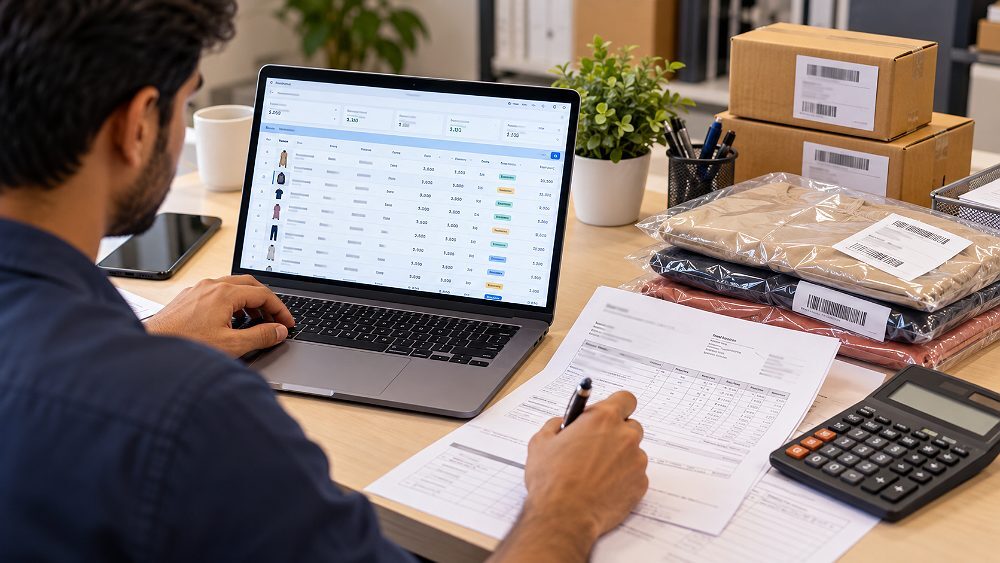
A seller should judge profitability at SKU level rather than from topline marketplace revenue. Consider two products that each generate ₹2 lakh in monthly sales. SKU A may use compact packaging, attract a low return rate and need modest ad support; SKU B may have bulky packed dimensions, higher reverse logistics, more discounting and a larger ad budget. Their revenue is identical, but their contribution margin can be completely different. Even perfectly calculated Flipkart seller fees cannot explain that gap unless SKU-level operating costs are included.
This is where finance, operations and catalogue work meet. At Ckstudio, marketplace projects often reveal that packaging discipline, consistent images, size/feature clarity and catalogue quality are operational inputs, not decorative extras. That experience can inform content-production planning, but sellers should use their own finance team or accountant for tax treatment and business-specific profitability decisions.
Improving margin starts with accurate Flipkart seller fees, then moves into packaging, returns, advertising and conversion. The objective is to improve contribution margin without relying on revenue growth alone.
Use this quick entity glossary when reading a seller rate card or settlement report. Flipkart Seller Hub is the seller-facing account environment for managing the Flipkart marketplace. The Seller Dashboard shows account and transaction information. A rate card or seller rate card describes applicable seller charges.
Most errors happen when Flipkart seller fees are treated as one percentage or when settlement is mistaken for profit. Use the checklist below before changing a product price.
Before listing or repricing a product, confirm each item below. This checklist turns Flipkart seller fees into a repeatable operating routine instead of a one-time spreadsheet exercise.
If catalogue performance is part of the margin problem, review catalogue upload, listing rejection fixes and Flipkart model photography as separate operational workstreams.
These answers summarise the main 2026-27 Flipkart seller fees questions. Live account rates can still differ, so the Flipkart Seller Hub remains the final check.
Flipkart seller costs can include commission, fixed fee, collection/payment charges, shipping and applicable taxes or transaction adjustments. The exact amount depends on category, selling price, fulfilment and current seller rate-card conditions.
Flipkart has zero-commission programmes for eligible products below ₹1,000 and, from July 2026, across fashion categories and price points. Zero commission applies to the commission component; other seller charges can still apply.
Start with estimated seller settlement, then subtract product cost, packaging, advertising, returns and other variable operating expenses. Divide the resulting net profit by selling price and multiply by 100 to estimate profit margin.
GST can apply to marketplace-service invoice lines according to the applicable tax treatment. Reconcile base fee and GST separately, then use the actual GST invoice and professional tax advice for input tax credit or business-specific treatment.
Settlement starts from eligible order value and is adjusted for marketplace fees, logistics costs, applicable taxes, refunds, returns and transaction adjustments. Reconcile the final amount against the order-level settlement report and bank credit.
Ckstudio helps ecommerce sellers build marketplace-ready product imagery and catalogue content. For project planning, call Prince on +91-8700258773, WhatsApp +91-8700258773 or email [email protected].
The most useful way to read Flipkart seller fees is as a complete seller-economics stack. Commission, fixed fee, collection, shipping, tax lines, settlement adjustments and business costs all affect the final result. Zero commission can improve economics significantly, but it does not remove the need for SKU-level cost control.
Ckstudio recommends keeping the live seller rate card beside the pricing sheet and reconciling estimated fees against actual settlement every month. Sellers expanding to fashion-led channels can also use the Myntra seller hub and the Myntra seller fees guide for marketplace-specific planning.