Fashion Photography Services

E-commerce Photography
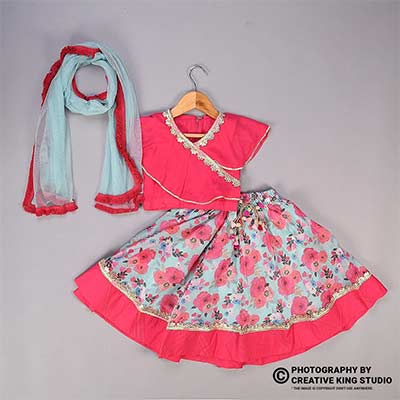
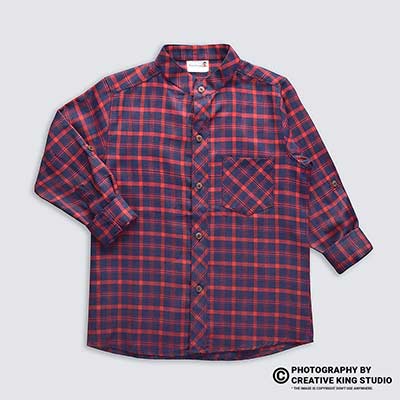
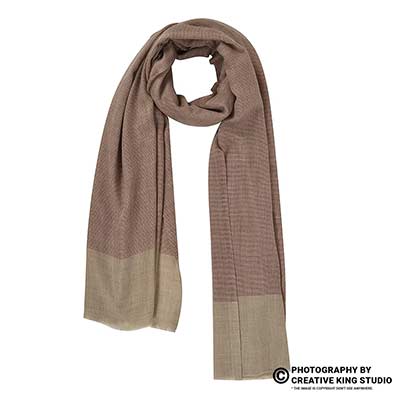
A practical, apparel-first playbook from an Indian standard ecommerce photography studio — covering model selection, poses, catalogue views, styling, AI photography and Delhi pricing.
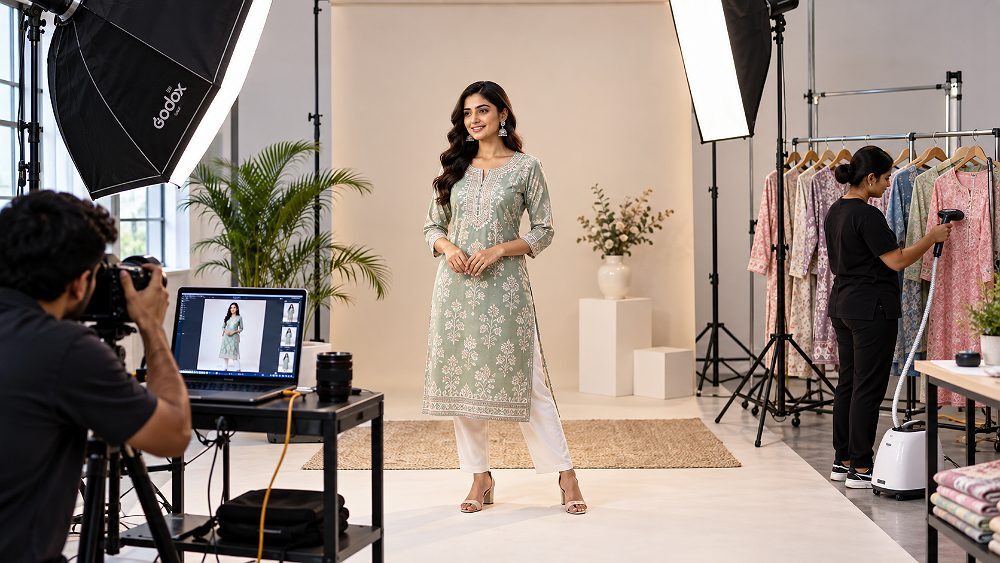
Flipkart model photography is apparel and fashion photography in which real or AI-generated models wear the product to show fit, scale, silhouette and styling to marketplace shoppers. A production-ready Flipkart apparel set documents the garment from the front, three-quarter, side, back and important fabric/detail views, plus optional lifestyle images — while staying inside the current Flipkart Seller Hub category requirements.
Flipkart model photography for apparel requires more than placing a garment on a model and taking attractive fashion photographs. Fashion sellers need a repeatable system for fit, poses, garment views, styling, colour accuracy and catalogue consistency — because Flipkart shoppers are effectively judging drape, silhouette and size confidence from a small mobile thumbnail.
At Ckstudio, our team has produced thousands of Flipkart-ready apparel SKUs for kurti brands, dress labels, menswear, ethnic wear and D2C fashion labels across India. In this guide, Prince shares the exact 11-shot framework, model-selection criteria and production workflow we use inside our ecommerce photography services in Delhi to help sellers scale confidently from 10 SKUs to 500+ SKUs.
You’ll learn what really belongs in the primary catalogue image versus a lifestyle image, how to plan front/back/side coverage, when a Flipkart product photography with ecommerce model shoot approach outperforms flat lay, when AI model photography actually works, and how to budget realistically. Marketplace specifications can change — always confirm current image requirements inside Flipkart Seller Hub before your final upload.
Search intent behind Flipkart model photography is a mix of commercial investigation and information — sellers want to know what to shoot and, very often, who should shoot it. Unlike generic packshot photography, Flipkart fashion photography has to solve a specific buyer problem: apparel shoppers can’t touch the fabric, so the images must simulate drape, fit and scale in seconds.
A standard Flipkart product photography shot focuses on the physical item — flat lay, hanging shot or ghost mannequin. Model photography adds fit, scale, silhouette and styling context. The product still remains the primary subject — the model is a scale reference, not a fashion portrait. This is where beginner sellers often get it wrong: they hire an editorial-style fashion photographer instead of an ecommerce-trained catalogue team, and the resulting images look premium but fail to sell.
Simple example: a plain white T-shirt shot flat can look identical to five other listings. The same T-shirt worn on a model, photographed from front/back/side, communicates length, neckline, sleeve fall and body-scale in a single glance. That is the core difference between a packshot and an ecommerce model shoot.
Model images are most useful when fit, drape, proportion, styling or real-world scale influences the purchase decision. Typical Flipkart categories where model photography is strongly recommended include:
For garments where fit is a major return-driver, plan a strategy to reduce returns using better product images before locking your shot list.
Before we go into creative planning, let’s ground the article in what Flipkart actually expects from apparel imagery. Because category-level rules can change, this section explains the principles — the final numeric checks should be confirmed inside Seller Hub.
The primary catalogue image should be product-first — uncluttered background, accurate colour, garment fully visible, no misleading retouching and no promotional text overlays. Buyers see this image as a thumbnail first, so silhouette and colour must read within milliseconds. Aggressive filters that shift the garment’s actual colour are a common reason for listing rejection and customer complaints.
A complete apparel image set should answer how the garment looks from the front, back and side, and show important fabric, construction and design details. Recommended fashion coverage:
Consistent camera height, focal length and model position across a catalogue is what separates a professional fashion catalogue from a stitched-together set of individual shots. This is exactly why we treat ecommerce catalog photography consistency at scale as its own workflow discipline.
Consistent white balance, matching camera height, similar model position, similar garment scale and standardised crop are non-negotiable for a fashion catalogue. Avoid excessive skin or garment retouching, and always match colours closely to the physical sample — the customer will compare the delivered product to the listing, and a colour mismatch is one of the fastest ways to earn a return.
For a broader compliance walkthrough that complements this article, use our Flipkart photography guidelines and the deeper Flipkart product photography guide.
This is the core framework we run inside our Delhi studio for every fashion catalogue. Think of it as the minimum viable set for a Flipkart-ready apparel SKU — it works for kurtis, dresses, shirts, T-shirts, activewear and most fashion categories.
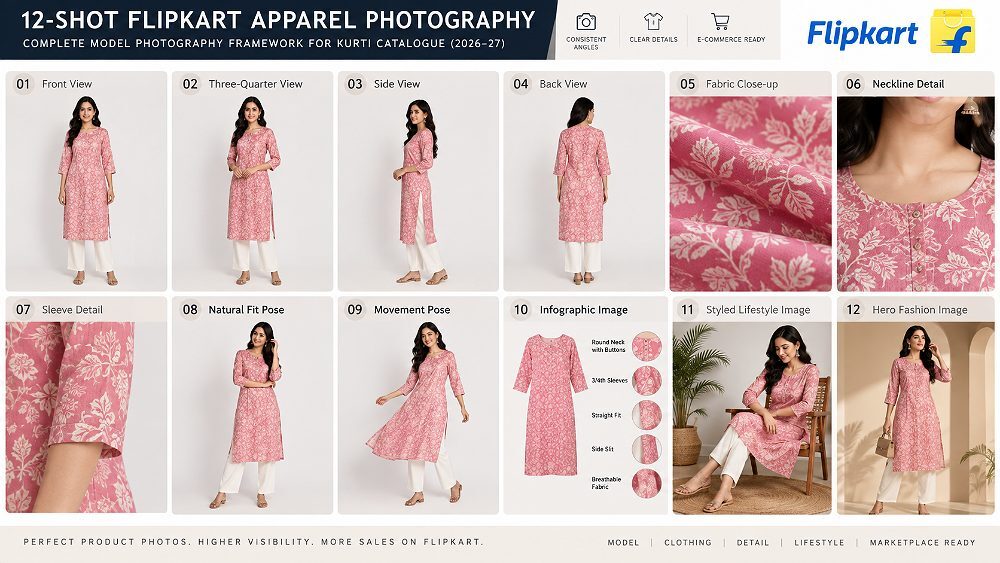
The first four shots are non-negotiable. They form the backbone of every Flipkart apparel listing and should be photographed with identical camera height, framing and lighting.
Show silhouette, neckline, length and overall fit. Model stands relaxed, feet slightly apart, arms clear of the torso so the garment outline reads cleanly.
A subtle 30–45° turn adds shape and depth while keeping the garment readable. This is often the strongest hero image after the flat front.
Shows garment depth, sleeve shape, side construction and how the fabric falls at the hip. Essential for structured pieces like blazers and A-line kurtis.
Documents back neckline, prints, pleats, closures, embroidery and overall rear fit. Skipping the back view is one of the top reasons Flipkart apparel buyers ask pre-purchase questions.
These four detail images are what convert curious shoppers into confident buyers. They mirror what a customer would do in a physical store — flip the collar, touch the fabric, check the stitching.
Show weave, embroidery, print, weave direction or fabric texture. This is where premium apparel earns its price tag on-screen.
Zoom on the neckline, collar shape or key construction element — the visual proof of quality that flat-lay images almost never capture.
Capture functional or design-specific elements like cuff style, pocket placement, buttons, zips or drawstrings. Especially important for menswear and workwear.
A quiet, natural stance that helps buyers understand how the garment truly falls on the body — not a fashion pose, more of a documentation frame.
These are the storytelling shots. They aren’t always required by Flipkart, but they lift click-through rates, work on ads, and can be repurposed for your website and social. Learn more about crafting lifestyle product photography assets that carry both catalogue and brand weight.
Twirl, walk or subtle motion — shows fabric flow and garment behaviour. Especially powerful for flared kurtis, dresses, sarees and skirts.
Model in a contextual environment (café, terrace, minimal interior) that communicates use case without distracting from the product. Backgrounds stay soft.
A single premium visual — usable as the campaign banner, ad creative, or landing-page hero. This is the shot that also feeds your fashion lookbook photography requirements.
Direct answer: A production-ready Flipkart apparel image set covers the garment from the front, back and both sides, adds three to four detail views for fabric and construction, and includes one to three lifestyle or hero images for branding — while staying within the current Seller Hub category image count.
Model casting is where many sellers accidentally sabotage their own catalogue. The best ecommerce model is not automatically the most editorial-looking model — they must photograph clearly, wear the sample size cleanly and communicate the customer’s aspiration.
Casting should be driven by the customer demographic, the sample size on hand, model height and proportion, brand positioning, whether it’s menswear, womenswear or kidswear, and whether the label is ethnic or western. A premium ethnic-wear brand needs a model who elevates drape and jewellery scale; a mass-market kurti brand needs a relatable face that mirrors the average Flipkart buyer.
Working with agencies that understand catalogue shoots — not only editorial ramps — helps. Explore how to shortlist through experienced modeling agencies in Delhi or book through our in-house model photoshoot in Delhi panel of ecommerce-trained talent.
Avoid poses that hide product details. Avoid excessive twisting that distorts prints or seams. Check for pulling and wrinkling before the shutter fires. Steam every garment. Pin only where it does not misrepresent the actual fit — a garment that looks perfect on set but arrives loose to the customer is a guaranteed return. This is one of the reasons we insist on real garments over fully synthetic setups when accuracy matters; see our take on real photography vs AI-generated product images.
Use the same model wherever possible for one collection, use the same pose marks, same camera and lens position, same crop and same lighting. Batch colour-correct at the end. When we scale from 50 SKUs to 500 SKUs, this discipline is what keeps the storefront looking like a single cohesive catalogue instead of a patchwork.
Styling is the invisible layer that makes a good Flipkart fashion photography set look premium — or cheap. A rushed styling call almost always shows up in the final images. For fashion sellers preparing samples, our garment preparation guide for ecommerce model shoots covers the pre-shoot checklist we hand every client.
Keep accessories secondary. Avoid oversized props. Keep footwear and jewellery relevant to the price point. Maintain repeatable styling across SKU families — if a kurti collection is being sold with the same style of leggings, use the same colour of leggings across the whole set.
Controlled lighting, consistent white balance, a calibrated editing workflow and comparing the edited file against the physical sample — this is what separates catalogue-grade retouching from Instagram-grade retouching. A recent Ckstudio project had two kurti fabrics that read as the same shade of green under natural light but needed separate colour-treatment profiles in post to stay accurate on-screen. That’s the level of colour work an experienced fashion ecommerce team quietly delivers.
Lifestyle photography is often oversold. It’s genuinely valuable — but only when it complements a strong catalogue set, not when it replaces it.
| Factor | Catalogue Photography | Lifestyle Photography |
|---|---|---|
| Primary objective | Product clarity | Context and aspiration |
| Background | Clean, controlled | Environmental, styled |
| Pose style | Documentation | Story-driven |
| Product visibility | Maximum | Secondary to mood |
| Marketplace usage | Primary listing | Ads, social, PDP support |
Keep the visual claim focused on merchandising clarity and shopper understanding — not promises of guaranteed ranking uplift. Real branding value comes from repeatable, on-brand images that also power your fashion catalogue shoot planning and future campaigns.
This is the fastest-moving question in Indian ecommerce photography right now, and the honest answer is: it depends. Neither approach wins across the board. For a detailed breakdown, see our dedicated comparison: AI Flipkart photography vs real photoshoot.
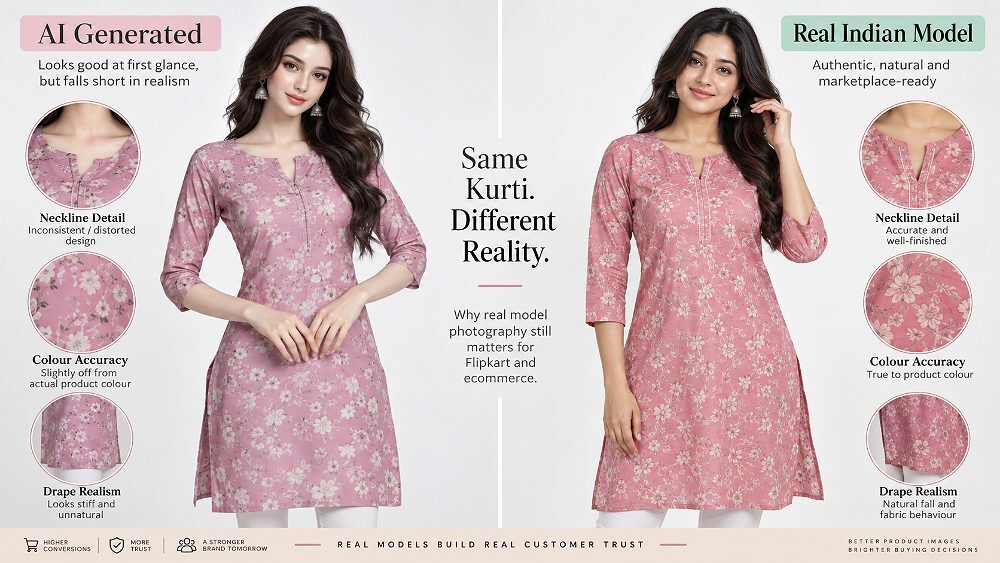
AI model photography works well for high SKU volume, reusing clean garment cutouts, fast creative testing, regional creative variations, secondary marketing content and budget-sensitive catalogue extensions. The critical rule: AI output must not materially misrepresent garment colour, construction, length, fit, print or included accessories. If the AI image implies a fit or drape the physical product does not deliver, you’re generating a return waiting to happen.
Real models win for complex drape (sarees, layered ethnic wear), fit-sensitive garments, sheer or reflective materials, premium campaigns, and any new product where accurate reference imagery does not yet exist. If the garment sells fit as its main promise, real model documentation is the safer bet.
The workflow we recommend inside our studio is:
REAL PRODUCT MASTER → ACCURATE GARMENT CUTOUT → AI OR REAL-MODEL VARIATIONS → HUMAN QC → MARKETPLACE-SPECIFIC EXPORT
Use real product photography as the visual source of truth — even when AI models are introduced later — so your catalogue always traces back to a physically verified sample.
An ecommerce model shoot is a production project, not a photography session. Treating it as production is the single biggest mindset shift for fashion sellers scaling beyond 50 SKUs.
Step 1: Product/SKU audit — list every garment, note sample size, matching accessories and any special handling. Step 2: Create a shot matrix — a spreadsheet that maps each SKU to the 11 shots. Step 3: Select model and styling direction — cast based on the audit, not on vibe. A structured ecommerce photography workflow starts weeks before shoot day.
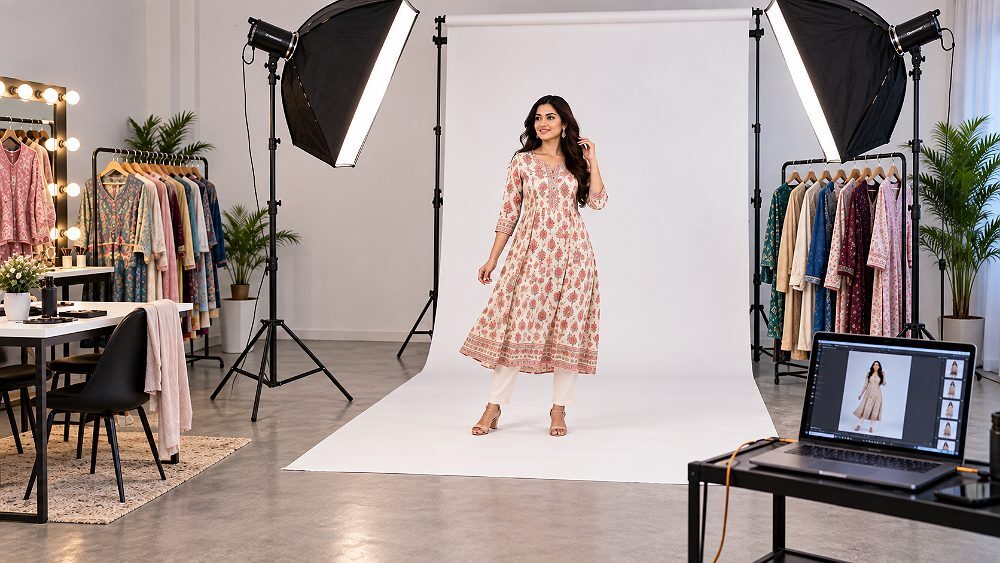
Step 4: Shoot consistent catalogue views tethered to a laptop for real-time review. Step 5: On-set product and fit QC — this is where the stylist and photographer stop the shoot if something looks off. Step 6: Retouching and colour correction, batched by SKU family for consistency.
Step 7: Export marketplace-ready files sized to current Flipkart specifications. Step 8: Final QC against current Seller Hub category requirements before delivery. If you’d like the deeper marketplace-side workflow, our Flipkart listing images guide and Flipkart A+ content guide continue where this article ends.
A short walkthrough of what a real Flipkart model photography day looks like inside an Indian standard ecommerce photography studio — from garment steaming and lighting setup, to model posing, front/back documentation, tethered review, retouching comparison and the final catalogue output.
You can see more of our production work on the Ckstudio portfolio and browse related behind the scenes of product photography stories.
Pricing questions are the most common commercial query we receive — and the most misunderstood. There is no single per-image rate that fits every fashion project. For city-specific benchmarks, our product photography cost in Delhi and the specific Flipkart photoshoot charges in Delhi for 2026-27 break the numbers down further.
Direct answer: Flipkart model photography cost in Delhi depends on SKU count, model fees, images per garment, styling, makeup, location and retouching. High-volume catalogue shoots usually need a custom per-SKU or shoot-day quotation rather than a universal per-image rate.
| Plan | Starting Structure | Best For | Deliverables | CTA |
|---|---|---|---|---|
| Basic Catalogue | From ₹300/SKU | Simple apparel catalogue | Core catalogue angles, basic retouching | Get Quote |
| Standard Model | From ₹400/SKU | Marketplace fashion brands | Expanded model views + details | Book Model Shoot |
| Premium Fashion | From ₹599/SKU | D2C / premium labels | Catalogue + styled lifestyle images | Plan My Shoot |
| Enterprise Catalogue | Custom | 100+ SKU catalogues | Dedicated production, model & styling team | Request Bulk Quote |
Model fees, makeup, stylist, location, special sets, travel, video and complex retouching may be charged separately.
Have 20, 50 or 100+ garments? Send us your SKU list on +91-8700258773 for a custom production quote.
Prince has personally supervised hundreds of fashion catalogue shoots. The following mistakes repeat across almost every first-time seller’s shoot — knowing them in advance saves a reshoot. For deeper case-by-case coverage, see the companion post on Flipkart photography mistakes to avoid.
A specialist ecommerce studio is most valuable when consistency, SKU volume and marketplace-ready delivery matter more than producing a few individual fashion portraits. If you are shooting 5–10 garments as a hobby experiment, freelance photographers are enough. If you’re building a real Flipkart catalogue, a studio-led approach usually costs less per shipped SKU.
The Ckstudio team in Delhi handles model casting coordination, fashion styling, repeatable lighting, bulk SKU workflow, colour-managed post-production, platform-specific exports, and combined catalogue + lifestyle + video production under one roof. Whether you’re building your first Flipkart product photography with model shoot package or scaling an existing catalogue, Prince and the team can help you plan the shoot around your actual SKUs. Call +91-8700258773, WhatsApp +91-8700258773, or email [email protected].
Flipkart model photography is ecommerce photography in which apparel, fashion products or accessories are photographed on a model to show fit, scale, styling and important product details for marketplace shoppers.
Create enough images to clearly document the product from the front, back and relevant side angles, plus important fabric or design details. The exact allowed image count should be checked for the product category in Flipkart Seller Hub before upload.
Start with straight front, three-quarter, side and back poses. Add one natural fit pose and selected detail or movement images without allowing the pose to hide important garment features.
AI model photography can support high-volume fashion workflows, but sellers should ensure the generated image accurately represents the real product and verify current Flipkart category and content policies before publishing it.
Cost depends on SKU count, model fees, images per garment, styling, makeup, location and retouching. High-volume catalogue shoots usually need a custom per-SKU or shoot-day quotation rather than a universal per-image rate.
The best Flipkart model photography is not the most editorial — it’s the most accurate, repeatable and consistent. Document the garment from every meaningful angle, prioritise fit over pose, keep the model relatable to your customer, and always verify current Seller Hub requirements before you upload. Do that, and your catalogue will out-perform ninety percent of competing fashion listings.
Whenever you’re ready to plan a shoot, Prince and the Ckstudio team can build the entire production around your SKU list. Call +91-8700258773 or email [email protected] to start.
Send Ckstudio your SKU count, garment category and reference style for a recommended shoot plan. Bulk catalogue pricing available for 50–500 SKUs.
Call Prince: +91-8700258773 WhatsApp Us View Fashion Portfolio
Next step: read the complete Flipkart seller guide 2026.