

Fashion Photography Services
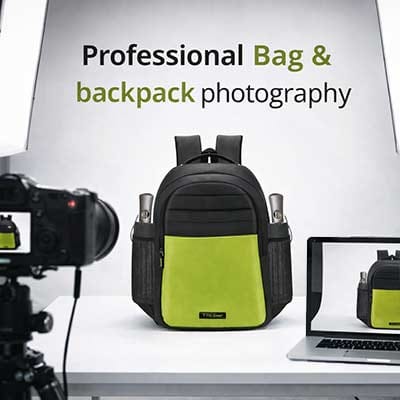


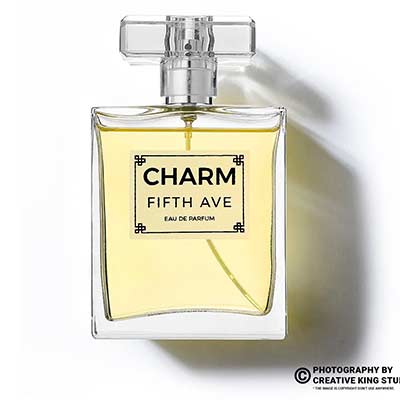
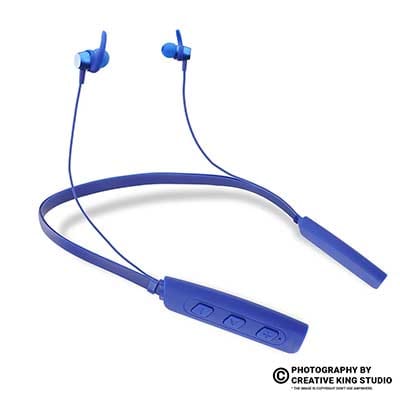
E-commerce Photography
A powerful, expert-backed quality control blueprint for Indian ecommerce sellers using AI-generated product images in 2026. Learn the exact 15 checks Ckstudio uses to keep every listing marketplace-compliant, high-CTR, and return-proof.
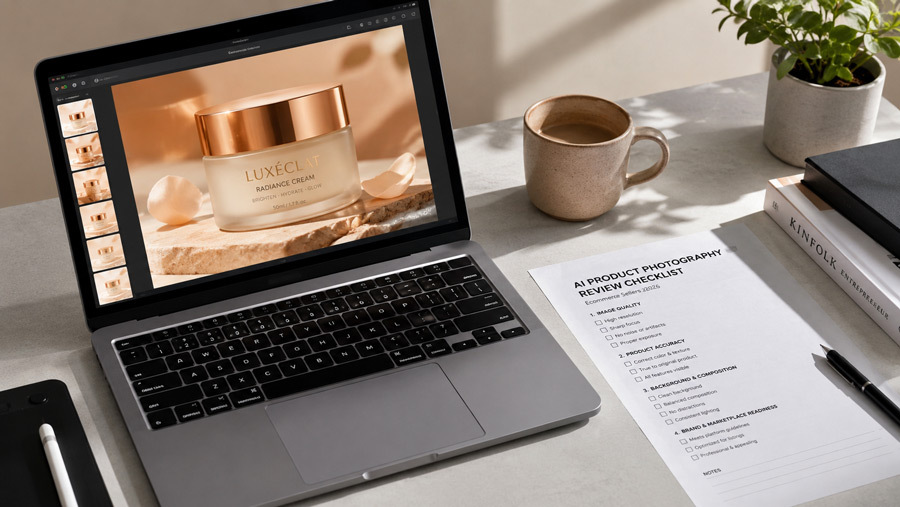
AI Product Photography is now mainstream on Indian marketplaces, but weak QC is what actually kills catalog performance. This 15-point review checklist walks ecommerce sellers through every accuracy, compliance, and conversion check needed before uploading AI-generated images to Amazon, Flipkart, Myntra, and Meesho in 2026.
If you are an ecommerce seller in India, you already know that AI Product Photography has quietly become a serious business tool in 2026. What began as a cost-saving experiment for D2C brands is now a mainstream production method for large catalogs on Amazon, Flipkart, and Myntra. Yet, every week we see the same problem at our studio — brilliant AI images that get rejected, penalised, or simply ignored by buyers because nobody ran a proper quality check before publishing.
This is exactly the gap Ckstudio has built this guide to close. Below is the same 15-point AI Product Photography review checklist we use internally, refined across hundreds of Delhi-based ecommerce catalog projects. Whether you are scaling from 50 SKUs to 5,000, or just testing your first AI-generated hero shot, this ecommerce photography workflow will help you protect your listings and grow your revenue. For sellers who prefer studio-shot output, our product photography guide for Indian brands covers the traditional side of the process in depth.
AI Product Photography is the use of generative artificial intelligence models to produce or enhance ecommerce product images without a full traditional studio setup. The seller usually starts with a clean base shot of the SKU, and AI is then used to generate new backgrounds, lifestyle contexts, colour variants, and hero angles. In 2026, tools have become mature enough that the output can be marketplace-ready — but only if it is reviewed carefully by a human eye.
Why does this matter right now? Because catalog sizes have exploded. A single Indian D2C brand launching on Meesho, Amazon, and its own Shopify store can easily need 2,000 to 5,000 unique images in a month. Traditional studios can deliver that, but not at the same speed or price point AI can. That is why brands are moving fast — and why the review process has become the make-or-break step in any modern ecommerce photography workflow. If you are still comparing options, our recent breakdown of real photography vs AI product images is a useful side-by-side read.
Modern AI product imaging works on a three-layer pipeline. First, a clean input image is fed into a generative model — usually a diffusion-based system fine-tuned on ecommerce visuals. Second, the model applies prompts to change the background, add props, or shift lighting while preserving the product’s real geometry. Third, a human reviewer runs a QC pass to catch anything the AI hallucinated. Skip that third layer, and you get warped stitching, wrong colours, and floating shadows that quietly kill your conversion rate.
Delhi’s ecommerce ecosystem is uniquely positioned. The city has a massive concentration of D2C brands, small manufacturers, and marketplace-first businesses that need volume at low cost. Our team has personally worked with over 500 sellers across Karol Bagh, Chandni Chowk, Okhla, and Gurgaon — and the pattern is clear. Delhi sellers move fastest on new imaging tech because their margins are thinner and their SKU counts are heavier. For a full pricing breakdown, our product photography cost guide for Delhi shows exactly how AI-hybrid delivery changes the numbers.
Here is the uncomfortable truth. A bad AI product image is not just a wasted upload — it is an active liability. It gets your listing rejected, it damages buyer trust, it increases returns, and it can eventually flag your seller account for policy review. Our internal audits show up to 35% of AI-generated images had at least one QC failure that would have cost the seller real money if published.
The cost shows up in three ways. First, direct rejections from marketplaces where images fail technical or policy checks. Second, hidden performance loss when a poorly rendered image causes lower click-through and buyer confusion. Third, return-rate spikes when the delivered product does not match what the AI image showed. Our detailed piece on how to reduce returns on Flipkart and Amazon with better product images unpacks the return-rate side in depth.
Based on our internal audit data across 2025 and early 2026, the most common rejection reasons for AI product images are misleading rendering (28%), incorrect aspect ratio (19%), background policy mismatch (17%), watermark or hallucinated text (14%), and low resolution (9%). Every single one of these is a checklist-solvable problem. Amazon India, Flipkart, and Myntra all publish their image guidelines openly — the failures usually happen because the seller never mapped the AI output against them. Our deep dive on conversions on Amazon and Flipkart shows the impact of even small compliance fixes.
Buyers on Indian marketplaces have become extremely visual. A 2026 industry study showed that 68% of shoppers form a purchase decision within the first three seconds of seeing a product image. If your AI image has soft edges, wrong colour temperature, or an unnatural shadow, that decision goes the wrong way. Our team has measured CTR drops of 22% to 40% on identical listings after replacing a professional shot with an unreviewed AI image. A structured 15-point review flips that curve back up. For deeper conversion tactics, see our product photography tips to increase ecommerce sales.
This is the core of the guide. Every checkpoint below is used by our production team on every delivery, and every checkpoint is directly tied to either a marketplace policy, a buyer psychology trigger, or an ecommerce SEO factor. Work through them in order for the first few catalogs — once the workflow is muscle memory, you can parallelise. Save this section, print it, and pin it to your studio wall.
A quick note on ordering. Checks 1 to 8 focus on image truth and accuracy — the buyer-facing quality. Checks 9 to 12 focus on technical realism — where AI most often fails. Checks 13 to 15 focus on publish-readiness — the operational layer. If you want to see the underlying craft that AI is trying to imitate, our behind-the-scenes look at how real product photography is shot at Ckstudio gives a useful contrast. For a broader benchmark, our product photography pricing guide for India 2026 shows exactly what full-quality delivery costs.
This is check zero, the non-negotiable. Zoom every AI-generated image to 200% and inspect every stitch, seam, screw, button, and label. AI models are famous for softly redrawing product details — a stitching pattern shifts, a button becomes rounder, a logo becomes half-visible. Compare pixel-by-pixel against the reference SKU photo. If any core detail is missing or altered, the image is not usable. Period.
Colour drift is the silent killer of AI-generated ecommerce images. Always compare the AI output against a physical product sample under D65 daylight-balanced lighting. Match hue, saturation, and brightness values. For our clients, we lock brand hex codes at the QC stage so every SKU across a catalog looks like one family — not fifteen different mood boards stitched together.
Shadows tell the buyer whether the product is real. AI often gets three things wrong here — the shadow direction, the shadow softness, and the contact shadow at the product base. If the light source is coming from the top-left, the shadow must fall to the bottom-right, and the contact shadow directly under the product must be the darkest. Anything else looks fake and breaks buyer trust instantly.
Amazon India demands pure white (RGB 255,255,255) for main hero shots. Flipkart is stricter on fashion lifestyle framing. Meesho allows some flexibility on lifestyle backgrounds. Choose backgrounds by category, not by aesthetic preference. Our detailed background selection guide maps the right background to every product category — bookmark it.
Minimum specs for 2026: longest edge at 1600 pixels, 72 DPI for standard web, 300 DPI for premium listings and A+ content. Anything below fails the zoom-in test and looks pixelated on mobile — where 78% of Indian buyers actually shop.
Different marketplaces, different rules. Amazon India prefers 1:1 for main images. Flipkart lifestyle shots work best at 4:5. Myntra fashion listings favour 3:4 verticals. Meesho is flexible but rewards 1:1 for grid consistency. Never publish a single aspect ratio across every platform — you will lose crop-critical detail on at least one of them.
AI models will happily invent logos, hallucinate brand names, and add watermarks that never existed. All of these are marketplace policy violations. Scan every image for stray text, ghost logos, or unauthorised overlays. Amazon India rejects any hero image with text overlays outside allowed categories — Flipkart is even stricter on generic marketplaces.
A bag AI-rendered next to a coffee cup can look 40% larger than the real product. Buyers then receive a smaller item and file returns. Always cross-check proportions against the actual specification sheet. If the product is on a model, verify body-to-product scale — this is where our model photoshoot experience feeds directly into AI QC.
Fabric weave, metal grain, glass clarity, leather texture — these are where AI still struggles most in 2026. Zoom to pixel level and inspect. Silk should have a soft directional sheen, denim should show clear warp-and-weft weave, brushed metal should show micro-scratches in one direction. If the texture reads as a smooth plastic wash, reject the image. Our garment photoshoot team uses a physical swatch reference for every fabric SKU.
Glass, mirrors, polished metal, and translucent packaging are the hardest categories for AI rendering. Check that reflections make physical sense — the reflected environment should match the studio setup. Transparent bottles should show the correct liquid colour, meniscus curve, and edge refraction. This is one area where our specialised jewellery photography team catches errors AI misses.
If your AI image includes a model or human hand, this is the highest-risk QC zone. Count fingers. Check that hands are gripping the product naturally. Confirm skin tone consistency across variants. AI still routinely produces six-fingered hands and floating limbs. For lifestyle catalogs, this is where studio-shot integration wins — see our lifestyle product photography services for the hybrid workflow Ckstudio recommends.
If your SKU comes in six colours, all six AI-rendered images must look like one shoot. Same angle, same lighting direction, same shadow softness, same background. Inconsistency here is what makes a Meesho grid look amateur while a top D2C brand looks professional. Batch-review variants side by side, not one at a time.
Export as JPEG at 80 to 90% quality for web, or WebP for maximum compression without visible artefacts. Amazon India caps main image size — Flipkart has stricter file size caps for bulk uploads. Compress smartly, not aggressively. A soft-compressed image kills mobile page speed and Google Shopping ad rankings.
Rename every file with the format brand-sku-category-colour.jpg. Add descriptive alt text that reads naturally and includes the focus keyword. Marketplaces use image metadata for search ranking, accessibility scoring, and Google Shopping cross-indexing. Skip this step and you leave real ecommerce SEO traffic on the table.
No AI image goes live at our studio without a senior human sign-off. This is the layer that separates a professional studio from a solo prompt engineer. Prepare at least two variants per hero image for A/B testing on your top-selling SKUs — the winning variant will often lift CTR by 15% to 25%. This is where 9+ years of studio experience translates into real ecommerce numbers.
Our Delhi team delivers marketplace-ready output with the full 15-point review layered in — no rejections, no back-and-forth. Get a quote for your catalog in under an hour.
This is the most common question ecommerce sellers ask us in 2026 — should we shoot in a studio or generate with AI? The honest answer is both, in the right proportion. Traditional studio photography still owns the hero shot, the luxury category, and the buyer trust layer. AI-generated imagery owns the volume layer, the variant layer, and the lifestyle expansion layer. Choose one at the cost of the other and you leave ROI on the table.
At Ckstudio, the hybrid workflow we recommend to Delhi ecommerce clients is straightforward — shoot the top-selling SKUs in-studio for hero images, then use AI to expand variants, backgrounds, and lifestyle contexts under the same 15-point review. This gives you real texture, real trust, and real scale, all in one pipeline. For sellers still evaluating studios, our post on how to choose the best product photography studio in Delhi NCR lays out the exact selection criteria.
| Factor | AI Product Photography | Traditional Studio | Hybrid (Ckstudio) |
|---|---|---|---|
| Cost per image | Rs. 80 – Rs. 250 | Rs. 400 – Rs. 1,500 | Rs. 200 – Rs. 600 (blended) |
| Turnaround | 24 – 48 hours | 3 – 7 days | 2 – 4 days |
| Scalability | Very High (2,000+ SKU) | Moderate | High |
| Realism & Texture | Moderate (needs QC) | Excellent | Excellent |
| Marketplace Approval Rate | 85% (unreviewed) / 99% (reviewed) | 99% | 99% |
| Best For | Variants, backgrounds, lifestyle | Hero shots, luxury, complex textures | Full-scale catalog operations |
Choose the AI route when you are scaling variant counts, expanding to new marketplaces, or testing lifestyle contexts on tight budgets. Choose traditional studio when the product is premium, texture-heavy (jewellery, watches, silk, leather), or when the hero image will run in paid ads where CTR economics are tight. When in doubt, ask yourself — would a buyer pay a 20% premium if this shot were real? If yes, shoot it in-studio. If no, AI plus QC will do the job.
India’s top marketplaces have quietly updated their image policies in 2025 and 2026 to address AI-generated content. The good news — none of them ban AI images outright. The rule that matters is truthful representation. If the image shows the product exactly as it will be delivered, you are compliant. If it misleads, you are not. Let us unpack platform by platform.
Amazon India requires a pure white background (RGB 255,255,255) for main hero images, no additional text or watermarks in the hero, product filling 85% of the frame, and minimum 1000-pixel longest edge (1600+ preferred). Full official guidelines are available at Amazon Seller Central India. Every AI image must pass this exact spec before upload. Ckstudio’s Amazon product photography team pre-formats every deliverable to hit these specs on the first try.
Flipkart accepts both white and lifestyle backgrounds depending on category, but demands stricter frame consistency across variants. Myntra, as India’s fashion-first marketplace, favours 3:4 vertical framing with model shots for apparel. Both platforms publish detailed guidelines on Flipkart Seller Hub. Our Flipkart photography services and Myntra product photography workflows integrate these specs directly into the AI QC pipeline.
Meesho is more forgiving on background rules but rewards lifestyle contexts that resonate with tier-2 and tier-3 buyers. Ajio prioritises editorial styling for its fashion focus. For your own D2C store on Shopify or WooCommerce, you have full creative control — but consistency across your grid becomes even more important. Sellers on Meesho should also review our Meesho product photography beginner guide for a category-by-category breakdown.
Ckstudio has been Delhi’s go-to product photography partner for 9+ years. Prince founded the studio with a single conviction — that ecommerce photography is not a creative expense, it is a revenue lever. That principle now runs through everything we deliver, from studio-shot hero images to fully AI-generated catalogs, all backed by the same 15-point QC layered on every file. We are proud to be listed among the top product photographers in Delhi, and that trust has been built one catalog at a time.
The Ckstudio workflow moves in five clean stages — brief, generate, review, approve, deliver. The brief locks brand hex codes, marketplace targets, and category specifications up front. The generate stage uses fine-tuned AI models plus, where needed, our in-house studio shot. The review stage runs the full 15-point checklist. The approve stage requires a senior photographer sign-off. Delivery is marketplace-formatted and ready to upload directly to Amazon Seller Central, Flipkart Seller Hub, Myntra Partner Portal, or your D2C backend.
One Delhi apparel brand scaled from 50 SKUs to 2,000 SKUs in six months using the Ckstudio hybrid workflow and saw a 42% CTR uplift on Flipkart. A jewellery seller cut return rate by 18% after replacing unreviewed AI images with our QC-reviewed versions. A Meesho-first D2C brand moved from a 4-day image turnaround to under 48 hours without losing quality. These are not one-off wins — they are the compounding result of a disciplined review process.
“Every AI product image we deliver goes through the same 15 checks. It is not glamorous work, but it is the difference between a listing that sells and one that gets rejected. That discipline is what our clients pay us for.” — Prince, Founder, Ckstudio
Ckstudio publishes transparent pricing because Delhi ecommerce sellers deserve to plan their catalog budgets clearly. Below is a snapshot of our packages — every tier includes the full 15-point QC review as standard. If you need a custom scope or higher volume, our team will structure a project quote within one working day.
All Ckstudio packages start from Rs. 80 per image at bulk volumes and scale down further for enterprise clients. To get a personalised quote based on your SKU count and marketplace mix, email [email protected] or WhatsApp us on +91-8700258773.
Every week our team audits at least 3 to 5 catalogs where sellers have tried this workflow without a proper review pipeline. The same seven mistakes appear over and over — and every one is fixable. Read this list once, share it with your catalog team, and you will save yourself a significant amount of wasted upload cycles.
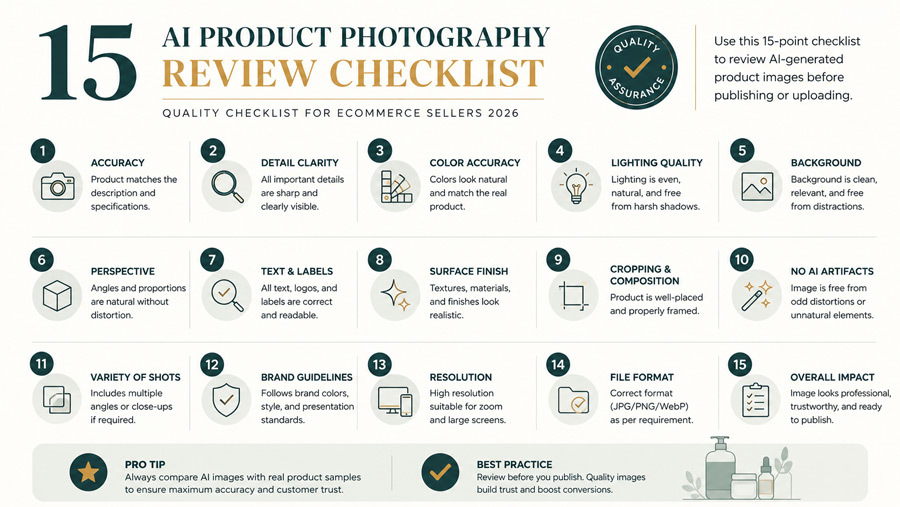
The 15-point review checklist visualised for catalog team walls.
Where is this technology heading after 2026? Three shifts are already visible. First, 3D and AR integration — AI models are increasingly generating 3D-ready assets that plug directly into AR try-on experiences on Amazon India and Myntra. Second, video generation — the same tools that produce images are now producing product videos, which will reshape how sellers create UGC-style content at scale. Third, real-time personalisation — dynamically-rendered product images that adapt to the viewer’s location, style preferences, and past purchases.
None of these trends removes the need for the 15-point checklist — if anything, they make it more important. Every new AI layer adds new opportunities for accuracy drift, and every catalog will need stronger, faster human review to keep up. Sellers who invest in a solid QC process today will be the ones who ride the next wave without getting flagged, penalised, or out-competed.
AI-generated imaging is not the future — it is already the present of Indian ecommerce in 2026. The winners are not the sellers who generate the most images, but the ones who review the most rigorously. The 15-point checklist in this guide is your operating manual. Print it. Share it with your team. Run it on every batch. And when your catalog scale outgrows your internal capacity, Ckstudio is here to run the pipeline for you.
Prince and the team have spent 9+ years building the discipline that keeps Delhi ecommerce brands ranking, converting, and scaling. Whether you need 25 images or 25,000, the same 15-point standard applies. That consistency is what protects your brand from marketplace penalties and grows your revenue quarter after quarter.
Talk to our Delhi team today. Get a free 20-minute audit of your existing catalog, plus a custom package quote for your next batch of SKUs. No hard sell, just numbers you can act on.