





If you sell jewellery online in India in 2026, the fastest lever you can pull is not another ad campaign — it is the image that shows up on the search result. This guide, built from thousands of catalogue shoots at Ckstudio, walks you through every decision that separates a listing that scrolls past from one that gets tapped.
This Jewellery Photography Guide is written for Indian brand founders, catalogue managers and marketplace sellers who want a single, trustworthy resource — the same Jewellery Photography Guide Prince uses to train new photographers at Ckstudio.
What Is Jewellery Photography and Why It Matters for Ecommerce Brands in 2026
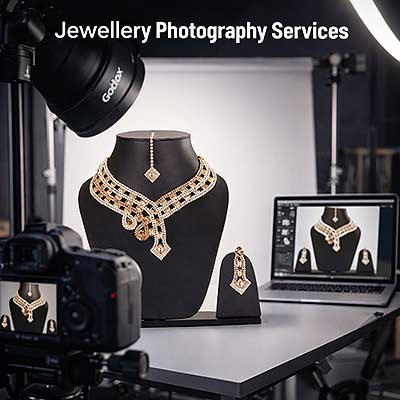
Jewellery photography is a specialised branch of product imaging that captures fine detail, accurate metal colour, gemstone brilliance and material texture in a way that helps a buyer decide with confidence. This jewellery photography guide is written specifically for Indian ecommerce, where every listing on Amazon, Flipkart, Myntra, Ajio and Meesho fights for a tap on a small mobile screen. At Ckstudio’s jewellery photography studio, we treat every image as the first — and often only — sales conversation a shopper will have with your brand.
In 2026, ecommerce jewellery photography has become more technical, not less. AI-driven marketplaces re-crop, compress and rank your visuals; shoppers open reels in landscape and swipe on mobile in portrait; return policies punish inaccurate colour. Weak imagery no longer just hurts conversion, it burns budget across ads, retention and reverse logistics. Strong imagery, on the other hand, compounds — better main frames raise CTR, better lifestyle frames raise ATC, better macros lower returns. That is the entire business case for treating your ecommerce product photography as core infrastructure, not marketing decoration.
- Product images drive over 75% of online purchase decisions in the Indian jewellery category.
- Marketplace-compliant images cut ad wastage and lower return rates simultaneously.
- Full-frame mirrorless bodies with 100mm macro lenses are today’s studio baseline.
- Diffused, controlled lighting solves the top three complaints in ecommerce jewellery photography: reflection, glare, and colour drift.
- A properly structured 2026 catalogue mixes white background, lifestyle, model, macro and 360°/video — not just one format.
The Business Impact of Professional Jewellery Product Photography
Every jewellery listing lives inside a grid of 20 competing thumbnails. If yours does not read at a glance, no amount of pricing or SEO recovers the loss. Professional jewellery product photography improves three metrics at once — click-through on search pages, add-to-cart on product pages, and return rates after delivery. Brands we work with at Ckstudio routinely see 40–90% CTR uplift after reshooting a top-selling SKU, and comparable D2C studies referenced across Amazon Seller Central India playbooks report a direct line between image quality scores and Buy Box performance.
There is also a compounding effect that is easy to miss. Better images give paid media stronger creative inputs, which drops CPC. Better images reduce returns, which frees working capital.
Better images also build brand recall on Instagram, lowering reliance on marketplace discovery. For a broader view of how these gains stack, our breakdown of how product photography improves conversions on Amazon and Flipkart makes the numbers explicit.
Why Indian D2C Jewellery Brands Are Investing More in Photography in 2026
Three shifts are pushing Indian D2C jewellery brands to reinvest in imagery this year. First, marketplaces are quietly increasing image quality thresholds — Amazon’s automated rejection engine is stricter about background purity, and Flipkart’s fashion vertical rewards multi-angle listings in ranking. Second, video-first surfaces like reels, shoppable stories and Amazon Live have made static-only catalogues feel dated. Third, AI-generated images have flooded the internet, and buyers now instinctively distrust anything that looks synthetic — which paradoxically raises the value of real, professionally lit photography.
For Indian D2C jewellery brands, this means the shift is not “should we invest in photography” but “how do we scale it without losing quality.” Prince and the team at Ckstudio run a production model built exactly for that — a repeatable, marketplace-tuned catalogue workflow that scales from 20 SKUs to 500 without the quality drift that kills brand consistency. If you are wrestling with volume, our note on scaling product photography from 50 to 500 SKUs is a practical starting point.
Types of Jewellery Photography for Ecommerce Success
Not every jewellery image does the same job. A hero white-background shot answers “what am I looking at”; a lifestyle frame answers “what will it feel like”; a model shot answers “will it suit me”; a 360° or video answers “can I trust the finish”. A mature 2026 catalogue uses all of these — each in the right slot inside your listing. Below are the five categories every serious brand should master (or outsource to a specialist studio like Ckstudio) before the next big marketplace sale event.
White Background Jewellery Photography (Marketplace Standard)
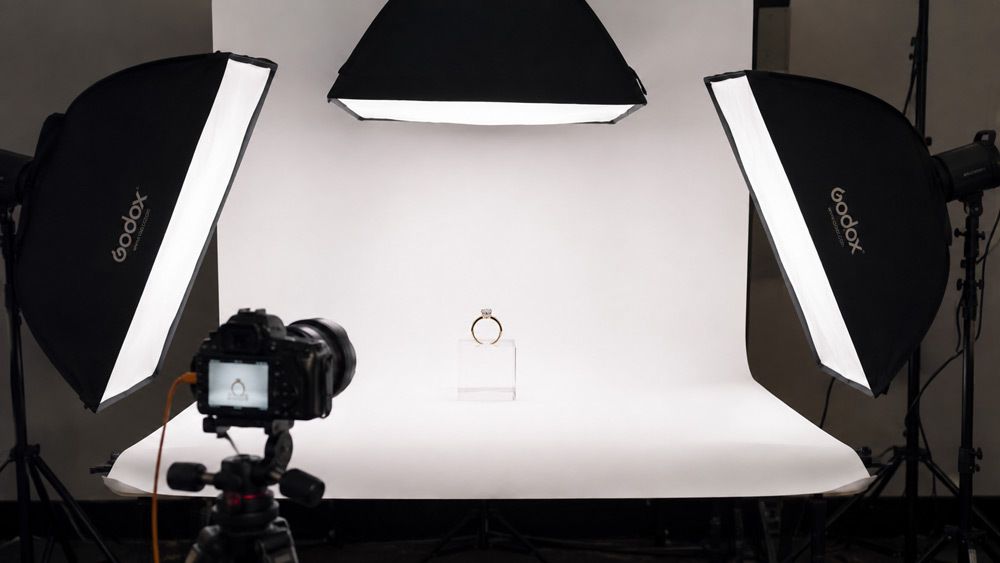
The white background jewellery photography shot is the non-negotiable first frame for every marketplace listing. Amazon, Flipkart, Myntra and Meesho all require a pure white RGB 255,255,255 background, the product occupying roughly 85% of the frame, no watermarks and no props. This image is the one that competes in search — its only job is to identify your product clearly at thumbnail size on a Redmi phone.
The mistake most sellers make is treating this frame as boring and delegating it to whoever is free. In reality it is the highest-leverage image in your entire catalogue. If you want to go deeper on how the main frame connects to marketplace ranking, our Amazon product photography services page and the complete Amazon seller’s guide for 2026 unpack the specifics. This is where every serious Jewellery Photography Guide starts — and where most sellers underinvest.
Lifestyle Jewellery Photography (Brand Story)
Lifestyle frames are where your brand voice actually lives. A silver anklet photographed beside a Kanjivaram silk drape, a diamond ear stud on a marble vanity with pastel florals — these images give a shopper permission to imagine ownership. Marketplaces increasingly reward listings that include lifestyle imagery in the secondary slots, and A+ Content on Amazon India relies almost entirely on this style. Our team frequently combines lifestyle product photography with flat lay photography in the same shoot to give brands maximum creative range from a single session.
Lifestyle frames also carry a hidden benefit — they are your reel and paid ad inventory. A catalogue shoot that only produces white-background images leaves your marketing team scrambling to source visuals every month. Building lifestyle depth into your catalogue upfront is one of the cheapest ways to future-proof your Instagram product photography pipeline.
Model Jewellery Photography (On-Body Shots)
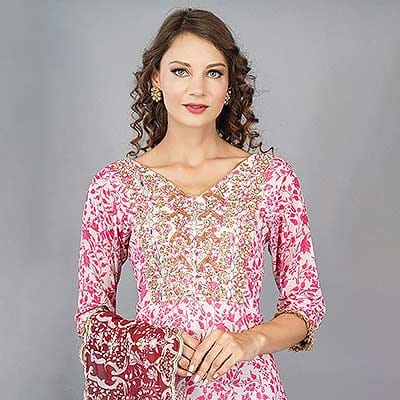
On-body shots are the single most effective way to build purchase confidence in fine jewellery. A necklace on a model’s collarbone gives scale, drape and skin-tone reference that a flat lay simply cannot. For bridal, statement and gifting categories, model imagery drives outsized conversion. Ckstudio handles the full stack from styling to talent coordination through our model photoshoot in Delhi service, and for menswear collaborations we run separate male model photography sessions.
Casting matters more than most brands realise. Neutral skin-tone diversity, expressive hand modeling for rings, and clean necklines for necklaces should be planned before the shoot — not fixed in post. Working with vetted modeling agencies in Delhi is usually the fastest path.
360° and Video Jewellery Photography
360° spin and short-form video are the trust-builders of 2026. When a shopper can rotate a ring or watch a chain move, uncertainty collapses. This is especially useful for high-ticket pieces where the buyer needs to inspect the clasp, the setting, or the reverse of a pendant. Marketplaces are actively surfacing listings that include either 360° product photography or short shoppable videos, and A+ modules that use motion outperform static equivalents by a wide margin.
Video does not need to be cinematic to work. A ten-second turntable clip with soft directional light, or a slow pan across a bridal set on velvet, is often enough. Our video production company team pairs these motion assets with the still shoot so nothing has to be re-lit.
Macro Jewellery Photography for Detail Shots
Macro frames are where craftsmanship gets sold. A close-up of a hallmark stamp, a prong setting, a filigree pattern or the facet cut of a solitaire signals quality in a way no marketing copy can. In premium and bridal categories these frames often close the sale. Focus stacking, tethered capture and careful lighting angle are what separate a real macro from a heavy crop of a wide shot — and it is why we treat macro as its own discipline inside Ckstudio’s jewellery photography pipeline.
Pre-Production Planning: Setting Up Your Jewellery Photography Shoot
The most expensive mistake in ecommerce jewellery photography is skipping planning to save a day. Every hour spent in pre-production saves three in edit and prevents reshoots that can cost more than the original session. A proper pre-production plan pins down aesthetic, angles, props, lighting, and delivery formats before a single frame is captured. If you would rather have us handle this, our team walks new clients through a free consultation on +91-8700258773 to lock scope, timelines and cost upfront.
Defining Your Brand Aesthetic and Mood Board
A mood board is not decoration — it is a decision-making tool. Two or three pages of reference images from Pinterest boards, competitor listings, and editorial magazines give the crew a shared visual language. Colour palette, prop tone, background material, and camera angle should be agreed here, not on set. When Prince runs a shoot briefing, this document sits in front of every stakeholder — photographer, retoucher, brand manager — so everyone shoots to the same North Star.
Choosing the Right Location: Studio vs In-House Setup
A dedicated studio like Ckstudio gives you controlled light, colour-calibrated monitors, tethered capture, and infrastructure that a garage or living-room setup will never match. An in-house setup is fine for extremely high-volume, low-complexity catalogues where the same lighting is used all day. For most Indian D2C brands, especially in bridal and premium tiers, the maths favours renting a professional studio slot over building one — and our guide to choosing the best product photography studio in Delhi NCR lays out the trade-offs in detail.
Prop Styling and Backdrop Selection
Props are supporting actors, not stars. A single fold of silk, a marble slab, a slice of tree bark, or a matte ceramic tile is enough — anything more starts stealing attention from the jewellery. Backdrops should be chosen based on the metal being shot: warm neutrals for gold, cool greys for silver, deep tones for diamond fire. If you want a broader treatment of background theory, our post on how to choose the right background for fashion ecommerce photography maps directly onto jewellery decisions.
Preparing Jewellery: Cleaning, Polishing, Handling
Every piece must arrive on set spotless. Fingerprints on gold, dust between prongs, lint on velvet backing pads, and stickers on price tags will all be visible under macro light. The Ckstudio prep station uses microfibre cloths, jewellery-safe polishing solution, cotton gloves, and compressed air. This ten-minute investment per piece prevents hours of retouching downstream — a principle we detail in our garment prep guide, which shares the same discipline.
Get the Ckstudio pre-production checklist — the one Prince uses on every shoot
Twenty-two items across brief, styling, gear and delivery. Built from 9+ years of running catalogue shoots for Indian jewellery brands.
Essential Equipment for Professional Jewellery Photography
Great gear does not automatically produce great images, but bad gear will always cap your ceiling. For jewellery product photography, the equipment stack has three jobs — resolve fine detail, render metal and stone colour truthfully, and stabilise the camera enough for focus-stacked macro. The list below is the same core kit we run at Ckstudio for shoots that end up on Flipkart, Myntra and premium D2C storefronts.
Cameras Best Suited for Jewellery Product Photography
Full-frame mirrorless is the sensible baseline in 2026. At Ckstudio we run the Canon R10 for daily catalogue work and the Sony A7R V for high-resolution bridal and premium shoots — the 61MP sensor lets us crop aggressively for macro delivery without losing detail. Nikon Z9 is an equally strong choice. What matters is a body that supports tethered capture, custom colour profiles, and clean shadow detail at base ISO. Full technical reviews on sites like DPReview are a good place to compare current bodies.
Macro Lenses and Focal Length Recommendations
A 100mm macro is the workhorse — long enough working distance to keep the camera out of the light path, short enough to stay handleable. For rings and small pieces, this is the default. For necklaces and bridal sets, an 85mm portrait lens gives a flatter perspective and covers more of the piece in a single frame. Avoid ultra-wide lenses entirely — they distort proportions and make gold look cheap.
Tripods, Focus Rails, and Stabilization Tools
A heavy carbon-fibre tripod with a geared head is standard for jewellery. Any camera movement between focus-stack frames ruins the stack, so vibration control matters more than in normal product work. A focus rail — a small sliding platform that moves the camera in precise increments — is what separates a serious macro setup from an amateur one. Even a basic manual rail dramatically improves final image sharpness.
Lightbox, Diffusers, and Reflectors
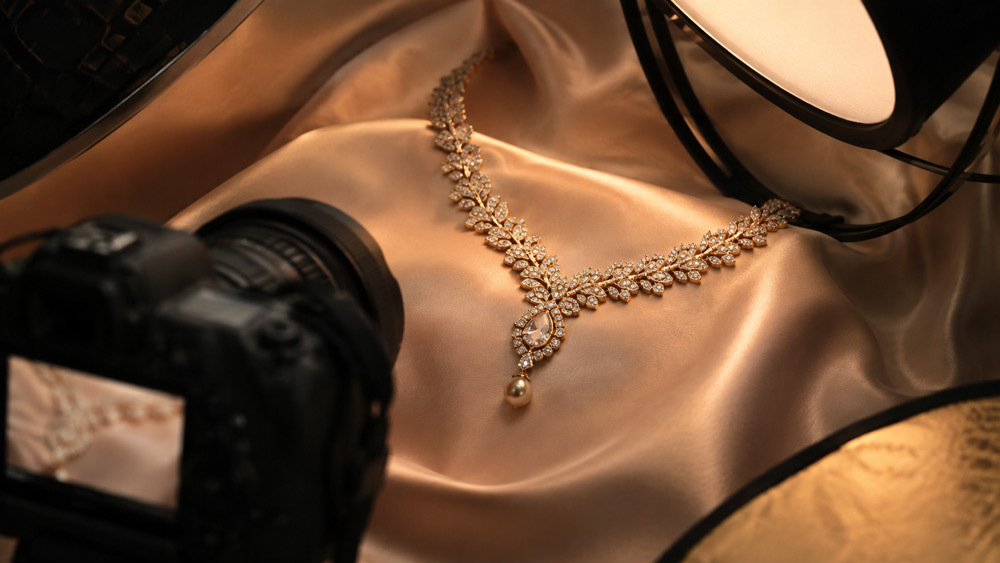
Ckstudio runs 4× Godox SK 400II strobes and 2× Elinchrom FRX 400 heads with 4× strip softboxes, 2× octaboxes, and a beauty dish for model shoots. For jewellery specifically, the value is in the modifiers, not the raw power — large diffusion panels and small black gobos to shape reflections are what create the “expensive” look on metal.
Tethering Software and Colour Calibration Tools
Tethered capture into Capture One or Lightroom is non-negotiable for catalogue work. Every frame previews live on a colour-calibrated monitor at full size, so mistakes get caught inside 30 seconds instead of at delivery. A grey card and a colour checker at the start of every setup keep white balance honest, and an X-Rite or Datacolor monitor calibrator ensures the images you sign off match what your client will see.
Lighting Techniques for Stunning Jewellery Photography
Lighting is where 80% of the game is won or lost. If you fix nothing else in your pipeline, fix lighting — the return on investment is immediate. Jewellery photography lighting has one core principle: control every reflection you can see. Every catch-light, every specular highlight, every dark shadow on a facet is a decision, not an accident. Master this and everything else in this jewellery photography guide starts working harder.
Continuous vs Strobe Lighting for Jewellery
Strobes give you power, colour consistency and the ability to freeze micro-vibrations from focus stacking motion. Continuous LED lets you see exactly what the final image will look like as you shoot. At Ckstudio we shoot 90% of jewellery on strobes with modelling lamps up, giving us both worlds — precise output with a real-time preview. For an in-house team just starting, high-quality continuous LEDs with a CRI above 95 are the more forgiving path.
Lighting Gold Jewellery Without Reflection or Glare
Gold’s problem is that it reflects everything around it — walls, ceiling, the photographer’s shirt. The fix is a controlled environment: a large diffusion tent or scrim above the piece, black gobos on either side to hide the studio, and no coloured surfaces in the reflection cone.
Shooting at f/11 to f/16 with polarising filters cuts specular hotspots further. The result is warm, honest gold — not the harsh yellow-orange that plagues DIY listings. This is the exact lighting logic we use for our gold jewellery photography and watch photography pipelines.
Lighting Diamond and Gemstone Jewellery for Sparkle
Diamonds want the opposite of gold — direction, contrast, and a small, hard light source to create fire in the facets. A single focused light with a snoot, placed at a steep angle, produces the star-flare that sells the stone. For gemstones like emeralds, rubies and sapphires, backlighting from beneath a translucent surface can dramatically deepen colour. Dark-field lighting — where the background is unlit and only the stone catches light — is a classic move for solitaires.
Lighting Silver, Platinum, and White Metals
White metals need cool, neutral light. Any warmth from tungsten spill or a mixed-source setup will make platinum look grey-yellow and silver look old. Calibrate white balance to 5500K, use daylight-balanced strobes, and light with soft frontal fill to reduce the harsh contrast that white metals amplify. A slight lift in mid-tones during retouching restores the “polished” feel.
Common Lighting Mistakes to Avoid
The mistakes we see most often — mixing tungsten and daylight sources in one frame, using a bare speedlight with no modifier, shooting against a coloured wall that bleeds into gold, forgetting to flag stray light off the lens hood, and skipping the grey-card reference. Any one of these can force a full reshoot. Sellers who have already been burned once usually appreciate our detailed post on reducing returns on Flipkart and Amazon with better product images — bad lighting is one of the biggest hidden drivers.
Camera Settings and Shooting Techniques
Once the lighting is right, camera technique is what pushes an image from good to catalogue-grade. The settings below are the working defaults our Ckstudio photographers use for the majority of jewellery product photography — feel free to adapt, but understand what each dial is doing before you move it.
Optimal Aperture, ISO, and Shutter Speed for Jewellery
Base ISO 100 always — jewellery cannot tolerate the noise that ISO 400+ introduces in shadow detail. Aperture between f/8 and f/16 depending on how much depth you need; smaller apertures pass through diffraction into softness, so focus stacking is used to keep sharpness at wider settings. Shutter speed is set by strobe sync (typically 1/125s) — under strobes, ambient light barely contributes, so shutter is mostly a flare-control tool. Lock white balance manually, do not use auto.
Focus Stacking for Sharp Detail Throughout the Product
A ring photographed at 1:1 macro has a depth of field smaller than a grain of rice. To keep the whole piece sharp, you shoot 8–20 frames at slightly different focus points and blend them in post using Helicon Focus or Photoshop. This is the single biggest technical differentiator between a professional macro and a phone-camera close-up.
Composition and Angles That Sell
The rule for hero angles: shoot from the angle a buyer would hold the piece at eye level. Rings tilted 30° upward showing the stone and profile; necklaces flat with slight downward tilt on the pendant; earrings straight-on but with side profile as a supporting shot. Avoid extreme top-downs unless you are shooting a flat lay set.
Tethered Shooting for Real-Time Preview and Accuracy
Every shoot at Ckstudio is tethered to Capture One on a colour-calibrated monitor. This means the retoucher, brand manager, and photographer see the exact same image simultaneously. Approval happens on set, not three days later. If reshoots need to happen, they happen while everything is still lit and styled. This single workflow decision saves more money than any equipment upgrade.
Post-Production: Editing Jewellery Photos Like a Pro
Editing is where catalogue consistency is either preserved or lost. A great shoot handed to a mediocre retoucher becomes a mediocre catalogue. The Ckstudio post-production workflow is built around one principle: every image in the catalogue must feel like it was shot on the same day, in the same studio, by the same team — even when it was not. For a deep look at how we systemise this at scale, our team’s behind-the-scenes of product photography walkthrough shows the actual pipeline.
Background Removal and Clean White Background
The marketplace-standard pure-white background is not just “click magic wand and delete”. A proper white removal preserves the subtle shadow beneath the piece — jewellery needs a light drop shadow to avoid looking pasted on. Pen-tool selection, careful edge softening on chain links, and a hand-painted contact shadow are what separate a real ecommerce shot from an obvious cutout.
Colour Correction and White Balance for Metals
Gold should look gold, not orange. Silver should look silver, not blue. Colour correction starts from the grey-card reference frame shot at the start of every session, then micro-adjustments per metal type. Diamonds want a slight blue-white shift; rose gold wants controlled warmth without going pink; oxidised silver needs preserved contrast so the darkening reads as intentional, not dirty.
Dust, Scratch, and Blemish Removal
Under macro light, even a spotlessly cleaned piece reveals dust in the settings, tiny scratches on the metal, and imperfections in the stone. Frequency separation, healing brush at 100% zoom, and per-facet cleanup on stones is standard. The retouch preserves genuine character — a hand-forged texture stays, an accidental scratch goes.
Enhancing Sparkle, Shine, and Reflections
A restrained star-flare on a diamond, a subtle brightening of the specular highlight on gold, and a controlled boost to gemstone saturation is where jewellery post-production earns its fee. The trap is going too far — over-enhanced sparkle looks fake, kills trust, and drives returns when the physical product arrives.
Batch Editing for Catalogue Consistency
Consistency comes from templates, not from individual attention. Capture One styles, Photoshop actions, and Lightroom presets built specifically for each catalogue shoot let a retoucher process 200 SKUs in a day without drift. Our post-production team also runs a final side-by-side comparison of every fifth image against the catalogue baseline to catch any creep before delivery.
AI-Powered Retouching Tools in 2026
AI retouching is now genuinely useful for the boring 80% — background removal, dust cleanup, batch colour matching. But it still fails on the interesting 20% — accurate gemstone rendering, honest metal colour, and subtle craftsmanship detail. At Ckstudio we use AI as a first-pass accelerator, then human retouchers finish everything. If you are weighing whether to skip real photography entirely and use AI generation, our detailed comparison of real photography vs AI-generated product images is a candid look at where AI helps and where it hurts.
Ecommerce Marketplace Image Guidelines (India 2026)
Every marketplace has its own image specification and its own automated rejection engine. Getting these right the first time saves days of listing purgatory. Below are the current 2026 specs for the platforms most Indian jewellery brands care about — Ckstudio delivers files pre-sized for each of these as part of every shoot.
| Marketplace | Min. Size | Format | Background | Notes |
|---|---|---|---|---|
| Amazon India | 1000×1000 (2000×2000 rec.) | JPEG | Pure white (255,255,255) | Product fills 85% of frame |
| Flipkart | 500×500 min | JPEG | White | Multi-angle rewarded in ranking |
| Myntra | 1080×1440 | JPEG | Light grey | Model shots strongly preferred |
| Ajio | 1080×1440 | JPEG | White or grey | Ghost or model preferred |
| Nykaa Fashion | 1200×1500 | JPEG | White | Editorial style rewarded |
| Meesho | 800×800 min | JPEG | White or lifestyle | Mobile-first, front-facing hero |
| Shopify / D2C | 2000×2000 rec. | JPEG/WebP | Flexible | Lifestyle depth matters more |
Amazon India Jewellery Image Requirements
Amazon India is the strictest of the marketplaces. Any grey creep in the background, any watermark, any additional text, or any prop in the main image triggers an automated rejection. Our complete Amazon product photography guide for 2026 covers the full compliance checklist — worth reading before your next catalogue upload.
Flipkart Jewellery Listing Image Standards
Flipkart is more forgiving on strict specs but rewards depth — listings with 4+ angles rank better than single-image listings. The platform’s automated quality score also penalises low-resolution uploads even when they meet the minimum size. Our Flipkart photography guidelines for 2026 unpack the ranking signals in detail.
Myntra, Ajio, and Nykaa Fashion Image Rules
These fashion-first platforms all favour model imagery over flat lays for jewellery, especially for earrings and necklaces. Ajio has its own seller image guidelines for 2026 that most brands miss on first upload. For Myntra, the ghost-mannequin and on-model requirements overlap with our ghost mannequin photography pipeline for apparel.
Meesho and JioMart Image Compliance
Meesho is aggressively mobile-first — assume the buyer will only see the image at 200 pixels wide. Bold, front-facing hero shots outperform stylised editorial frames. Our Meesho product photography guide lays out the beginner playbook.
Shopify, WooCommerce, and Custom D2C Store Recommendations
Your own D2C store is the one place where you set your own rules. This is also where lifestyle and editorial depth pay off the most. Use larger, higher-quality files, prioritise scroll-triggered visuals, and lean into brand storytelling. Our product photography guide for Indian brands is a good primer if you are building your own storefront.
Jewellery Photography Pricing in India (2026 Benchmarks)
Pricing is where most brand conversations get uncomfortable. We keep it transparent at Ckstudio because opaque pricing wastes everyone’s time. Below are the honest 2026 benchmarks for jewellery photography price in Delhi NCR and, broadly, across India. For a broader look at product photography costs beyond jewellery specifically, our product photography cost in Delhi and Mumbai pricing breakdown maps every service tier and volume band.
Per-Product Pricing Breakdown
A single jewellery piece with white background, 3–4 angles and basic editing typically sits between ₹300 and ₹800 in Delhi NCR. Add a lifestyle frame and it rises to ₹800–₹1,500.
Add a model shot and pricing moves to ₹1,500–₹2,500. Add 360° or video and premium retouching, and bridal work can push ₹2,500 to ₹4,000 per piece. Studios quoting significantly lower are usually skipping retouching or shooting in bulk without individual attention.
Package Pricing for Catalogue Shoots
Package pricing gets sharper as volume grows. A 25-piece catalogue with white background and light lifestyle can land around ₹14,999–₹19,999 in Delhi NCR. A 50-piece premium catalogue with model shots runs ₹29,999–₹49,999. For 100+ SKUs, custom quotes typically settle 30–40% below per-piece rates because the studio setup, lighting and styling amortise across volume.
What Affects Jewellery Photography Cost in India
Five variables drive the number — piece complexity (a solitaire ring is faster than a temple necklace), number of angles, whether models are required, retouching depth, and turnaround urgency. Rush jobs typically add 30–50%. Bridal and premium categories that require styling assistants and multiple retouching passes cost more than daily-wear categories. Our full product photography pricing for India in 2026 post shows the variable-by-variable math.
DIY vs Professional Studio: Cost Comparison
DIY setups look cheap until you count in-house salaries, equipment amortisation, reshoot cycles and marketplace rejection losses. A brand shooting 500 SKUs a year in-house usually spends more than they would outsourcing to a specialist studio — and gets less consistent output. The tipping point where in-house makes sense is roughly 2,000+ SKUs per year with a stable, low-variety catalogue. Everyone else wins by outsourcing.
- 10 products, white background
- 2 angles per product
- Basic editing
- Marketplace-ready formats
- 3-day turnaround
- 25 products
- White BG + lifestyle per piece
- 4 angles per product
- Advanced retouching
- Multi-marketplace formats
- 5-day turnaround
- 50 products
- White BG + Lifestyle + Model
- 6 angles + video per piece
- Premium retouching + grading
- All marketplace + Shopify
- 7-day turnaround
- Creative director assigned
- 100+ products
- Full-service catalogue shoot
- 360° + video + lifestyle + model
- Priority delivery
- Dedicated production team
- Ongoing brand partnership
Top Jewellery Photography Mistakes Ecommerce Brands Make
After 500+ jewellery brand engagements at Ckstudio, the same handful of mistakes come up over and over. Each of them is fixable — but only if you know to look. This section is the “what went wrong” post-mortem, written so you can avoid making the same calls.
Poor Lighting and Colour Cast Issues
The most common failure by a wide margin. Yellow gold looks orange, silver looks blue, diamonds look grey. Fix: calibrate to 5500K daylight, shoot a grey card, use a monitor calibrator, and never trust auto white balance.
Inconsistent Backgrounds Across Products
A catalogue with 40 subtly different whites screams amateur to a marketplace algorithm and to a buyer. Fix: build a single white-balance template at the start of the shoot, apply it to every SKU, and QA the final delivery as a grid.
Ignoring Marketplace Image Specifications
Uploading a 1600×2000 portrait file to Amazon (which wants square) or a 4:3 file to Myntra (which wants 3:4) forces the marketplace to auto-crop — usually cutting off exactly the detail you cared about. Fix: deliver files sized for each destination during the shoot, not after upload rejection.
Over-Editing That Kills Product Authenticity
Diamonds so sparkly they look CGI, gold so saturated it looks brass, model skin so smoothed it looks plastic — all of these hurt trust and drive returns. Fix: retouch to enhance, not to invent. The product on delivery must match the product in the image.
Jewellery Photography Trends to Watch in 2026
Every year the visual grammar of ecommerce shifts a little. Here are the trends actually moving numbers in 2026 for Indian jewellery brands — not the ones on trend reports that never translate.
AI-Powered Jewellery Photography and Virtual Try-On
AI try-on for rings and necklaces is starting to appear on premium D2C stores. It works best when combined with high-quality reference photography — AI needs clean source material to generate believable try-on frames. Brands using this as a supplement to real photography are winning; brands using it as a replacement are seeing return-rate spikes.
360° Spin and AR/VR Jewellery Visualization
360° spins have moved from novelty to expected in the premium tier. AR-based virtual try-on is following. The barrier for most brands is not the tech, it is the underlying photography workflow — 360° needs a specific shoot approach that many studios still do not offer at scale.
Cinematic Video-First Product Content
Short, cinematic product films — 8 to 15 seconds — are outperforming photo-only listings across Instagram Shop, Amazon Live and Myntra Studio. Our team increasingly packages these as part of the shoot, and we cover the mechanics in our UGC video production for social media ads workflow.
Sustainability and Ethical Storytelling in Visuals
Buyers are increasingly asking where materials come from. Photography that shows provenance — hallmark stamps, BIS certification detail, workshop stills — carries real conversion weight in the premium and bridal tiers.
Why Choose Ckstudio for Ecommerce Jewellery Photography in Delhi NCR
Everything in this jewellery photography guide is the same discipline Ckstudio applies on every shoot, whether we are producing 20 SKUs for a bootstrapped D2C brand or 500 for a heritage jewellery house scaling nationally. Prince founded Ckstudio 9+ years ago on a simple thesis — Indian ecommerce needs a specialist product photography studio that speaks the language of both craft and conversion. That thesis still runs the studio today.
Our Jewellery Photography Portfolio & Client Results
Ckstudio’s portfolio spans over 500 jewellery brands — from independent artisans on Meesho to established premium houses on Nykaa Fashion. Our case studies track real client outcomes: CTR uplift, return-rate reduction, and catalogue consistency scores across multi-marketplace deployments. Clients who initially came for a small shoot often stay for years because the compound gains keep showing up.
End-to-End Studio Process at Ckstudio
Prince or a senior producer walks through your catalogue, marketplace mix, brand tone and delivery timeline on a free consultation call.
We build the visual reference board, lock shot list, angles, props and deliverables in writing — no scope creep, no surprise costs.
Tethered capture on colour-calibrated monitors, real-time client approval, focus stacking on every macro frame.
Our post-production team runs a template-driven workflow that keeps every SKU consistent across the catalogue.
Files sized, named and formatted for Amazon, Flipkart, Myntra, Ajio, Meesho and your D2C store — ready to upload the same day.
Turnaround Time, Pricing, and Delivery Formats
Standard turnaround is 5–7 working days for catalogues up to 50 SKUs, with rush options available. Pricing is transparent and published upfront on our contact page. Deliverables ship as raw high-res masters plus platform-ready exports. For a live studio walkthrough or a shoot slot, message Prince on WhatsApp at +91-8700258773 or email [email protected].
Frequently Asked Questions About Jewellery Photography
The most common questions we hear from Indian brand founders and marketplace sellers, answered directly.
How much does jewellery photography cost in India in 2026?
What is the best camera for ecommerce jewellery photography?
How do you photograph gold jewellery without reflection or glare?
What are Amazon India’s image requirements for jewellery listings?
Which is the best jewellery photography studio in Delhi NCR?
Final Thoughts: Building a Winning Jewellery Photography Strategy for 2026
This jewellery photography guide covers the technique. The strategy is simpler than the technique: treat imagery as infrastructure, not decoration. Build a catalogue that mixes formats — white background for search, lifestyle for brand, model for confidence, macro for craftsmanship, video and 360° for trust. Ship it in marketplace-native formats. Refresh your top 10% of SKUs annually.
The brands that scale in Indian ecommerce over the next five years will not be the ones with the biggest ad budgets — they will be the ones whose product images convert 2–3× harder than their category average. That is a photography decision, made once, that compounds forever. If you want a partner who has already made these calls 500 times, Prince and the Ckstudio team are one call away at +91-8700258773.
Book a free jewellery catalogue audit with Ckstudio
Send us 3–5 of your current listings. Prince will personally review lighting, background, angle strategy and marketplace compliance — and tell you honestly where the gains are. No obligation.
Topic Analysis — Where This Guide Fits
The main search intent behind this guide sits at the intersection of informational and commercial investigation — Indian brand founders, D2C startups and marketplace sellers looking for a comprehensive resource that also helps them evaluate whether to hire a specialist studio. The typical user is a jewellery brand founder, catalogue manager, marketing head, or manufacturer scaling online for the first time. The pain points that bring them here are consistent: poor images killing conversions, reflections and colour drift on gold, Amazon and Flipkart image rejections, unclear pricing, and confusion about which marketplace wants what size. The angle this guide takes — treating ecommerce jewellery photography as end-to-end craft rather than a checklist — is deliberate, because that is the gap most competitor content leaves open. Where competitors miss India-specific Meesho and JioMart guidelines, or skip transparent GST-inclusive pricing, or ignore 360° and video entirely, Ckstudio’s jewellery photography guide covers all of it in one place.