Fashion Photography Services
E-commerce Photography
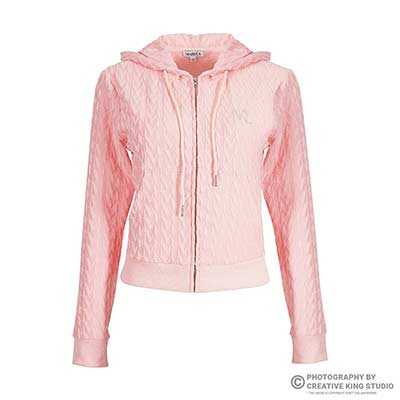
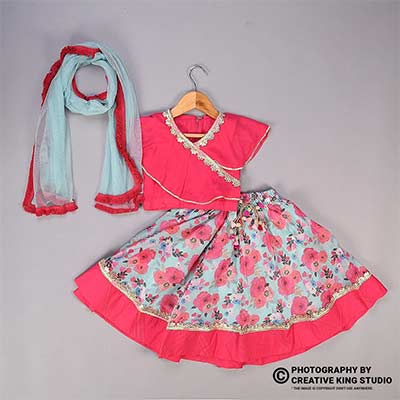
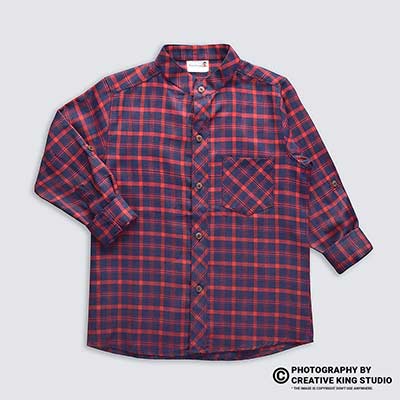
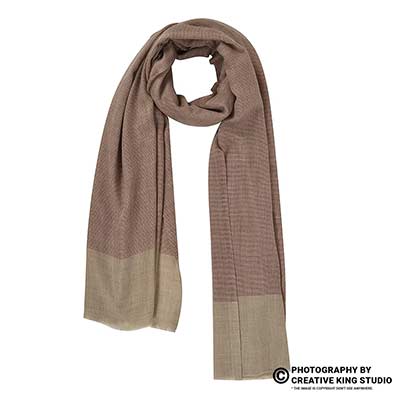
A category-wise masterclass from Ckstudio — draping, lighting, styling and marketplace-ready workflows tuned for Indian ethnic wear brands selling on Myntra, Amazon India, Nykaa Fashion, Ajio, Flipkart and Meesho.
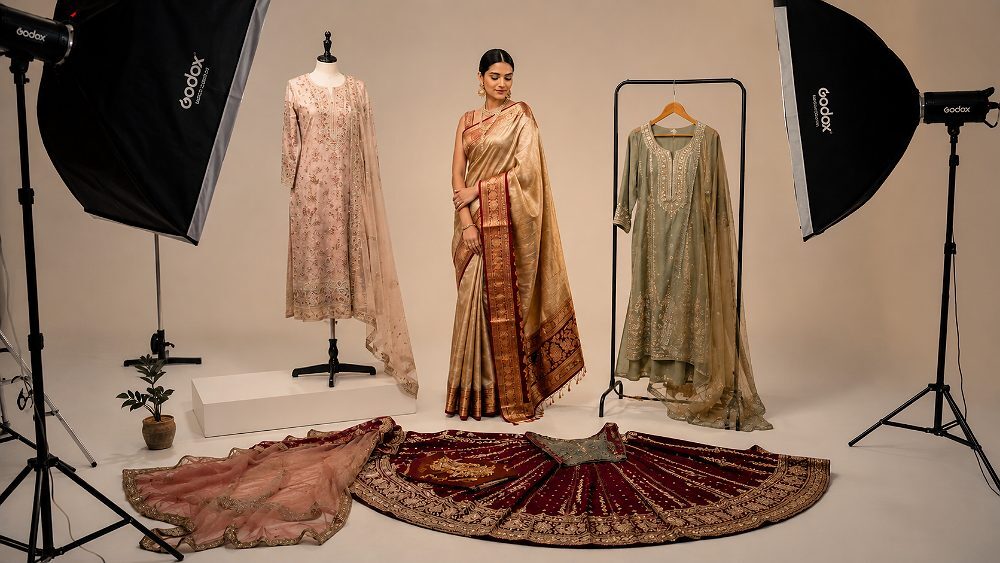
Ethnic wear photography is not one workflow — it’s four. Sarees demand drape and pallu movement, kurtis reward ghost mannequin scale, dresses need silhouette storytelling, and lehengas call for ghera flare and bridal-grade lighting. This guide walks through category-specific techniques, lighting rigs, marketplace specs and pricing benchmarks built on 9+ years of Ckstudio catalogue work.
Ethnic Wear Photography is the single highest-leverage decision an Indian fashion brand makes before its first sale goes live. A ₹4,999 kurti and a ₹49,999 lehenga are both bought on trust — and that trust is built almost entirely by images. At Ckstudio, our team has processed more than 50,000 ethnic SKUs across sarees, kurtis, dresses and bridal wear, and one pattern is clear: brands that treat photography as a category-specific craft convert 2× to 3× better than those running a generic “put it on a mannequin” workflow.
This guide is the resource we wish existed when we started. It combines Indian marketplace requirements, fabric-specific lighting maths and shot-list frameworks for each ethnic category. Whether you sell on Myntra and Nykaa Fashion, run a Shopify D2C store, or scale a wholesale ethnic label from Chandni Chowk, the pages below are designed to make your e-commerce catalogue calmer, faster and more profitable. When you want a partner instead of a playbook, Prince and the Ckstudio team are one call away at +91-8700258773.
Ethnic wear photography is the discipline of translating three-dimensional, texture-heavy Indian garments — sarees, kurtis, lehengas, salwar suits, dresses and dupattas — into flat, marketplace-ready images that preserve fabric truth. Unlike Western fashion where silhouettes are geometric and colour palettes narrow, Indian ethnic wear lives in zari, gota patti, mirror work, chikan embroidery, block prints and hand-woven weaves that behave differently under every light source. A generic apparel workflow flattens all of that. A category-specific workflow protects it.
Most brands underestimate how much category the fabric dictates. A Banarasi silk saree with real zari needs a completely different lighting rig from a printed cotton kurti, which in turn needs a different setup from a sheer chiffon Anarkali. Getting this right is the difference between a shopper zooming in and adding to cart, or bouncing to the next listing. It’s also why our ecommerce photography services team keeps category-specific rigs pre-built in the studio rather than resetting for every shoot.
Return rates on ethnic wear are among the highest in Indian ecommerce — often 25% to 35% for saree and lehenga categories, driven almost entirely by “product looked different.” Professional photography attacks the root cause: colour fidelity, fabric texture, drape realism. Our internal benchmarks across ethnic clients show that switching from smartphone or DIY images to studio-grade catalogues typically lifts add-to-cart rates by 40% to 90% and cuts SKU-level returns by 12% to 20%. If you are planning your investment, our breakdown of product photography cost in Delhi pairs well with our category-wise guide on how to reduce Flipkart and Amazon returns with better images.
There is also a compounding effect. Once you have a consistent visual grammar across your entire ethnic catalogue, listing quality scores on Myntra and Amazon India start rewarding you with better placement, sponsored ad economics improve because CTR climbs, and repeat customers begin recognising your listings from the thumbnail alone. Ecommerce photography is not a cost line — it is the foundational asset that every other marketing investment leans on. Read our companion piece on how professional ecommerce photography lifts conversion rates for the numbers behind this claim.
When brands ask us for an ethnic wear photography quote, we always start by segmenting the catalogue. Each category below carries its own drape logic, prop language, model brief and post-production ladder. Bundling them into one flat rate is how studios go over budget and clients get inconsistent output.
Great ethnic wear photography is 60% preparation and 40% shooting. The single biggest reason shoots overrun is skipped pre-production — arriving with unsteamed garments, unstyled dupattas, no shot list and a model who hasn’t seen the collection. Our studio operates on a strict pre-production checklist that we hand every client 48 hours before the shoot day, and the same discipline is what any brand doing serious ecommerce work should adopt. If you’re new to the process, our garment preparation guide walks through the exact checklist.
Every ethnic garment must arrive at the studio steamed, tagged and hung on padded hangers. Silk sarees crease brutally — a stray fold across the pallu will show up as a shadow line in the final image and no amount of Photoshop will make it look natural. We use industrial-grade vertical steamers for cotton and silk, and handheld travel steamers for delicate zari and sequin work where direct heat contact would damage the embellishment. Chiffon and organza need cool steam from a distance, not touch pressure.
Tag every garment with SKU, size and shot type before it enters the frame. A 40-piece kurti shoot loses 90 minutes if the stylist has to guess which SKU is which halfway through. This is elementary catalogue discipline but it’s where amateur shoots collapse. Our team follows a colour-coded hanger system so the on-set stylist, photographer and post-production lead all reference the same identifier.
The single most consequential pre-production decision is which visual mode fits each garment. Get this right and your catalogue scales beautifully. Get it wrong and you burn budget re-shooting. The right answer changes by category, price point and marketplace — a lehenga on flat lay is a sale killer, but a printed cotton kurti on flat lay may be exactly what a Meesho buyer expects. Our ghost mannequin photography and model photoshoot teams work side-by-side precisely because most ethnic catalogues need both.
Use a live model when drape movement, silhouette or size-scale matters — sarees, lehengas, bridal wear, editorial capsules, festive campaigns and any SKU above ₹3,000 in D2C. A model gives the viewer confidence about fit, fall and how the garment sits on a real body. It’s slower and more expensive but it’s what premium ethnic wear demands.
Use ghost mannequin for high-volume kurtis, kurta sets, straight-cut ethnic tops and any category where you need consistent, scalable, model-free imagery. It shows the garment’s shape without a body and is the workhorse of high-SKU-count ecommerce catalogues. Marketplace buyers on Amazon India and Meesho are comfortable with this format, and it cuts shoot costs by 40–60% compared to model work.
Use flat lay for dupattas, stoles, sarees where the pallu is the hero, printed cottons, festive gift sets, and social-first Instagram catalogues. Flat lay is fast, gorgeous when styled with props, and dominates Nykaa Fashion editorial imagery. It is also where our flat lay photography team layers dupattas, jewellery and vintage brass props to give the frame narrative weight.
The Ckstudio ethnic wear rig is built for consistency across hundreds of SKUs in a single day. We standardise on Sony A7R V and Canon R5 full-frame bodies for the resolution needed to capture zari and thread work, paired with 50mm f/1.4 and 85mm f/1.4 primes for model shoots and 100mm macro for jewellery-adjacent detail shots. Lighting is a mix of four Godox SK 400II strobes and two Elinchrom FRX 400s, all diffused through strip softboxes, octaboxes and one beauty dish for face light on model shoots. Everything shoots tethered to Capture One for real-time colour verification.
Backdrops are the unsung hero. We stock white cyclorama, ivory canvas, warm-neutral hand-painted muslin, textured plaster walls and one deep-maroon velvet for bridal capsules. For anyone building an in-house rig, budget for at least three backdrop options — pure white for marketplace listings, warm neutral for editorial, and one branded colour for social. Our studio selection guide details what to look for if you’re outsourcing instead.
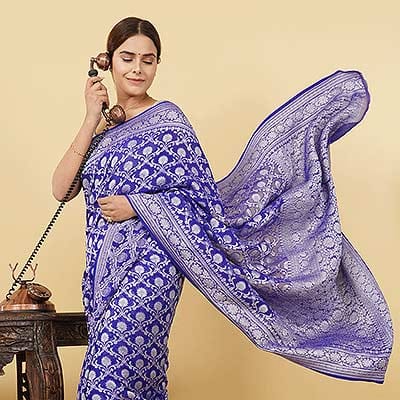
Saree photography is the toughest sub-discipline inside ethnic wear photography — and the most rewarding when you nail it. A saree is 5.5 to 9 metres of unstitched fabric that must be draped, pleated, pinned and lit so that the viewer can see the border, the body, the pallu and the fall in a single frame. Get one of those elements wrong and the entire garment looks unloved. Our Delhi NCR studio shoots roughly 150 sarees a week during peak wedding season, and the workflow below is what actually holds up under that volume.
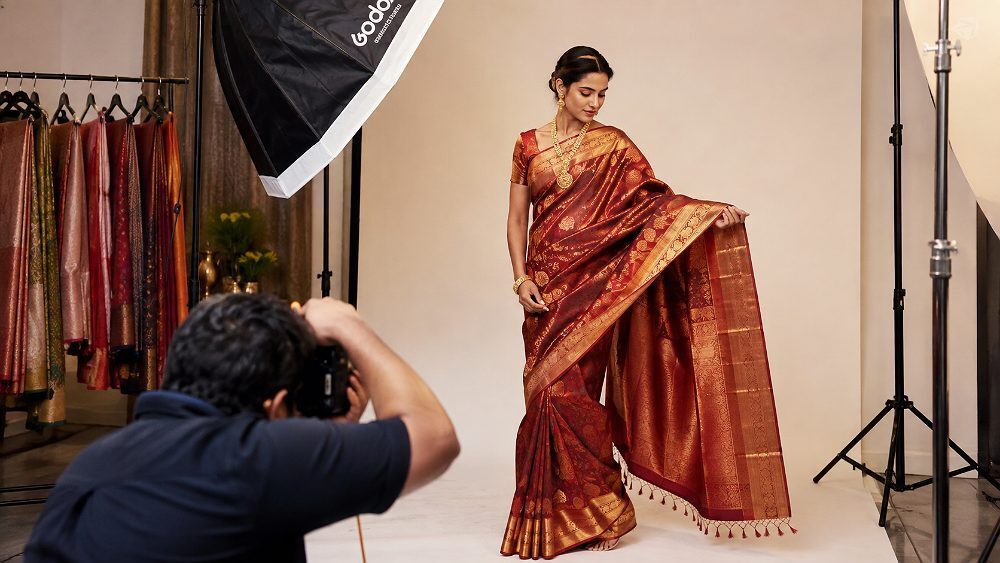
Nivi drape (the Andhra style with pallu over the left shoulder) is the industry default for ecommerce because it reveals the body of the saree while showing the pallu detail cleanly. It is also the most familiar to Indian buyers, which reduces cognitive friction. Bengali drape, Gujarati front-pallu drape and half-saree drapes are worth using only when the collection is regionally specific or the pallu is the primary design element — a heavily embroidered Gujarati bandhani, for example, benefits from front-pallu presentation.
Consistency matters more than perfection. If you’re shooting 50 sarees for a single collection, use the same drape style, same pleat count, same pin placement across every SKU. Buyers scanning your catalogue subconsciously read this consistency as “professional brand” — inconsistency reads as “individual seller.” For high-volume sarees, our team documents the exact drape recipe in a one-page sheet the stylist references between every look. If you want the deeper technical breakdown, our fashion photoshoot preparation guide covers drape rehearsal timings.
The fabric type is the lighting brief. This is where most brands get it wrong — they buy a single lighting rig and use it on everything from raw silk to sheer chiffon. The result is either hot-spot glare on the silk or muddy shadows on the chiffon. Below is how our team modulates lighting for each major fabric family.
Silk is reflective and directional. Use a large diffused key (48-inch octabox at 45°), a soft white fill from the opposite side, and a subtle rim light to define the border. Cross-polarised filters on both the light and lens cut hot spots on zari and metallic thread. Shoot at f/8 to f/11 for sharpness edge-to-edge, ISO 100, and always in RAW. Colour temperature 5500K, locked, not auto.
Sheer fabrics need luminance to reveal their transparency without going grey. Use a large diffused key at 60°, backlight the pallu with a low-power strobe through a translucent scrim, and keep the background clean and slightly brighter than the fabric. This creates the “float” effect that makes chiffon look ethereal instead of limp. Watch for moire on very fine weaves — a slight lens shift usually solves it.
Bridal work is about texture reveal. Use a beauty dish as key for controlled directional light that catches embellishment shadows, add a strip softbox as accent to skim across the embroidery, and keep the fill light minimal so the beadwork keeps its dimensionality. Shoot at f/9, tethered, and check on a calibrated monitor between every look. Our team also shoots a dedicated 100mm macro detail sequence of each bridal saree for the listing’s zoom experience — it is what convinces the ₹80,000 buyer to commit.
Kurti photography is the volume workhorse of Indian ecommerce. A serious ethnic label lists hundreds of kurti SKUs a season, and the photography workflow has to be built for repeatable throughput without going ugly. Where saree work rewards artistry, kurti work rewards ruthless consistency — same neckline framing, same sleeve fall, same crop points, SKU after SKU. Sellers on Meesho especially thrive when their kurti catalogue looks like a brand rather than a bazaar. Our Meesho photography guide covers the marketplace specifics.
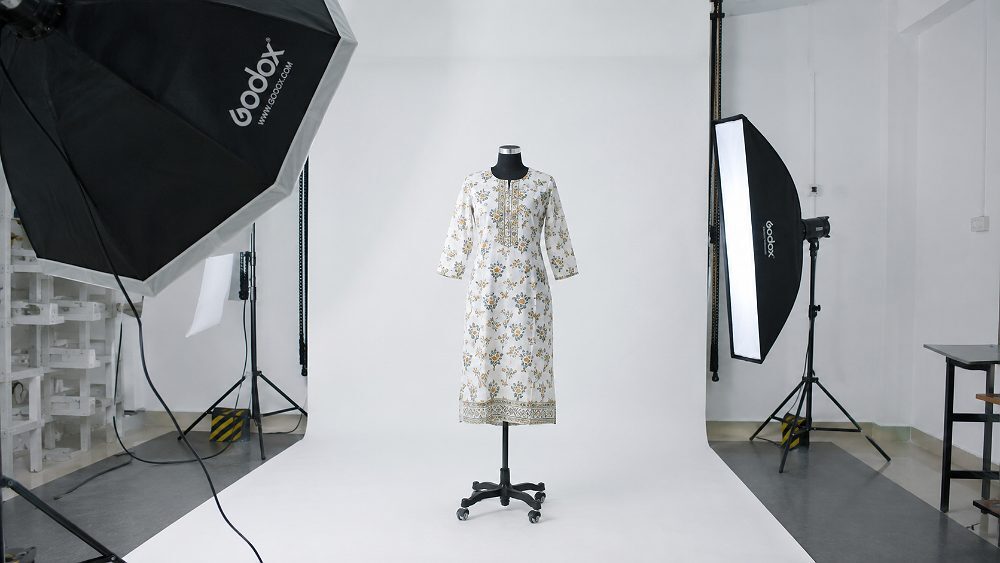
Straight kurtis, A-line kurtis and Anarkalis each need slightly different framing. A straight kurti sits best in a full-length front shot with the model’s hands in a neutral pose — arms slightly away from the body so the side seam and sleeve fall are visible. A-line kurtis need a subtle 15° body angle to reveal the flare without making the model look off-balance. Anarkalis demand a full ghera reveal — either a straight-on symmetric shot or a subtle skirt sway to show volume.
Style with intent, not decoration. A kurti paired with a plain palazzo, minimal earrings and simple footwear will convert better than one styled with heavy jewellery and a competing dupatta — because the buyer’s attention stays on the product. Save the maximalist styling for the lifestyle or ambient shot, not the primary. Our internal rule: primary shot is 100% product, secondary shot is 60% product / 40% context.
The standard Ckstudio kurti rig is a two-light setup: 60-inch octabox key at 45° camera-left, 4×6 softbox fill at 90° camera-right, both at 5500K. This gives soft, even, colour-accurate light that reveals fabric texture without harsh shadows. For printed kurtis with fine detail, add a hair light from behind to separate the model from the background. For ghost mannequin work, we tighten the fill to reduce shadow depth so the compositing stage in post is faster.
Colour accuracy is the make-or-break element. Every kurti shoot at our studio starts with an X-Rite ColorChecker card as the first frame, and the entire session is white-balanced to that. Skipping this step is why so many DIY kurti catalogues have that faint yellow or green cast that makes real fabric colours look off. If you’re managing colour at scale, our note on catalog photography consistency at scale is worth a read.
For a standard kurti SKU targeting Amazon India, Myntra or Flipkart, plan six shots. Ghost mannequin front, ghost mannequin back, neckline close-up, sleeve or hem detail, fabric texture macro and one lifestyle shot. For premium D2C or Nykaa Fashion listings, add a live-model front and back plus a styled dupatta pairing shot — nine to eleven images per SKU. For Meesho and volume marketplaces, four ghost mannequin shots plus one detail is often sufficient.
Indo-western dress photography sits at the crossroads of ethnic and Western fashion codes, and that hybrid is exactly where most brands go wrong. Shoot a dhoti dress like a saree and it looks under-styled. Shoot it like a Western dress and the ethnic details vanish. The right approach is to lead with silhouette (Western instinct) but preserve texture and drape (ethnic instinct). This is where our fashion photography and ethnic teams collaborate most closely.
Keep the styling minimal and modern. Indo-western buyers on Ajio and Nykaa Fashion respond to clean editorial styling rather than heavy ethnic prop layering. Contemporary hair, subtle statement earrings, block-heel or minimalist footwear, and neutral backdrops. The dress does the talking. For festive fusion capsules, one styled hero shot with prop layering can anchor the campaign, but the marketplace listing sequence should stay clean. If you’re building the styling brief in-house, our background selection guide is a useful starting point.
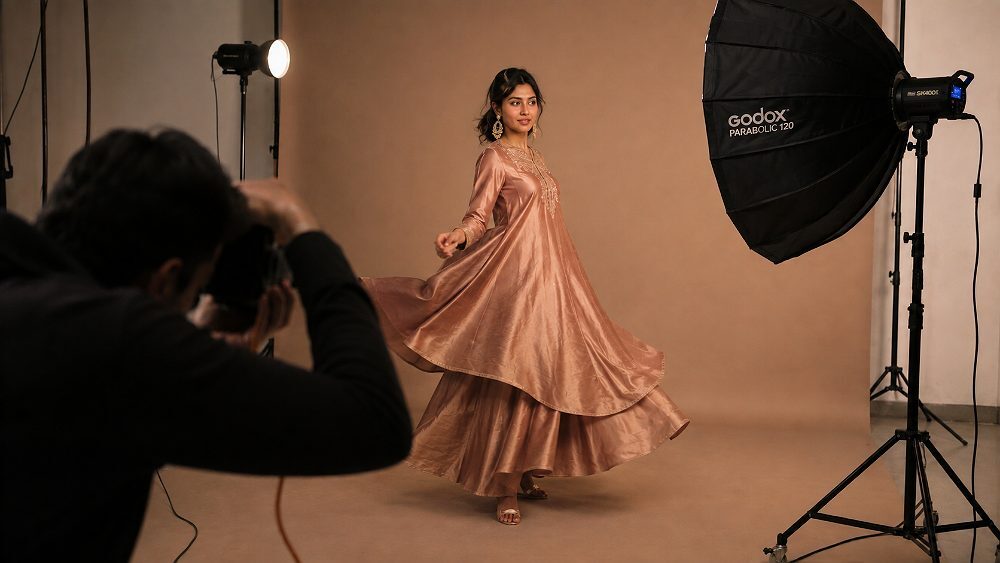
Silhouette is the primary selling attribute of a fusion dress. Shoot the front full at 35mm equivalent to preserve body proportion, avoid wide-angle distortion, and include at least one movement shot where the model steps forward and the hem swings — this is the frame that sells the drape. For heavier fabric dresses like silk fusion gowns, a slow-shutter motion capture (1/60s with strobe) creates the fluid drape that flat static shots can’t. This kind of specific movement work is why we recommend model shoots over ghost mannequin for dress categories above ₹3,500.
Bridal and heavy ethnic wear is where the studio investment pays for itself. A single well-shot bridal lehenga can generate ₹15 lakh to ₹40 lakh in bookings for a designer label, and the photography has to match that gravity. This category rewards patience, premium lighting, hair and makeup investment, and often videography as an accompaniment. Our team treats every bridal shoot as a mini editorial production, not a catalogue session.
The ghera (skirt volume) is the hero. Every lehenga listing must have at least one shot where the ghera is fully spread — either a top-down symmetric flat lay showing the full flare, or a low-angle model shot with the skirt held wide. This is the frame that shopping algorithms and human buyers both anchor on. Follow it with a straight-on model shot showing the dupatta drape (front or two-shoulder), a back shot showing blouse cut and dupatta fall, and dedicated detail sequences for zari, dabka, sequins, mirror work and any hand embroidery.
Lighting for lehengas favours contrast and dimension over flat evenness. A beauty dish key, one narrow-strip fill on the dupatta side, and a rim light behind the model to separate her from the backdrop. Colour temperature stays at 5500K but exposure runs 1/3 stop under so the deep maroons, emeralds and royal blues retain their saturation. Overexposure on jewel tones is the fastest way to make a ₹1.5 lakh lehenga look ₹15,000. Read more on our dedicated garment photoshoot approach.
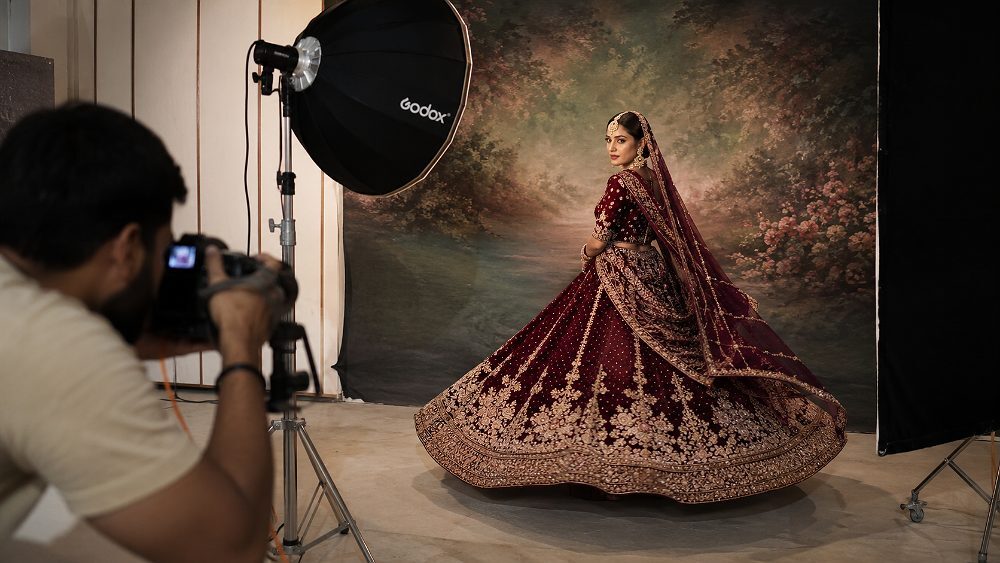
Salwar and Anarkali suits sit between kurtis and lehengas in complexity. The stitched suit body works like a kurti shoot, but the dupatta needs its own attention. Style the dupatta three ways across the sequence — over one shoulder for a formal look, both shoulders draped for a bridal-adjacent look, and held up in a movement shot showing the print or embroidery. Shararas need floor-to-ceiling framing so the flare and hem work show fully — never crop above the ankle on a sharara listing.
Bridal work is where our team collaborates with dedicated bridal makeup artists, jewellery stylists and set designers. The shoot day runs slower — 4 to 6 hours for a single bridal look versus 20 minutes per kurti — because every drape, every jewellery placement and every backdrop has to be considered. We often shoot bridal on warm cyclorama or hand-painted textured backdrops rather than pure white, because the extra warmth flatters gold work and skin tone together. This category should also always include a videography add-on — a 15-second cinematic clip is what converts on Instagram Reels and Nykaa Fashion mobile.
Lighting is where amateur ethnic wear photography reveals itself. Even a perfectly draped saree on a perfect model shot with the wrong lighting will look flat, dull or over-exposed. The three fabric behaviours you must plan for are reflectivity (zari, sequins, metallic threads), translucency (chiffon, organza, sheer nets) and embellishment relief (dabka, stone work, hand embroidery, mirror work). Each demands a different lighting philosophy.
Reflective surfaces mirror your light back at the lens as hot spots. The fix is diffusion and angle. Use the largest softbox you can — 60-inch or bigger — placed at least 4 feet from the garment and angled at 45 degrees rather than direct-on. Cross-polarised filters (a polarising film on the strobe plus a circular polariser on the lens, rotated to cancel) eliminate metallic glare almost entirely. This is standard practice on premium bridal work at our jewellery photography desk and it translates directly to zari-heavy sarees.
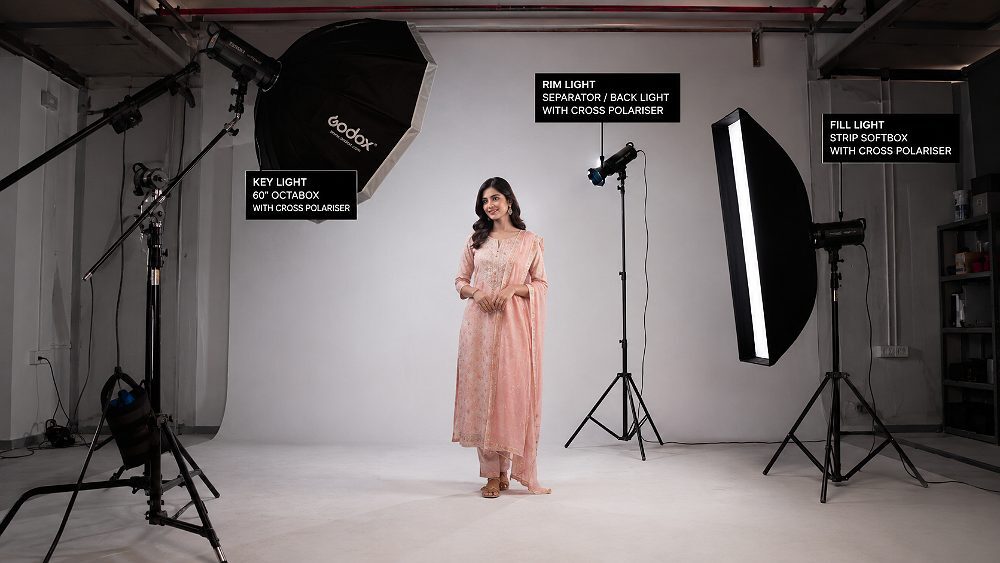
Sheer fabrics need backlight to breathe. A low-power strobe fired through a translucent scrim behind the garment separates the fabric from the backdrop and reveals the weave. Without it, chiffon and organza go grey and lifeless. Keep the backlight one stop below the key so it doesn’t overpower the front-lit detail. This is also the setup that makes chiffon sarees, organza dupattas and net Anarkalis look premium instead of cheap.
Embellished fabrics need directional light to cast micro-shadows that reveal three-dimensional detail. Flat, even lighting kills embellishment — it looks painted-on instead of raised. Use a beauty dish at a steeper 30° angle for key light, a small strip light as accent skimming across the embroidery, and minimal fill so the shadows keep depth. For truly heavy bridal work, we often add a hand-held reflector to bounce accent light exactly where the embroidery detail lives — the extra 90 seconds per shot is worth it.
Retouching ethnic wear is a discipline unto itself. Over-retouch and you kill fabric authenticity — buyers receive the garment and feel cheated. Under-retouch and the catalogue looks amateurish. The Ckstudio post-production ladder has three tiers depending on marketplace and price point, and every ethnic wear brand should think in those tiers rather than a single “retouched” bucket. Our image editing services desk handles about 800 ethnic images a week.
Colour correction starts with the ColorChecker frame captured at the start of the shoot. Every image in the sequence is white-balanced to that reference, then fine-tuned on a hardware-calibrated monitor (we use BenQ SW271C’s calibrated monthly). The rule: if the physical garment doesn’t match the on-screen image, the retouching is wrong regardless of how “pretty” it looks. This is especially true for reds, maroons and jewel tones which shift dramatically between camera sensor colour science and sRGB display.
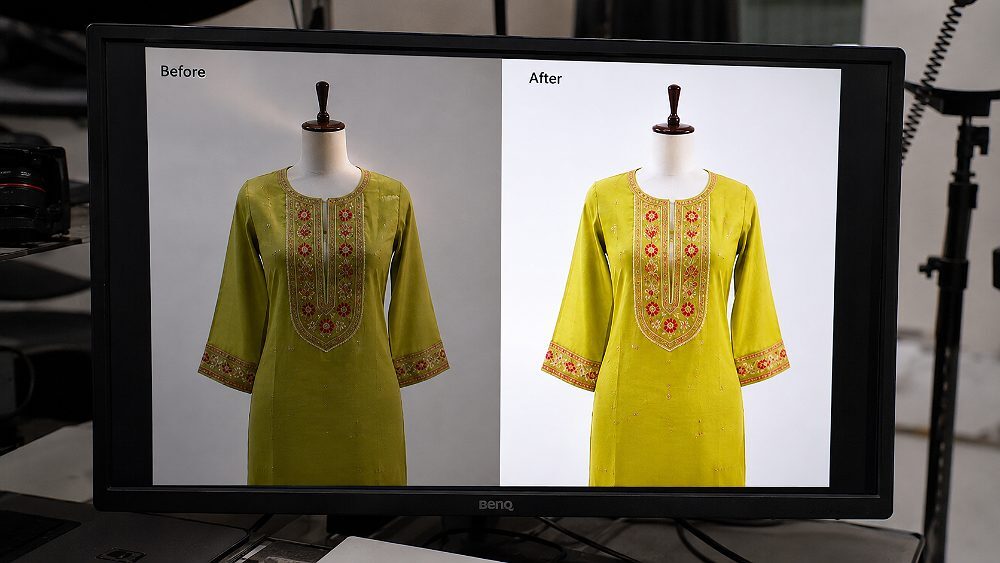
For marketplace listings requiring pure white backgrounds, hand-clipped paths beat AI cutouts every time on ethnic wear. Fabric edges — especially chiffon, net and fringed sarees — need pen-tool precision that automated masking still fumbles. Ghost mannequin compositing requires two shots per SKU (front garment on mannequin, then the inside neckline shot with the mannequin removed) merged in Photoshop. Our full workflow is documented in the ghost mannequin editing guide.
Export in sRGB colour space, JPEG quality 10-12 (or WebP for D2C sites), long-edge 2500px for Myntra and premium D2C, 2000px for Amazon India and Flipkart, and 1080px for Meesho. File size ceiling of 1MB for Amazon India, 3MB for Myntra. Always run a batch resize action in Photoshop or Capture One rather than manually per file — human hands are where naming and sizing errors sneak in.
Every Indian marketplace has its own image compliance rules, and they change often. What’s technically accepted and what actually performs are also two different things. Below is a distilled reference table for the current 2026 standards across the six major platforms Indian ethnic wear brands sell on. For deeper platform-specific playbooks, our guides on Amazon photography, Myntra photography and Flipkart photography go deeper.
| Marketplace | Min Image Size | Background | Model Rule | File Format |
|---|---|---|---|---|
| Amazon India | 1600 px longest edge | Pure white #FFFFFF | Ghost mannequin preferred; model allowed on non-primary | JPEG, <10 MB |
| Myntra | 2000 × 2400 px | Pure white #FFFFFF | Live model required on primary | JPEG, <10 MB |
| Flipkart | 1500 × 1500 px | White (#FFFFFF) or light neutral | Ghost mannequin or model | JPEG, <150 KB thumbnail / <3 MB main |
| Nykaa Fashion | 1080 × 1440 px | White or brand-neutral | Live model strongly preferred | JPEG/WebP, <5 MB |
| Ajio | 1080 × 1440 px | Pure white or brand-approved | Live model on primary | JPEG, <5 MB |
| Meesho | 1080 × 1080 px | White or clean background | Ghost mannequin or flat lay accepted | JPEG, <2 MB |
For the up-to-date official standards, always cross-check with Amazon Seller Central India and Flipkart Seller Hub, since marketplace requirements refresh quarterly. Our team also maintains internal compliance checklists that we update monthly. If you’re just starting on Meesho or scaling to Ajio, our Ajio image guide and Flipkart beginner’s guide break down the platform quirks in detail.
Ethnic wear photography pricing in Delhi NCR varies from ₹399 per image on high-volume flat lay work to ₹65,000+ per day for full bridal editorial productions. The right price point is a function of category, marketplace, model requirement and post-production tier — not a single number. Below is the transparent 2026 pricing structure we use at Ckstudio, benchmarked against Delhi NCR market rates. For a wider view, our 2026 ecommerce photography pricing guide covers broader category pricing.
Pricing beyond these tiers — for example, jewellery-heavy bridal accessories or industrial-scale 500+ SKU catalogues — is quoted per project. Ckstudio’s Delhi NCR studio also offers volume-tier discounts starting at 100+ images per booking. Prince personally reviews every enterprise brief, so a call to +91-8700258773 or an email to [email protected] is the fastest path to a firm quote.
Ckstudio is a Delhi NCR based ecommerce and product photography studio with nine years of category-specific work behind it. Prince founded the studio with a simple thesis — Indian ethnic wear brands deserve the same visual craft that global luxury brands enjoy, but at production speeds that let a D2C label actually launch weekly. That thesis is what powered our 50,000+ ethnic SKU count and long-term work with saree houses, kurti labels, bridal designers and marketplace power sellers.
What we bring to the table: a dedicated ethnic wear rig that stays built, drape stylists on staff, an in-house post-production ladder that handles Amazon India, Myntra, Flipkart, Nykaa Fashion, Ajio and Meesho exports from a single master file, and hardware-calibrated colour throughout. Whether it’s a 40-piece saree drop or a 200-SKU kurti season, the Ckstudio workflow scales. Explore our portfolio or read a few client case studies to see recent work.
Beyond ecommerce catalogues, our studio also runs adjacent services that ethnic wear brands often need — lookbook photography for seasonal campaigns, lifestyle photography for social channels, and full video production for reels and marketplace videos. One team, one colour pipeline, one point of accountability.
Ethnic wear photography in Delhi NCR ranges from ₹499 per image for volume flat-lay work to ₹1,499 per image for premium model shoots, with dedicated bridal editorial productions starting at ₹65,000 per day. Ckstudio catalogue packages start at ₹499 per image with volume-tier discounts for bookings above 100 images. Get a firm quote at +91-8700258773.
Kurtis scale best with ghost mannequin for consistency across large catalogues, while sarees benefit from live models to showcase drape and pallu movement. Flat lay is ideal for dupattas, printed cottons and Instagram-first accessory shots. Bridal wear and lehengas above ₹15,000 should always use live model imagery.
Use large diffused softbox lighting (60-inch or bigger) placed at 45°, shoot in RAW at 5500K white balance locked, and apply cross-polarised filters on both light and lens to eliminate metallic hot spots. Post-production colour correction on a hardware-calibrated monitor is essential. Our jewellery lighting guide covers reflective-fabric technique in depth.
Myntra requires 2000×2400 px on pure white (#FFFFFF) with live model on primary; Amazon India needs 1600 px minimum longest edge with ghost mannequin preferred; Nykaa Fashion accepts 1080×1440 px with live model strongly preferred. All three prefer JPEG format under 10 MB. See our marketplace standards reference for the full breakdown.
Plan 6–10 shots per SKU for standard ecommerce — front, back, side, embroidery close-up, fabric texture, styled detail and one lifestyle frame. Bridal and premium ethnic wear benefit from 10–12 shots plus a 360° spin or short video. Meesho and volume marketplaces can work with 4–5 shots per SKU.
Yes. Our Delhi NCR studio runs dedicated volume workflows that process 200-500 SKUs per cycle across kurti, saree and dress categories. Larger jobs are scheduled across multiple shoot days with parallel post-production so delivery timelines stay within 7-10 working days. Call +91-8700258773 to plan a bulk booking.
Not for real product listings. AI images cannot faithfully represent your actual garment’s fabric, colour, drape or embellishment — which leads to buyer disappointment and return rates jumping 30% or more. AI is useful for concept moodboards but never for the primary catalogue image. Our full comparison sits at real photography vs AI-generated images.
Partner with Ckstudio — Delhi NCR’s trusted ecommerce photography studio for sarees, kurtis, dresses, lehengas and bridal wear. Nine years of experience, 50,000+ SKUs delivered, marketplace-ready output.